January 28th…...”WERE YOU EVER PULLED OVER BY POLICE TO RECEIVE A TRAFFIC TICKET FOR SPEEDING IN A CAR?”
Rear-view trouble!!
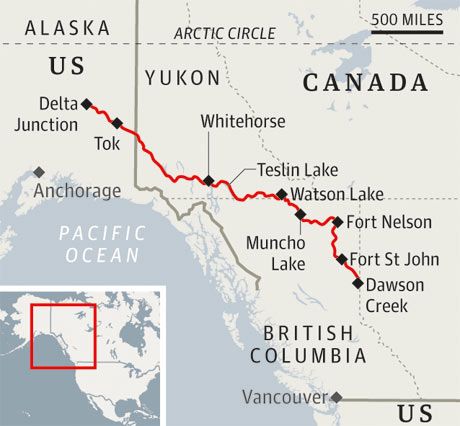
“DON’T MOVE YOUR HEAD!!!”came the terse command from my Uncle Barney Hollembaek as he sat in the passenger seat next to me. As we screamed down that Canadian gravel road, I had twisted my head to the right to inform my uncle that a Royal Canadian Mounted Policeman (with a very fast horse…..said tongue-in-cheek…hehehe) had just come off of a side road as we made our way along the Alaska/Canadian Highway and had flipped on his dashboard lights as he was now in pursuit of us. “If you keep your headstill, maybe he’ll think you didn’t notice him and will just drive by!!” But, alas, that bit of advice didn’t work in my case.
1970 Ford Mustang Boss 302
I’ll leave you in suspense, for a moment, as I backtrack to fill you in on what transpired up to this point. It was March of 1972. I was an 18 year old Senior at Battle Ground High School in Battle Ground, Washington. Our school was about to be let out for the annual Spring Break Vacation. Our fun-loving Uncle Barney was passing through our town and had invited me to keep him company as he drove my Cousin Scott Hollembaek’s handsome 1969 Ford Mustang back up to Alaska. Our mountain man of a cousin had left the ‘Stang’ in our keeping about 6 months earlier when he took a flight out of Portland, Oregon bound for Hawaii and a construction job. Scott had done some amazing tweaking of that 302 power-plant that made this “Grabber Blue” Mustang the hottest set of wheels I had ever ridden in!!! When Scott ‘punched it’, that car literally threw me back into my seat as we’d rocket off down the road. I remember cautioning Scott one afternoon about our local cops pulling him over for a speeding ticket. His response? “Ahhh, theygotta CATCH me first!!!!” 😉
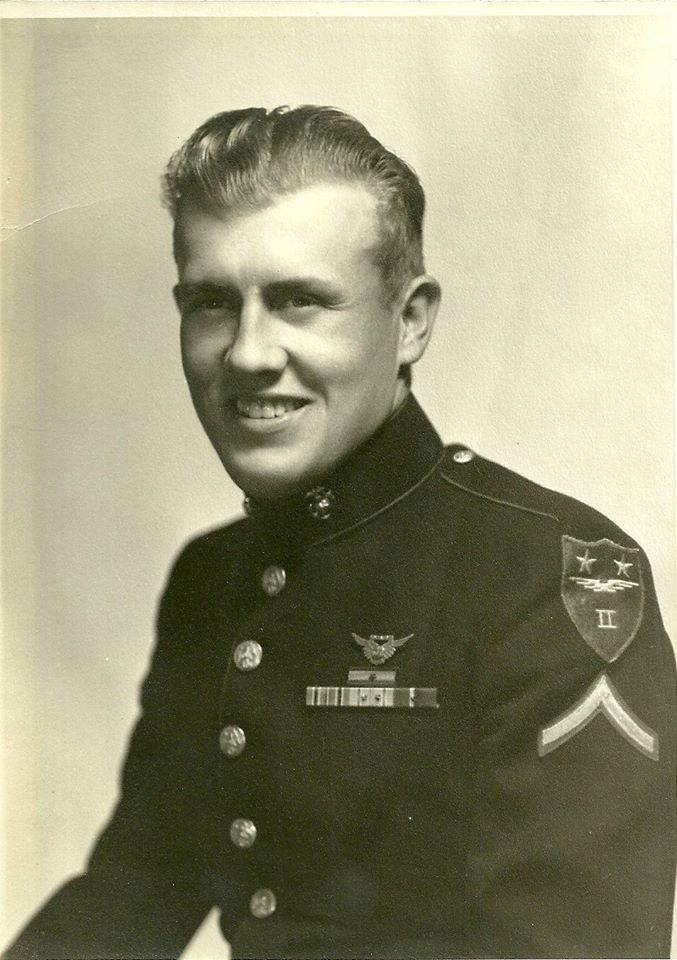
Uncle Barney Hollembaek.
Our bigger than life Uncle Barney was a Leatherneck Marine during World War II and had served in the South Pacific. He was a risk taker, a business man, an innovator and he employed all those qualities that worked towards success for him over his years there in Alaska. Uncle Barney had invited me along on his journey back to Alaska, so, having received permission from my folks, I was more than thrilled to be his driving buddy on the way back up to the wild north country, riding shotgun, so to speak, inside this amazing Ford Mustang. I’m not sure just who (Scott or Barney) or why, but someone had disconnected the odometer on the ‘Stang’ before we pointed the car northwards towards Seattle, then the Canadian border, British Columbia and eventually up the Alaska/Canadian Highway to Palmer, Alaska. Since the speedometer (as well as the odometer) were now dead, the only way to mark our speed, as we rolled along, was to watch the tachometer needle moving through its spectrum and kinda gauge the general flow of traffic around us on the freeway.
Too much fun = TICKET!!
On the second morning, after we cruised across the Canadian border and into British Columbia, Barney was ready to take a breather from driving. The 290 ‘horses’ under that blue hood were now all mine to command and, ohhh, it was a treat!!! With a ‘four on the floor’ transmission and the ‘pedal to the metal’ gas pedal, we saw mile after mile of stunning, rugged scenery pass by us as we talked up a storm and enjoyed each other’s company on this long journey. On our way towards the actual Al/Can Highway at Dawson Creek, the wild country and the road itself, took on a more rugged atmosphere.
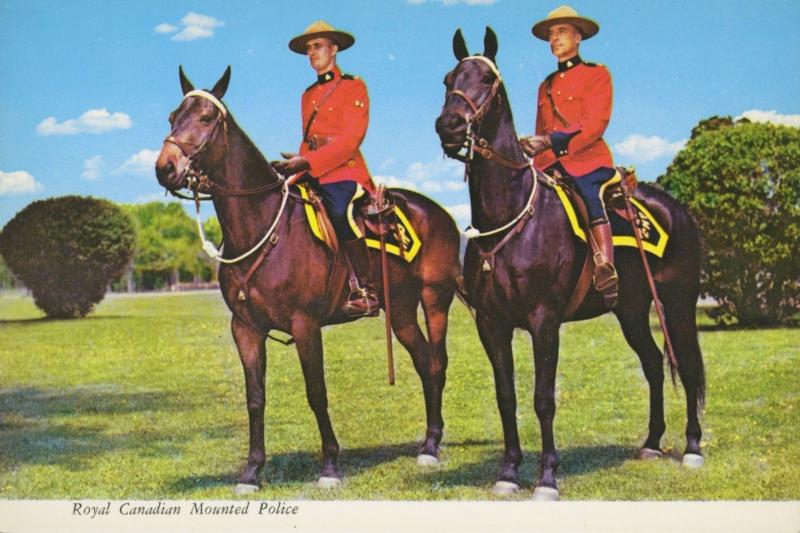
That “Mountie” was one cool and relaxed dude!!
In 1972, the majority of the Al/Can Highway was still graveled. The only paved highway sections were a few miles before and after major cities. It was on one of those stretches of graveled roads, one day, that I met another car in this journey that I considered a ‘challenger’. This car had passed me and I thought to myself, “O.K., no biggie! Hope ya have a great day.” Then, that same car in front of me started slowing down. So, I shifted down and punched that 302 powerhouse and passed the guy. It was quickly becoming a cat n mouse game. He passes me, I pass him; and each time we’re both going faster and faster. Remember, I only have a tachometer to gauge my speed. I’m really starting to cook up some ‘rpms’ to catch this ‘mouse’ again, when, all of a sudden, out from a side road comes an Royal Canadian Mounted Patrol police car and flips his dashboard lights on. As you recall my uncle’s directives earlier, well, my steady head did nothing to cure what happened next. That Canadian ‘copper’ came zooming up alongside us and, in sign language, swung his arm over and over, telling us to pull over. We did. He now ‘punches it’ and literally FLIES up ahead of us and catches my intended ‘mouse’, too.
“That’ll cost you $45, sir!!”
Barney and myself sat in the car, alongside that gravel road, patiently waiting while the trooper wrote a speeding ticket for my ‘mouse’ up ahead and then lets him drive off. With a swing of his authoritative arm, ‘Mr. Mountie’ summons us to drive slowly up to where he stands. That handsome officer was resplendent in his Canadian policeman’s uniform that day which even included his ‘Smokey The Bear’ hat. Our Royal Canadian Mounted Policeman was also in command of a great personality as we chatted while he wrote me a speeding ticket for doing 85 miles per hour in a 60 mph zone. The price of my fine was to be $45.00 and we were to be honest men and stop up ahead in the town of Quesnel, British Columbia and pay my fine at the courthouse there. By today’s standards (as of February of 2024), $45 is a little drop in the bucket, but back in 1972, that comparable amount of money today was a pretty impressive $332.00……Wowsa!!! That chunka change that was gonna be sucked outta my pockets!!!
I could tell that Barney was about to ‘milk the moment’, seeing that our law officer was so laid back and amiable with us. Uncle Barney asked, “Just curious, Constable, what if we bypass Quesnel and just keep on driving?” To which, in a very relaxed tone of voice, our Constable replied, “Oh,no problem, gentlemen, we’ll just radio ahead, if you don’t arrive within the hour, and have you both arrested.” You can bet yer sweet bippy that we DID stop in Quesnel and I DID fork over a precious $45.00 of my vacation spending money that was supposed to buy some fun in Alaska for this Norwegian Farmer’s Son.
Elliott still is impressed with the Royal Canadian Mounted Police….and their fast “four-wheeled horses”!! 😉
January 27th……“WHAT WAS THE MOST UNIQUE EMPLOYMENT YOU HELD DURING YOUR VOCATIONAL CAREER?”
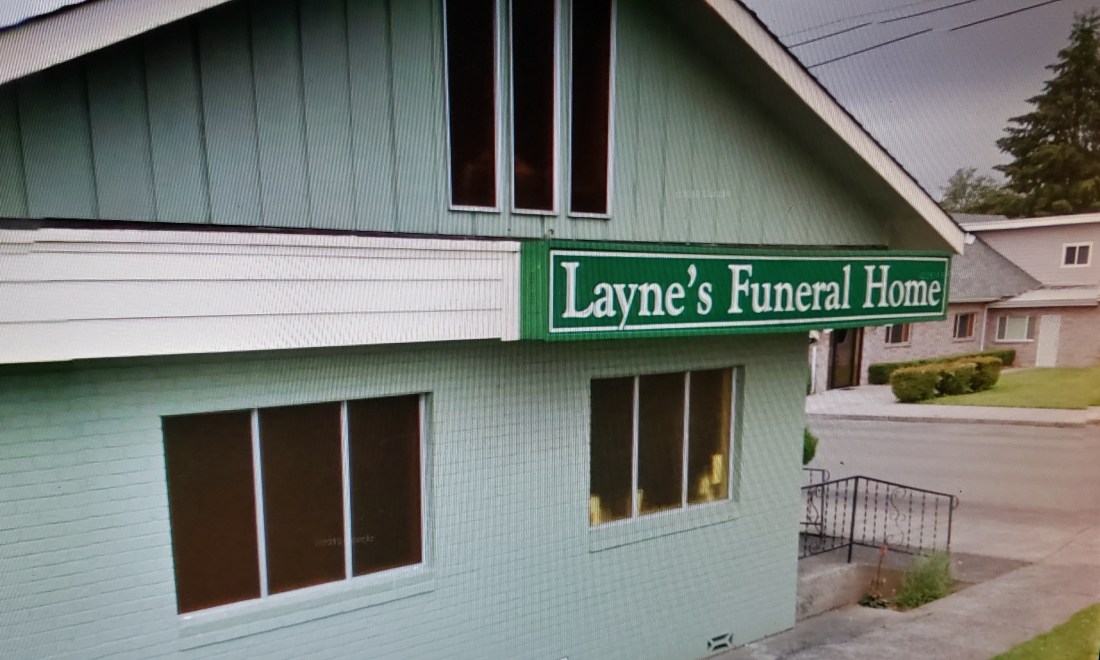
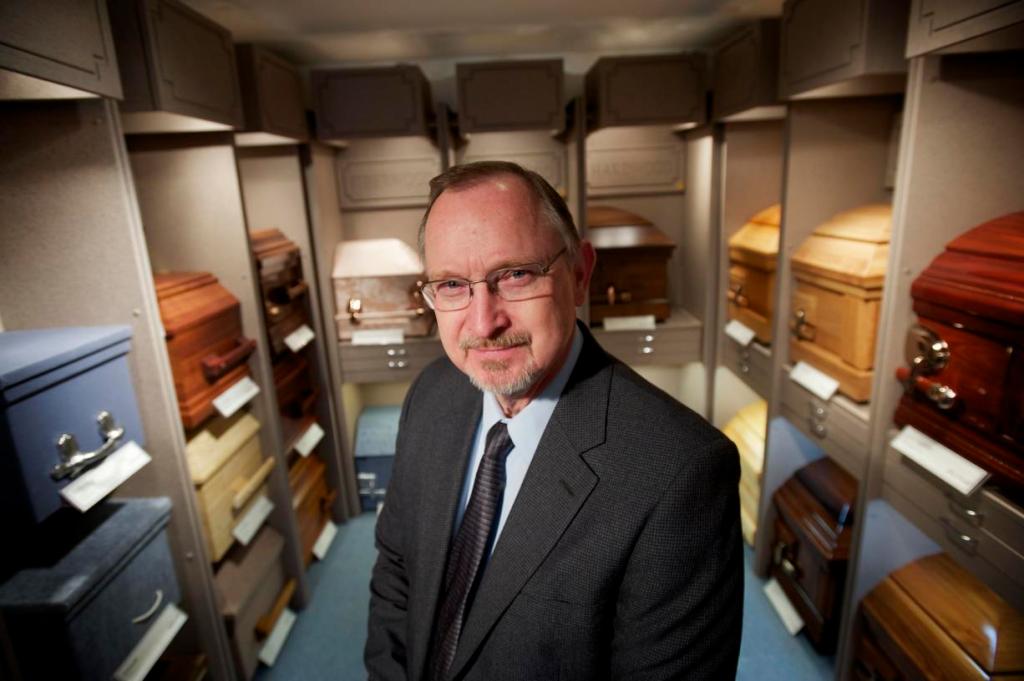
Layne’s Funeral Home director Denton Harlan, shown, Saturday, April 7, 2012, has been in the funeral business for over 40 years. (Steven Lane/The Columbian)
A distant, muted chime could be heard as I entered the front door. My arrival had been automatically announced by a small, swinging trip switch at the top of the door header of Layne’s Funeral Home in Battle Ground, Washington. In the respectful quietness, I walked to the back pews of the chapel. My kind friend, Denton Harlan, who had heard that chime in what was known as the Prep Room, stepped out into the front of the chapel to greet me and welcome me to my new employment. It was the Summer of 1983. A few weeks prior to this, Denton had ‘bumped into’ my wife and I while we were getting Traveler’s Checks for our vacation at the old location of The First Independent Bank in our town of Battle Ground, Washington.
The ‘grapevine’ had informed Mr. Harlan that I was seeking part time employment to help care for our growing family. “When you get back from vacation, come see me over at the funeral home.”, said Dent, “I need someone to help out cleaning the building, washing cars, etc..” As my years with Denton unfolded, I was to find out how many pleasant ways his “etc.” would encompass. I was elated for his kindness to us, as a family, and gladly anticipated beginning my new part time career.
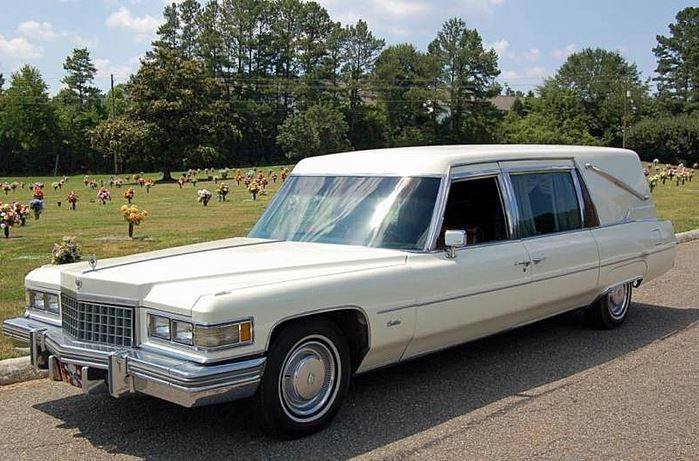
Elliott scrubbed n rubbed all the vehicles.
The funeral business can be paralleled to farming, in a way. For, like a farmer, a funeral director sees to the needs of giving attention, devotion, sacrifice and work to meet the grieving needs of a family at any time around the clock. Seven days a week and any time of the day or night these dear servants of our community were on call to meet a family’s needs whenever they lost a loved one. After discussion with Denton of my duties, it was decided that for me to meet the needs of the building and car cleaning, we would propose a tentative weekly duty time of Saturday afternoons. I was more than happy to be flexible, regarding that schedule, for if a funeral had to be performed during my usual cleaning time. I’d just come into the funeral home on a different day.
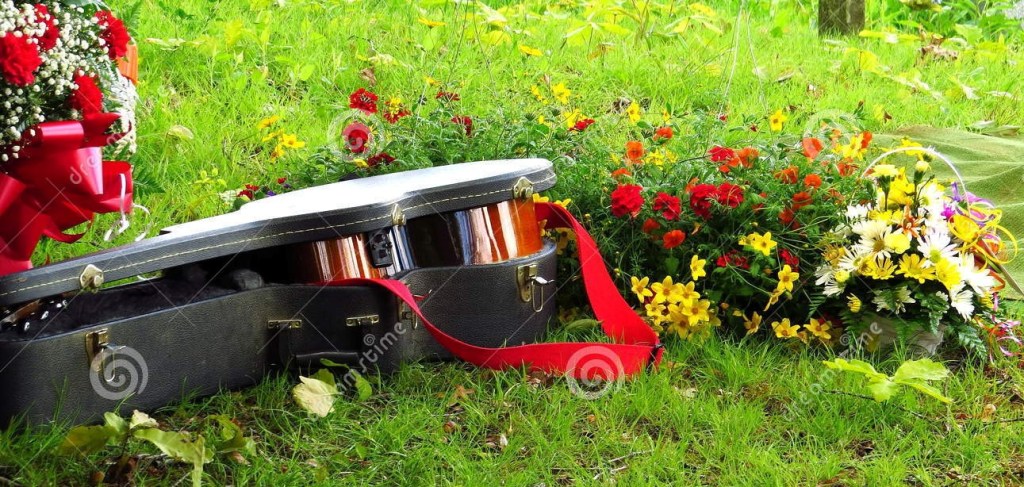
Elliott played guitar and sang if families requested.
Denton and myself both attended the same church, over the years, so he knew that I played guitar and sang. I was honored whenever my custodial position at “Layne’s” took a turn towards being part of something different than just cleaning. I found pleasure in giving families solace by singing a special song, or two, at the “Layne’s Funeral Home” chapel in a tribute for their loved one. On occasion, at graveside services, I found myself singing to the family and mourners as birds sang nearby and gentle breezes floated through the pine trees while I’d play my ‘Black Beauty’ Guild guitar and sing “That Silver-Haired Daddy Of Mine” or some other tune of their choosing.
Elliott’s ‘smile medicine’ each week.
The greatest majority of Saturday afternoons at the funeral home were clear and open for me to do my cleaning and car washing. It was also around my beginning funeral home employment of 1983 that I became aware of, and a giant fan of, a weekly radio show on Minnesota Public Radio called, “A Prairie Home Companion”. Not wanting to miss a broadcast, I’d bring along my little walk-man radio with ear plugs and was tickled when 3pm came around. I called it my weekly ‘smile medicine’ as I’d hear Mr. Garrison Keillor do the opening song of his radio show and I’d be ‘set’ for 2 hours of laughter, great music, skits, phony commercials (like the “Fear Mongers Shop”, etc.) The humdrum of cleaning was always made more palatable with smiles from this grand radio show.
Denton was, and is, a multi-talented gentleman.
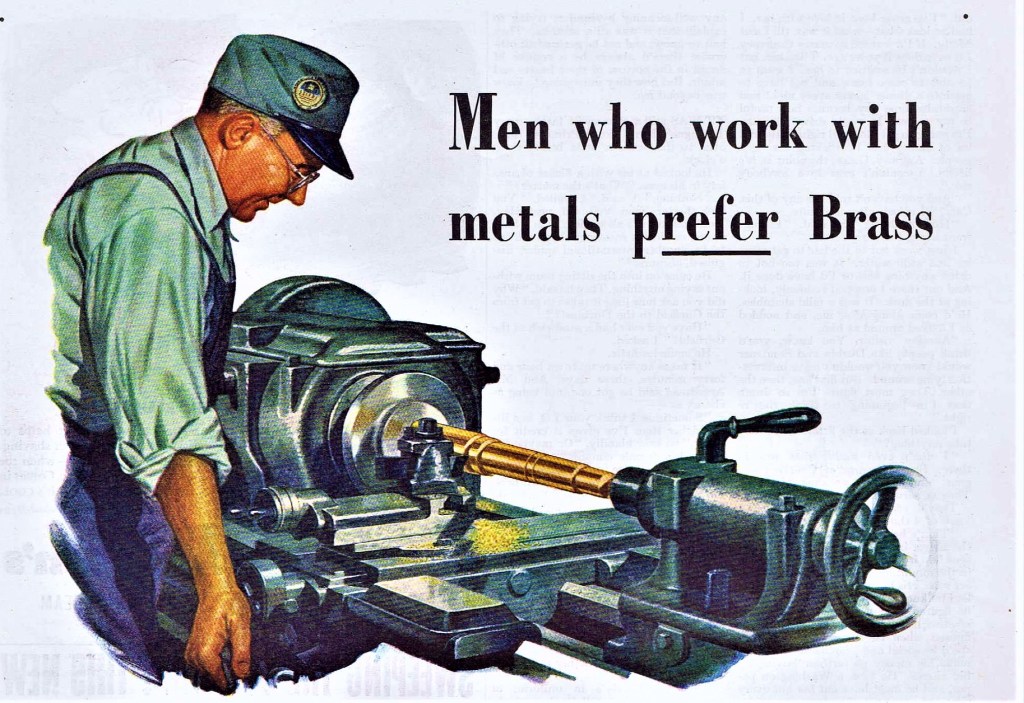
Over my 27 years in service to Denton and his business, I became more deeply impressed with the tender and sincere heart of this dear man. His integrity and open heart had made him a very well-loved community figure. So many families in our Battle Ground, Washington area knew that Denton Harlan always had their best needs at heart. And, on more than one occasion, I saw Denton use his myriad of talents to meet those needs. One instance really stood out to me. A family had lost their dear father who was an avid hunter. They wanted to somehow carry a memento of their dearly departed daddy. Here’s what Denton did for them to meet their need. Denton had purchased a World War II era metal lathe that had originally been used at the Boeing Aircraft Plant in Seattle, Washington. This amazing funeral home director/craftsman took some brass rod stock and ‘turned’ it in his lathe to create these handsome bullet-looking key rings. The center of each ‘bullet’ had been drilled out to make an empty core. A brass, threaded cap was also created for each key ring that even had little rubber ‘O-rings’ to make the ‘bullet’ air tight when the cap was screwed into place. Their father had been cremated, so Denton poured some of the father’s ashes into each key ring and sealed it shut. The family members were just thrilled that Denton had found a way for them to ‘take Daddy with them’ wherever they went as a memento of his love and the life that he had lived.
Whether I cleaned his place of business, washed his many vehicles, sang at funerals, helped usher funerals, or whatever service I could offer……….I was more than happy to be a brother in the Lord, and a friend of Denton Harlan who has always been a blessing to this Norwegian Farmer’s Son.
January 26th…..“AFTER WORLD WAR II, DID YOUR UNCLE ERWIN MARRY AND HAVE A FAMILY? WHAT WERE SOME OF HIS VOCATIONS THROUGH THE YEARS?”
Erwin impressed his new girlfriend in another way. 😉
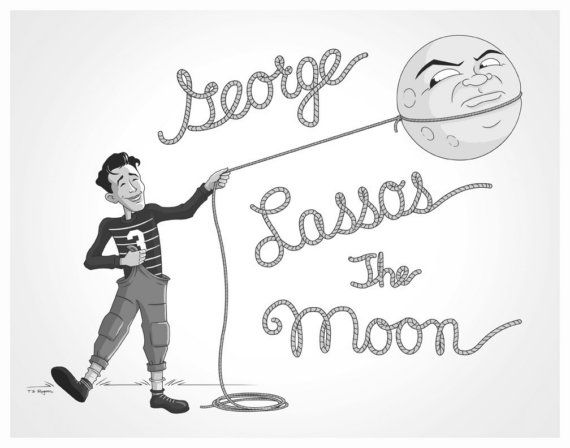
“What is it you want, Mary?” says George Bailey. “What is it you want?” “Youwant the moon?” “Just say the word and I’ll throw a lasso around it and pull it down!” “Hey, that’s a pretty good idea!” “I’ll give you the moon, Mary!!!” Such were the twitterpated wooings of a young man in love who wanted to make an impression on his new lady friend in hopes of winning her for the the rest of his life. You can just hear the idealistic, yet tender, infatuated voice of George Bailey (played by Jimmy Stewart) in the classic 1946 movie, “It’s A Wonderful Life!”.
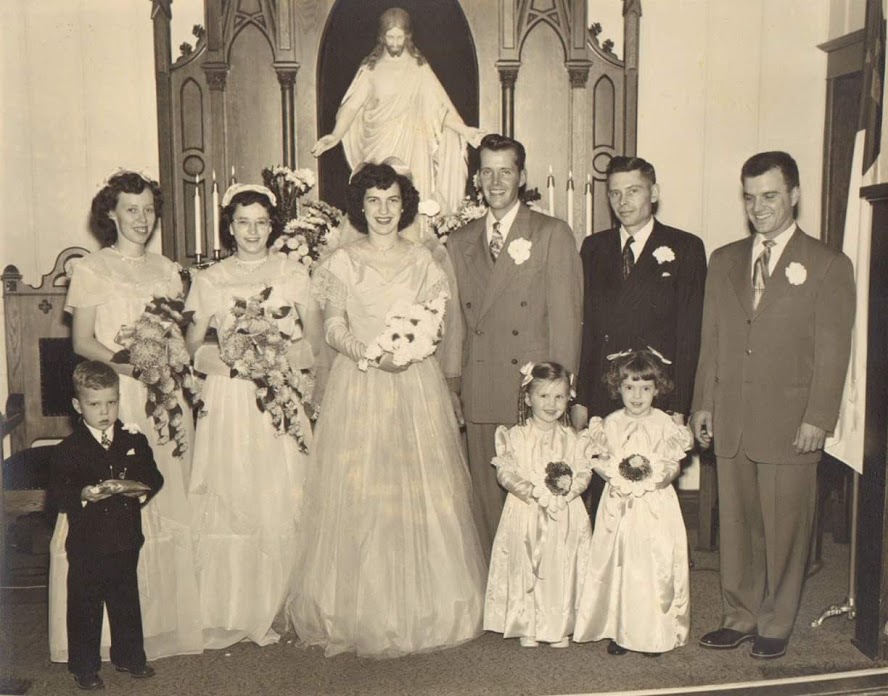
Elliott’s sister, Rosemary, was one of the flower girls at their Uncle Erwin’s wedding to his bride, Audrey, in December of 1950. Rosie is little cutie on the right and was only four years old at the time.
Impressing a lovely young lady would have a different twist for our uncle. Fresh from the Army and full of telephone communications knowledge, our paternal Uncle Erwin Noorlun arrived in Lyle, Minnesota in January of 1949. As he began his new job of updating the telephone systems in that town, he had the pleasure of meeting one of the loveliest switchboard operators he’d ever laid his eyes on. Her name was Audrey Virginia Kulff. Six years his junior and pretty as a picture, they struck up a friendship that culminated in their first date in the frigid January outdoors of that borderline town with the State of Iowa just beyond its southern city boundaries.
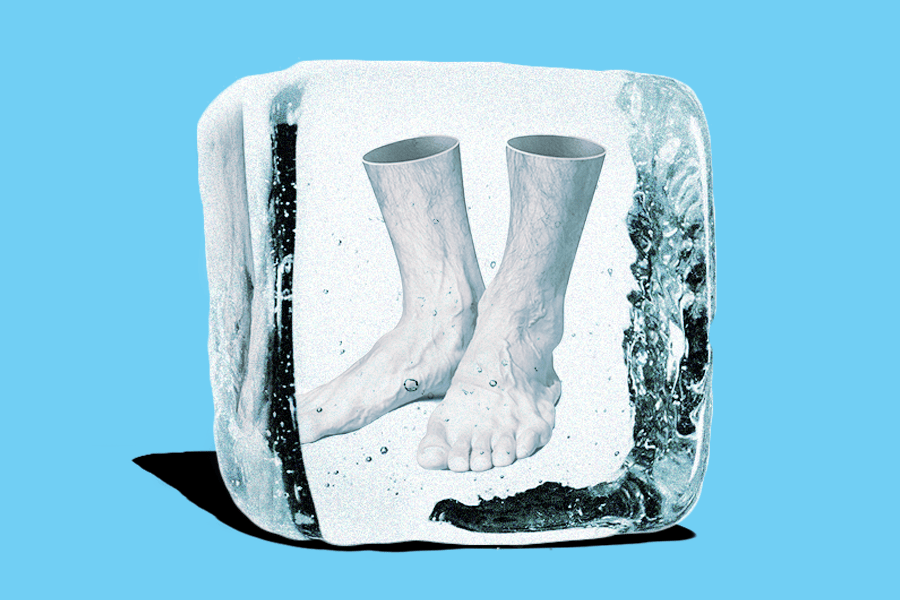
Erwin’s feet.
Now it kinda makes ya scratch yer head to figure that, here’s a young buck who grew up in Minnesota’s frozen north country. He must’ve learned all the proper ways to protect his body from winter’s chilling ways, right? Yet, on this magical first date with Audrey, my Uncle Erwin actually froze his feet!!! My, my!!! Was he overly captivated by her beauty and fell in a trance? Maybe he was guilty of staying out in the grinding cold to try to snatch that first kiss? Whatever the case may have been, that small town of 600 souls found Erwin’s predicament to be hilarious and he was the buzz of the chatter around that town for some time after the incident. Whatever Erwin’s cost, in frozen footsies, he won his maiden and they gathered at the north end of the little town of Lyle, Minnesota at Our Savior’s Lutheran Church to ‘tie the knot’ on December 2nd of 1950.
Edwin and Erwin hold Scott Noorlun, the first of his three sons.
Just like in the 1946 movie, Erwin and Audrey could jointly say, “It’s A Wonderful Life”!!! Not only had “Erv” been spared during World War II, there were the sweet blessings of how he and Audrey had met, married and began a handsome family of three great young sons. Baseball became just one of the numerous bonding times of a young father and his sons. On the special occasions that brought Erv’s family to our farm for a visit, I can still see baseball gloves ‘glued’ to the hands of our cousins Scott, Steve and Joey as they climbed out of their family car.
Elliott on left with cousins Scott and Steve.
Like any youngsters, my uncle’s boys and I had tons of fun climbing in and out of farm equipment and even played some baseball catch. One day, Uncle Erwin showed us all just how much power he still had in those paratrooper arms of his. He asked us to toss him one of the baseballs we had been playing with. With a spring-coiling windup of his body, Erwin let fly some baseballs that flew like bullets and shattered the wooden siding on our granary building. We kids just stood there with our jaws dropped open in amazement.
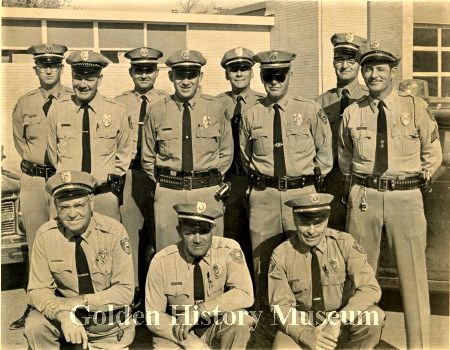
Elliott’s handsome Uncle Erwin Noorlun is the only police officer with sunglasses in this photo. Can you spot him? He’s standing third in from right.
In his early years, after marrying Audrey, “Erv” helped her brother, for a while, hauling new cars. Then, Erwin decided he wanted to move into law enforcement and spent 10 years as a policeman in Detroit, Michigan. The young Noorluns wanted to be closer to family, so, with the rank of Sargent, Erwin picked up and moved his young family to Golden, Colorado in 1963 – 64. He invested 20 more years with the police force there and retired in the early 1980’s as a Lieutenant.
Elliott’s father, Russell (left), with his younger brother, Erwin, at the Noorlun farm near Kiester, Minnesota. Late 1940’s.
Our handsome uncle is gone now. He left us in September of 2019. As I mused upon the overall scope of his life, I asked myself, was our uncle perfect? Not at all. He endured and weathered just as many human failings as any man. Heck, even our First President, George Washington, cut down the cherry tree, right? 😉 Yet, do I believe that Erwin had a ‘wonderful life’? That would come as a resounding YES from this Norwegian Farmer’s Son!!
January 25th….“TELL US MORE ABOUT YOUR PATERNAL UNCLE ERWIN. DID HE SERVE IN WORLD WAR II?”
During World War II, Elliott’s grandmother stands next to their patriotic window banner with two service stars.
Not one lugubrious ligament languished lazily in Uncle Erwin’s lithe young body. That vibrant eighteen year old Norwegian frame, of our very handsome uncle, was resplendent with energy from head to toe and plenty of muscles in-between. Erwin was one of eight beautiful children that were brought to life, in the northern Minnesota farmlands, by our family patriarch and matriarch, namely Edwin A. and Marie L. Noorlun. Uncle Erwin was, like so many of his generation, toughened by growing up and enduring the hardships of country life as well as being partaker of those who survived the Great Depression in America that lasted between 1929 and 1939. Like so many who lived through those lean years, Erwin learned and lived by the sage saying that went……..”Used it up, Wear it out, Make it do, Or do without!”
The surprise Japanese attack at Pearl Harbor, Hawaii, on December 7th, 1941, had thrust America into World War II. Erwin (and his brother, Doren) were among the 16 million young Americans incensed by that aggression, and, when their time came, they responded to Uncle Sam’s call to serve our great land in her time of need.
It was customary, during the War, for our government to honor families who had sons, or daughters, who served in the military. That honor was bestowed by sending each military family a window banner that had a blue star for every loved one who served their country during that tumultuous global conflict. A banner personally honoring the Noorlun boys was proudly hung in the window of the family home for all passersby to see and admire. If a son or daughter gave the ultimate sacrifice of their life in service during the War, then a “Gold Star” banner was sent to the family with condolences for the supreme sacrifice in the death of their son or daughter. We, as a family, would always thank the Lord that both Erwin and Doren came home safely from that fight for freedom.
Fort Benning, Georgia Jump School
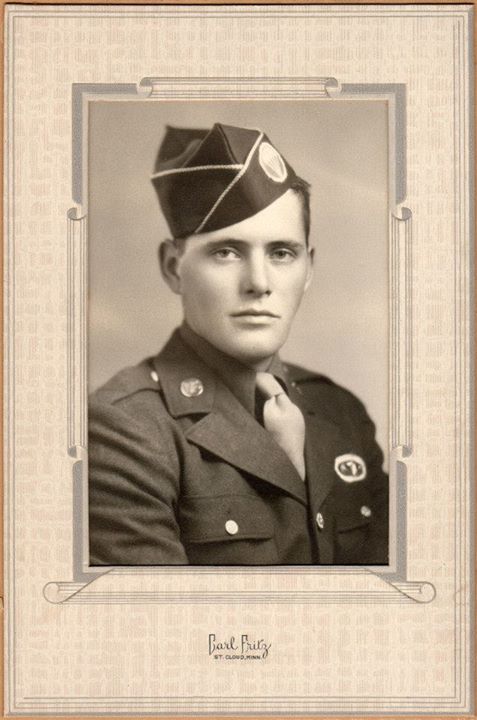
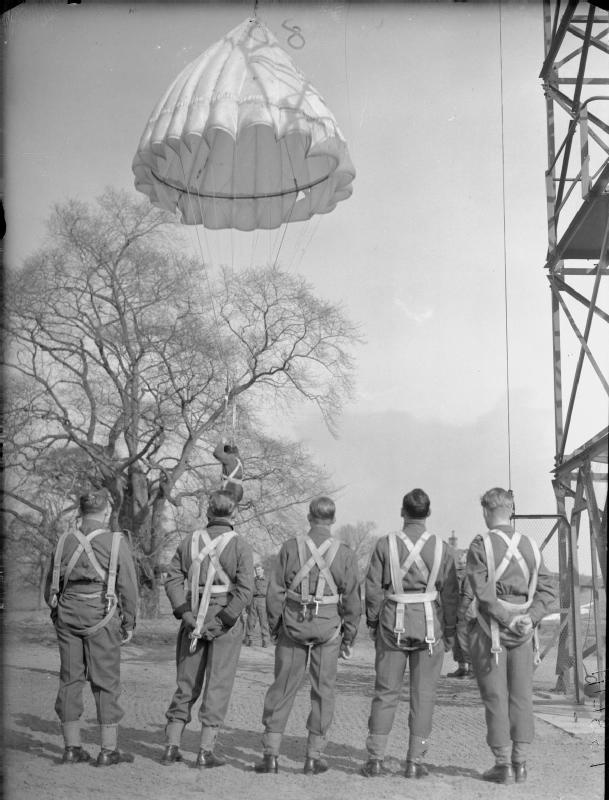
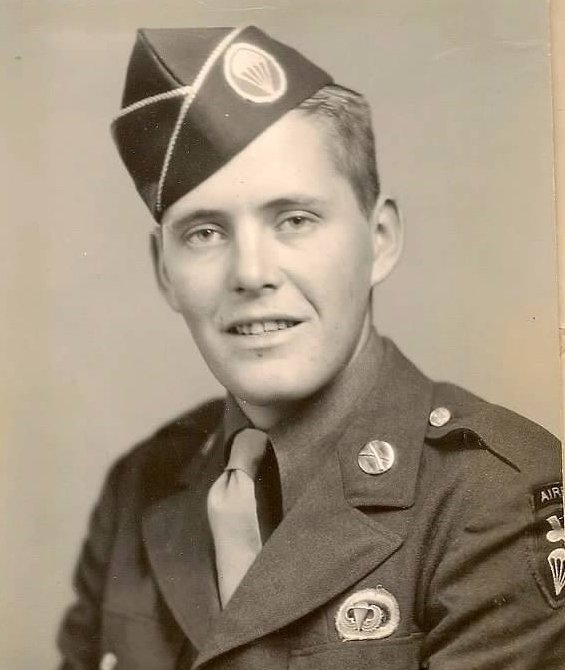
“Meeep Meeep!!!” went the short report of a Jeep’s horn as it kicked up dust while driving past Erwin and his Army buddies during Paratrooper Jump School in Fort Benning, Georgia. It was now 1944 and our uncle had matured to the point of now qualifying to join the ranks of the 16 million warriors that served in the War. It was one thing to join the Army, but it was a noble aspiration to step up the echelons to be the best and serve with the best……..The Paratroopers. Yes, the $50.00 extra a month in bonus pay was a big incentive for many a hopeful paratrooper recruit, but there was also the badge of pride that every man would wear, deep inside his heart, if he could survive and thrive through some of the most grueling training that the Army could throw at you. To become one of the Army’s elite, you ran till your lungs felt like bursting, you climbed up and down every obstacle imaginable (with full pack and rifle), hand to hand combat was taught because you’d be dropping behind enemy lines, and, above all that, you had to be able to learn to jump and parachute out of an airplane (with full gear) five times, in order to get your jump wings. When Erwin accomplished all of those goals, he was then given the honored privilege to spit-shine his jump boots, blouse his trousers over those boots and proudly wear the parachute patch on his garrison cap with accompanying Parachute Jump Wings on his uniform coat. He was now a full-fledged paratrooper and member of the United States Army 17th Airborne Division.
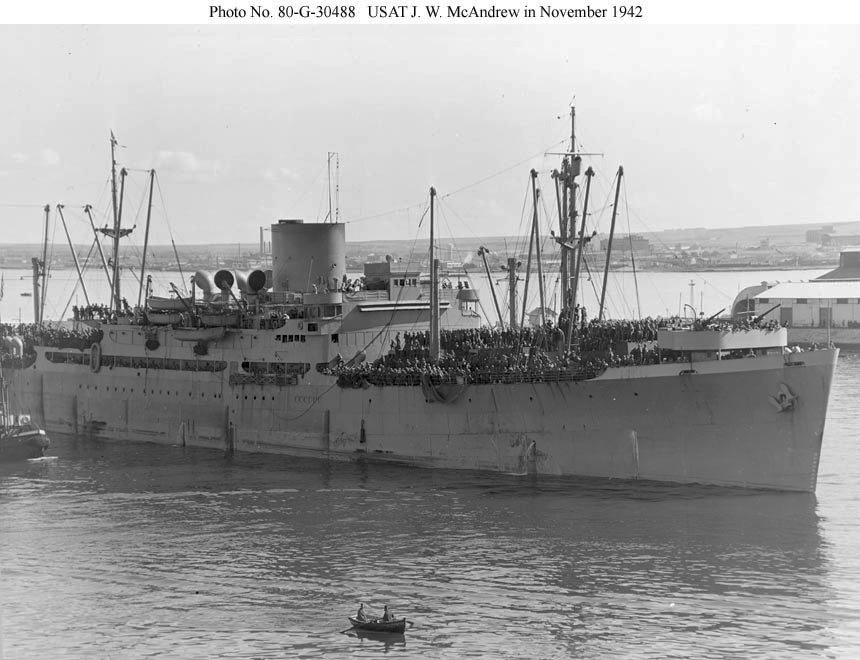
Elliott’s Uncle Erwin Noorlun was aboard the USS J.W. McAndrew when his troop ship was struck by a French aircraft carrier.
In early 1945, the war in Europe was now in the Allies favor and victory seemed imminent, so the Army ‘big brass’ (leadership) began planning for the proposed invasion of the main islands of Japan. In the meantime, on March 13th, 1945, while on the Atlantic Ocean bound for Europe, Erwin was one of hundreds of paratroopers onboard the USS J.W. McAndrew troop ship. That night, under the cloak of darkness, and thrown about by heavy seas, the French aircraft carrier, Bearn, collided with Erwin’s troop transport killing up to 130 men who were sleeping peacefully down inside the McAndrew’s hold. Our uncle’s life was thankfully spared, but he was forever impacted by the tragic loss of so many young men that would never see marriage, family and other enjoyments of life, having died so young.
Elliott’s Uncle Erwin was among these Paratroopers celebrating the end of World War II and going home!! 😉
In early August of 1945, Erwin was again onboard a troopship that had come through the Panama Canal, in Central America, and was on it’s way towards Japan. Operation Downfall was to be the actual invasion of the Japanese home islands and Erwin’s paratroopers were to make air jumps onto military targets. One day, joyous pandemonium broke out among the men onboard ship when the Captain of the troop transport got on the overhead speakers and relayed wonderful news. Due to the two atomic bombs having been dropped, Japan had finally surrendered. The War was over!!! The ship’s new course setting? Home to the good old USA and the port of Newport News, Virginia.
Erwin in post-war service.
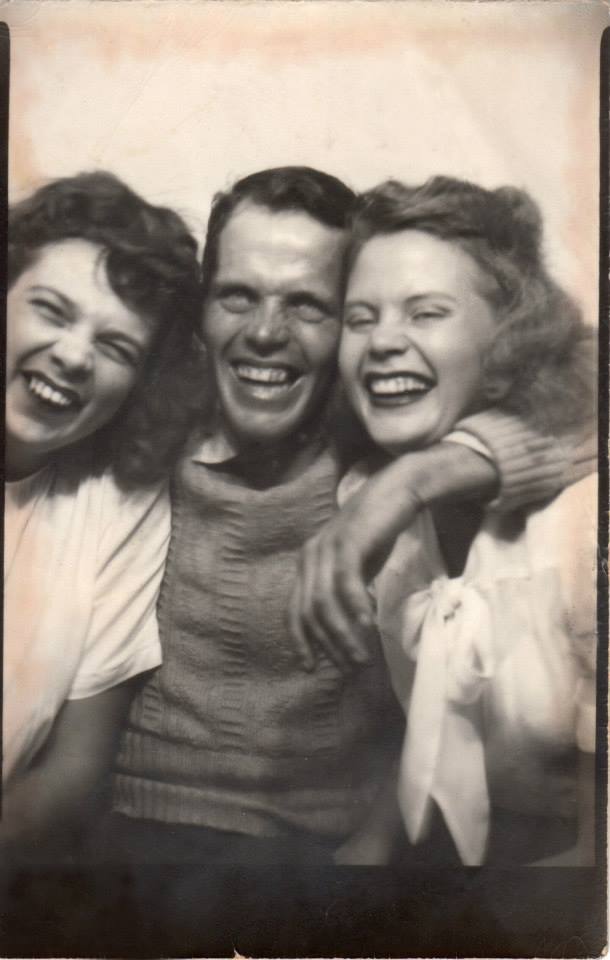
With peace restored to the world, Erwin came home to Minnesota for a well-deserved family celebration and a ninety day leave for rest and recuperation. In welcoming Erwin (and brother Doren) home from the War, there were lots of family hugs n kisses….well, at least from his three sisters ;-). We even have a photo of Erwin’s siblings giggling with laughter. They had indulged in some alcohol-laced libations and were ‘well-lubricated’ in inebriated silliness while they partied with their soldier brother.
The silly celebrations of Russ (center) and Doris (right) when their brothers came home.
Then, on January 1st of 1946, our uncle then decided to re-enlist with the Army, at Minnesota’s Fort Snelling where he received initial training in various forms of telephone communications. The Army then sent Erwin to Salt Lake City, Utah for more communications training. He was finally sent to San Francisco, California to climb aboard a ship heading for the post-war Japanese Prefecture of Okinawa. For the next 30 months, Staff Sargent Erwin Maurice Noorlun faithfully helped to rebuild everything that was needed to repair telephone and telegraph systems that had been destroyed during the World War II battles that consumed that island between the Japanese and Americans. When Erwin successfully completed that tour of duty in Okinawa, he received his honorable discharge from the Army on September 29th, 1948 at the rank of Staff Sargent.
Staff Sargent Erwin Maurice Noorlun. 1945.
We were all so proud of our patriotic and talented Norwegian former farm boy who could “do it all”……..be it jumping from airplanes, to climbing telephone poles for Uncle Sam.
Thank you, Lord, for the uncle of this Norwegian Farmer’s Son.
January 24th….”PLEASE TELL US ABOUT ONE OF YOUR PATERNAL UNCLES. WAS HE HANDSOME? WHAT WAS HIS EARLY LIFE LIKE IN NORTHERN MINNESOTA?”
Uncle Erwin is to the far right and in front of his mother, Marie. Photo is circa early to mid 1930’s. Elliott’s father, Russ, is center in white shirt.
A midwife, bundled against the frigid, northern Minnesota winds rushed into the farm home’s warm kitchen. She arrived that night as an angel of mercy and was there to help in the rural farm home of Edwin A. and Marie Louise Noorlun. That humble farm home lay near the town of Mahnomen, Minnesota which resides within the White Earth Chippewa Indian Reservation. For that time in history, the town sported a healthy population of 989 stalwart souls who clung to the wildness of that wooded land.
The snowy chill and whiteness of that day on December 10th, 1925 was not about to hold back the drama and warmth of a tiny, new life that was about to be brought into the world. That new life, complete with a set of loud lungs, was from the birthing breath of my paternal Uncle Erwin Maurice Noorlun. Being born the sixth, out of eight children, this handsome little boy child was about to begin a very remarkable life. In a smiling, poetical sense……..Erwin was destined to find that he would mimic the definition of his hometown’s name; for you see, Mahnomen, in the Chippewa tongue, means “wild rice”; and Erwin was going to have some fun in life sewing his own……’wild rice’ 😉
Two church services equals too much! Erwin is on the far right with his brothers.
Not only was my Uncle Erwin a very handsome Norwegian boy, but he was as sharp as the proverbial tack, too. School came easy for our uncle who often excelled in his studies to the point of garnering championships in the local school’s Spelling Bee competitions. Erwin was also faithful in lending his youthful, muscular prowess in helping with the family chores there on their farm in the big woods of northern Minnesota.
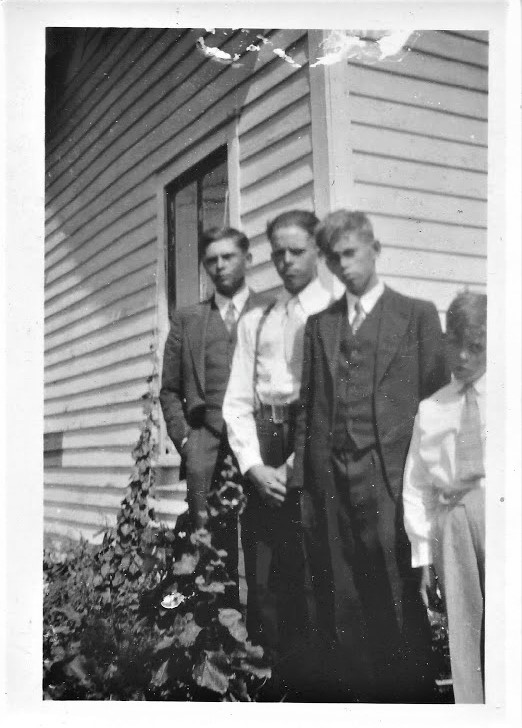
The Noorlun family had been raised in the Norwegian Lutheran Church. It appears to make logical sense (at the time) that the church elders desired to preserve the cultural heritage of Norway. So, to provide for the senior saints in their midst, who still spoke mostly Norwegian, there would be one Sunday morning worship time in English and one in Norwegian. Grandpa Ed and Marie concurred with that edict, so Erwin and his siblings were required to attend not just one, but TWO worship experiences every Sunday. One worship time was in the English language (for the younger crowd, perhaps) but then, Erwin and his antsy siblings had to stay seated in those long, hard pews for a repeat worship, only this second time around, the experience was all in Norwegian. Therefore, when the occasion arose for four of the Noorlun brothers to have their photograph taken one Sunday, before leaving for the double morning worship time, it’s no wonder that they all showed themselves sour-faced about what they were about to endure that morning at church! 😉
Erwin’s father, Edwin (on load of hay in 1948) knew how to drive a team of horses. He soon found, though, that cars were a different beast! Elliott’s Uncle Erwin is shirtless at center and Uncle Doren Noorlun, is to right.
Horses played a prominent role in the farm life of the Noorlun family. All of those good looking Norwegian siblings were adept at riding a horse. My father, Russell, even spoke of being so comfortable with the giant draft horses, that he’d climb aboard their broad backs and fall asleep on lazy summer days while those equine leviathans gently foraged in their pasture land.
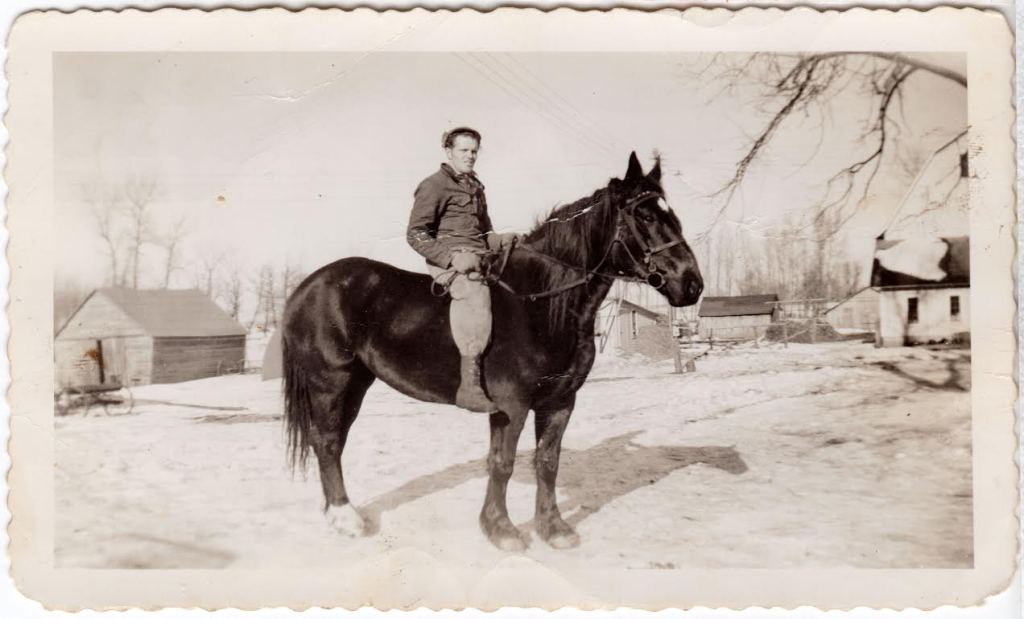
In kin with his brother Russ, one of Uncle Erwin’s early employments was to deliver mail to many Mahnomen area farmers. Like a repeat of the storied “Pony Express” riders of western legend, Erwin carried out this task on horseback in that same proud tradition of faithfully getting the mail delivered.
In 1935, when Erwin was a mere 10 years old, his quiet-mannered father bartered a deal to trade away one of their handsome teams of horses in exchange for procuring the Noorlun family’s very first car. That 1928 Model A Ford sure didn’t whinny like a horse, but there were plenty of ‘horses’ under that hood. Now, true to fact, our Grandfather Edwin had never driven a car before. From his birth in 1888, to that day in 1935, Edwin’s life was spent with horses; either riding on top of them or driving a team from behind them. Was he gonna ‘bronco break’ this metal hombre, or would the metal hombre ‘break’ him? Edwin Noorlun was a horseman through and through, yet here he was, now the master of a metallic, mechanized marvel that happened to be pointing towards their shed that day. Erwin’s dear daddy crawled inside this new-fangled ‘animal’. Edwin managed to bring the beast’s engine to a coughing, sputtering life and somehow even popped it into gear. Only problem was, there were no leather reins to pull to control the ‘horses’ under the hood. The Model A was on a roll, picking up speed and heading right for the shed. Grandpa Edwin started yelling,“WHOA!! WHOA!!!”, as if he was still talking to his team of horses. Thankfully, and in the nick of time, Ed found the brake pedal on the floor and stopped the Ford just before he crashed into that wooden structure. Erwin’s mother, Marie, began a hearty laugh at her horse-farmer husband who kept yelling, “WHOA!!” at the car!!! By this time, the whole family joined in hysterical laughter at the happy ending of what could have been a crashing experience.
The Noorlun’s new barn in process of construction.
As if right out of the pages of “Little House On The Prairie”, a few more years down the road of life passed by when our Uncle Erwin (along with his family) saw a prairie fire erupt and consume their family’s barn in horrific flames. For a farming family that relied on horses to help them till the land of their farm, thirteen-year-old Erwin could only stand by and suffer the trauma of seeing several of their precious horses burned to death in that fire. His father, Edwin, had valiantly tried to coax the animals out of the burning barn, but the confusion of the smoke and mayhem around those fine horses was too much for them to bear and they could not be led to safety. This left Edwin no choice but to save himself and get out of that conflagration before he, too, would be killed. Yet, even in such sadness, every cloud has a silver lining, and thankfully, as was the noble norm for those times, many friends, family and neighbors came together to re-build the Noorlun family a brand new barn to house their remaining livestock.
Elliott’s Uncle Erwin(left), along with a man named John Kinney, hold and comfort some survivors of the disastrous barn fire on their farm.
An old saying goes like this: “The only thing consistent in life is change” Even though the death of those fine horses touched Erwin deeply, it was time to celebrate those that survived and prepare for the inevitable change that comes with a new chapter of life. To capture that thankful moment, Erwin led out one of the survivor horses, while Mr. John Kinney carefully coaxed the mare’s little colt alongside. A photograph was snapped and a new beginning commenced.
Thank you, Lord, for the fine life lived by the uncle of this Norwegian Farmer’s Son………(to be continued) 😉
January 23rd….“WHAT WERE SOME SIMPLE, YET WONDERFUL PLAYTIME EXPERIENCES ON YOUR FARM NEAR KIESTER, MINNESOTA?
Homemade joy for this boy!! Yum! Yum!
As this panivorous, pug-nosed purveyor of playtime plowed through the back-porch screen door to play outside on our farm, I hollered to our mother in Norwegian, “MANGE TAKK!!!“ You see, being that both sides of our family were full-blooded Norwegians, we children had learned that in order to say “Many Thanks!”, in our ancestral language, you’d say two words that phonetically sounded like “mahn‘-geh talk”. My little farmer boy’s euphoric effusing came from the happy fact that our loving mother had just finished baking another batch of heavenly-tasting homemade bread!!! I now possessed, in my hands, a thick slice of that delicious delight with an aroma that is hard to describe to the bland lifestyle of today’s children. Still warm in my hands, I grabbed a butter knife and smothered that slice of bread with some honest to goodness, sweet-cream butter that our Kiester Co-op Creamery had made for us.
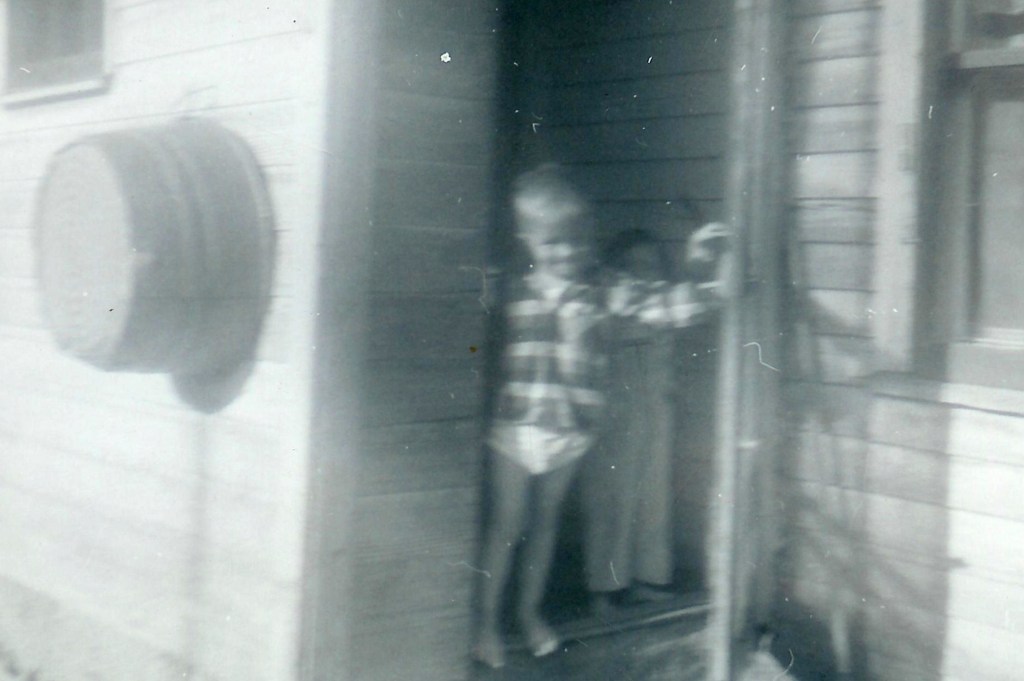
Elliott and little sister, Candice, at the back-porch door of their farm in the Summer of 1959. Five years old and ready for fun!
The happy slap of the wooden screen-door behind me was my cue to now devour this golden piece of ‘fuel for my furnace’. After licking my fingers clean, from that culinary delight, now it was: “Look out world, here comes the five year old FLASH!!” 😉 Even though I was only ‘knee high to a grasshopper’, my energy level was immeasurable. I loved to run, just for the joy of looking down and watching my well-worn farm shoes in a blur beneath me while I flew back and forth across our graveled farm yard. As I’d round the corner of the giant Elm trees, that held our tire swing, I’d race up our large front lawn and eventually crash in a heap of smiles on the embankment that sloped towards the gravel road that ran past our wonderful farm.
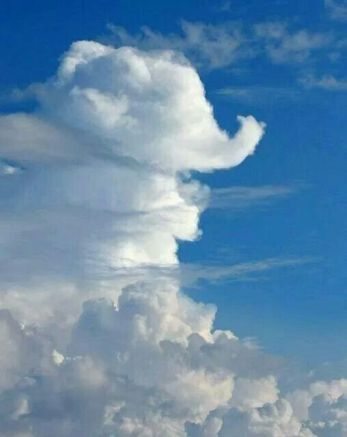
Elliott’s dreams and imagination flowed easily under those sapphire Minnesota skies
As my little Norwegian ‘engine’ purred under the ‘hood’ of my heaving chest, I lay in the repose of that sloping lay of our lawn and became lost in the grandiose beauty of the giant, cumulus ‘castle’ clouds that towered over me in that richly blue Minnesota sky. Even The Bible speaks of clouds in the Old Testament Book of Job, Chapter 35 and Verse 5: “Look at the heavens and see, And behold the clouds —-they are higher than you”. Captured in the awe of it all, it seemed like hours passed by, as I’d lay there on my back, in the cool, refreshing grass, and observed those white-soft ‘mountains in the sky’ merge and create for me so many white, make-believe creatures of joy for my imagination. Elephants lumbered by, followed by horses prancing and even giant baby booties would form and then disappear as the prevailing winds gently moved these ‘sheep of heaven’ as they’d give me pleasure from their blue ‘pasture’ above me. Conjuring my vivid mind of wondering, I imagined myself to being a bird, or a powerful airplane. As such, I’d then vicariously fly up there and dive in and out of those white mountains of the sky; even having a seat upon the ledge of a cloud that I was sure could hold a five year old like me.
Now rested and ready for more fun, I’d see my little sister, Candi, coming towards me from the house. She would gladly join me as we’d enter another playtime of simply rolling down that soft lawn incline towards the gravel road. Sometimes, we were a tire and would roll head over heels. Other play ideas were to lay down and bring in our arms along our sides. We resembled human hot-dogs as we rolled side over side over side down that slope and up the next steeper slope to the roadway. We’d roll and giggle till our little bodies lost all equilibrium and our tummies were about to become the ‘Duke of Puke’……..but still, it sure was a rich and simple joy that didn’t require batteries or a ‘smart phone’, such as today’s modern children rely on. 😉
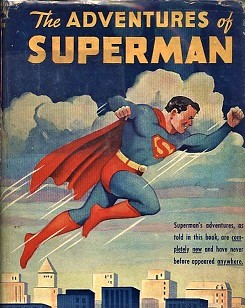
“Super Elliott”…faster than a speeding hiccup!
On other playtime occasions, having just completed watching the latest black and white episode of “Superman!” on our old television set, I’d ask our mother to help me find a ‘cape’ of some sort so I could play like my hero from the planet “Krypton”. Her large white bed sheets would’ve been my preferred flying apparatus, but I’d settle for one of her biggest bath towels. Then it was outside I’d ‘fly’ to begin jumping off tractors or tall stacks of hay-bales in my ‘flight’ and then to run as fast as my legs could carry me, all the while looking behind me to see my ‘cape’ flying in the wind just like “Superman’s” did. My imagination station, located between my ears, seemed to always have more adventures just waiting for me to ‘save the day’ and be a hero to all. 😉
Elliott’s most magical playtime literally ‘lit up’ the night around him.
Being the minuscule midget of merriment, I found that the most magical time of creating fun was when I could disappear in the vast, wide ditches of tall grass that ran parallel to the gravel road that bordered our farm on the east. Being the pint-sized, bantam boy that I was, it was an easy crawl on my tummy and I soon became one, at ground level, with the little beings that lived in those tall grasses. As daytime morphed into placid evening shadows, those grasses came ‘alive’ with tiny flashing lights. It was as if pixies had landed amongst us from Peter Pan’s Never-Land. In that paradisaical moment, I was now giddily surrounded by the illuminated world of Fireflies (some folks call them Lightning Bugs). Thousands of them ‘winked’ at me, with puff lights on my face, in colors of red, yellow, green and an occasional blue. The tall grasses that surrounded me on those nights were pulsating points of little boy bliss as my luminary, tiny ‘lamps’ lit the organic world around me that whispered a boy’s joy thanks to the nocturnal breezes that glanced off the bowing tips of tall grasses. It was truly a magical time for this Norwegian Farmer’s Son.
January 22nd…..”WHAT KIND OF TELEPHONE DID YOUR PARENTS USE IN THEIR EARLY YEARS ON THE FARM NEAR KIESTER, MINNESOTA?”
Elliott’s dad got “cranked”!
The metallic ‘click’ of Dad’s buckle loop could be heard in their bedroom as he swung his last shoulder strap over and fastened his farmer’s ‘suit of armor'(also known as coveralls) for another day of life and work on the family farm northwest of Kiester, Minnesota. Both our father and mother (Russell and Clarice) adhered to the sage advice of one of America’s Founding Fathers (Benjamin Franklin) who said, “Early to bed,and early to rise, makes a man healthy, wealthy and wise“. I’m also of a mind to surmise that our ‘Planting Prince’ would’ve also agreed with another of Benjamin Franklin’s sayings that went, “The early morning has gold in its mouth!”
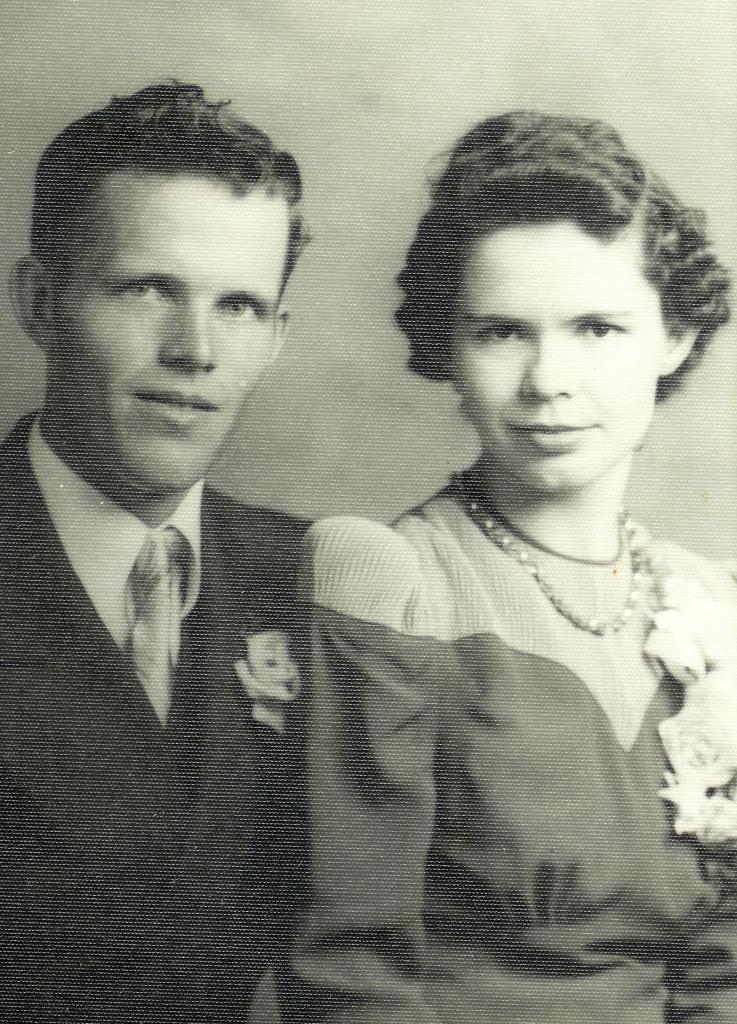
Russ & Clarice Noorlun
In that summertime 4:30am darkness, the pleasant, invisible breezes coursing through our parent’s bedroom windows animated the curtains as they billowed and waved to our parents; it was as if that light-weight fabric was beckoning them to start in and relish this new day of life God had given us. Our humble country kitchen was just a mere hinge-swing away from our parent’s bedroom as they stepped from their slumbering abode and snapped on the kitchen’s light-switch. As automatic as waking up, the next thing our folks did was to bring out the “Drip-o-lator” drip pot to make some coffee to get their Norwegian ‘engines’ running for another day of farm life. With a slurp or two of Mom’s hot coffee (and a cookie to tide him till breakfast), Dad gave his bride a peck of a kiss and strode out through our back pantry screen door. In the predawn shadows of the farm’s single yard light, Dad’s striped overalls were silhouetted as he crossed our graveled yard. His short commute complete, Russ disappeared through the Dutch-doors (half top/half bottom) of our classic red barn to begin the morning milking of our fine herd of Holstein dairy cows.
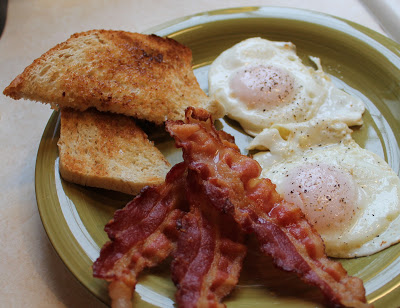
Breakfast was Russell’s biggest meal of the day!
As co-regents of their agrarian world, Dad was ‘King Of The Cows’, but when it came to our mother, Clarice, she was the unequivocal ‘Queen Of The Kitchen’. After seeing that her own morning chores were completed (such as feeding chickens, gathering eggs, etc.) she began what could almost be termed as her ‘symphony’ of breakfast for Dad and their young Norwegian family. Breakfast was our father’s favorite meal of the day, so Mom always sought to meet the needs of her man. Dad could ‘polish away’ three or four sunny-side-up eggs, lots of bacon, a bowl of cereal, orange juice, a half grapefruit and still had room left to wash all that down with Mom’s delicious hot coffee. So, to satiate that hefty appetite……….and with Mom’s deftness of wrist, those fresh eggs from the Chicken House were perfectly cracked on the edge of the skillet to allow those liquid gold contents to spill onto the the hot griddle. While they began to pop n sizzle, ‘soldier rows’ of bacon ‘came to life’ in another pan as they began a porcine prancing caused by the heat beneath them. Those fragrant food aromas, with a heady morning wonderment, filled the kitchen. Mom’s homemade bread popped out of the toaster; black, just like our daddy enjoyed it while he slathered its hot surface with sweet creamery butter. When Dad came into the house, after milking, to wash up, the ambrosia of that atmosphere was evident upon his smiling face.
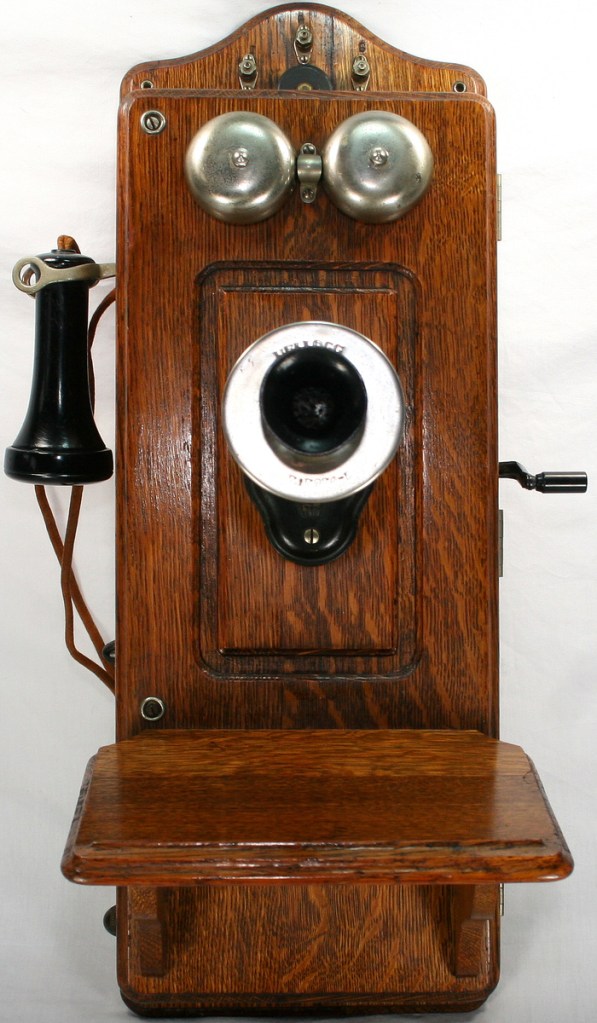
The Noorlun’s crank telephone.
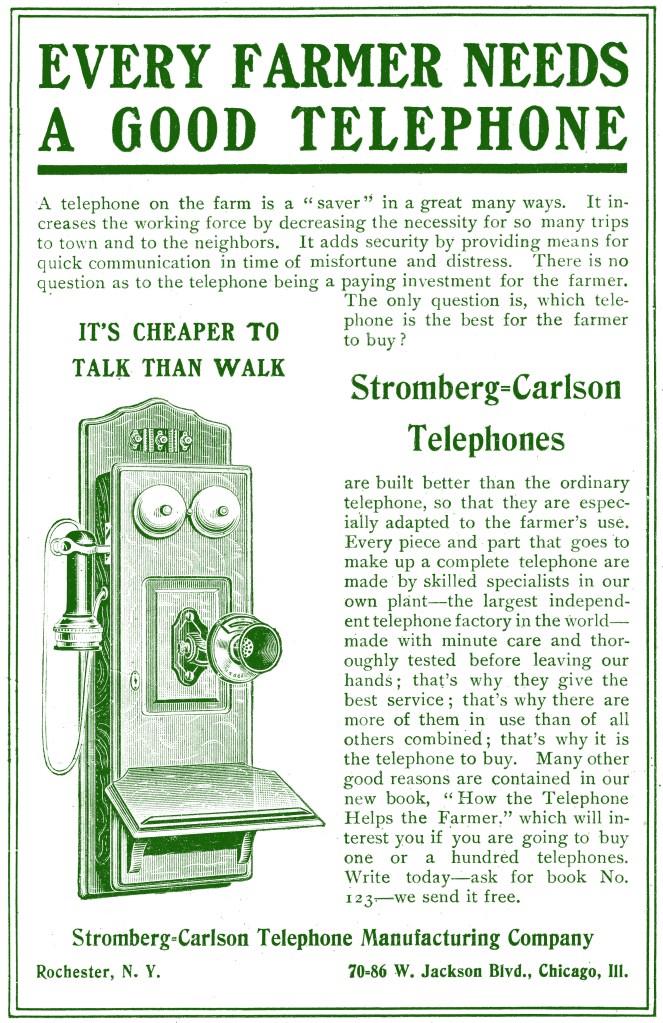
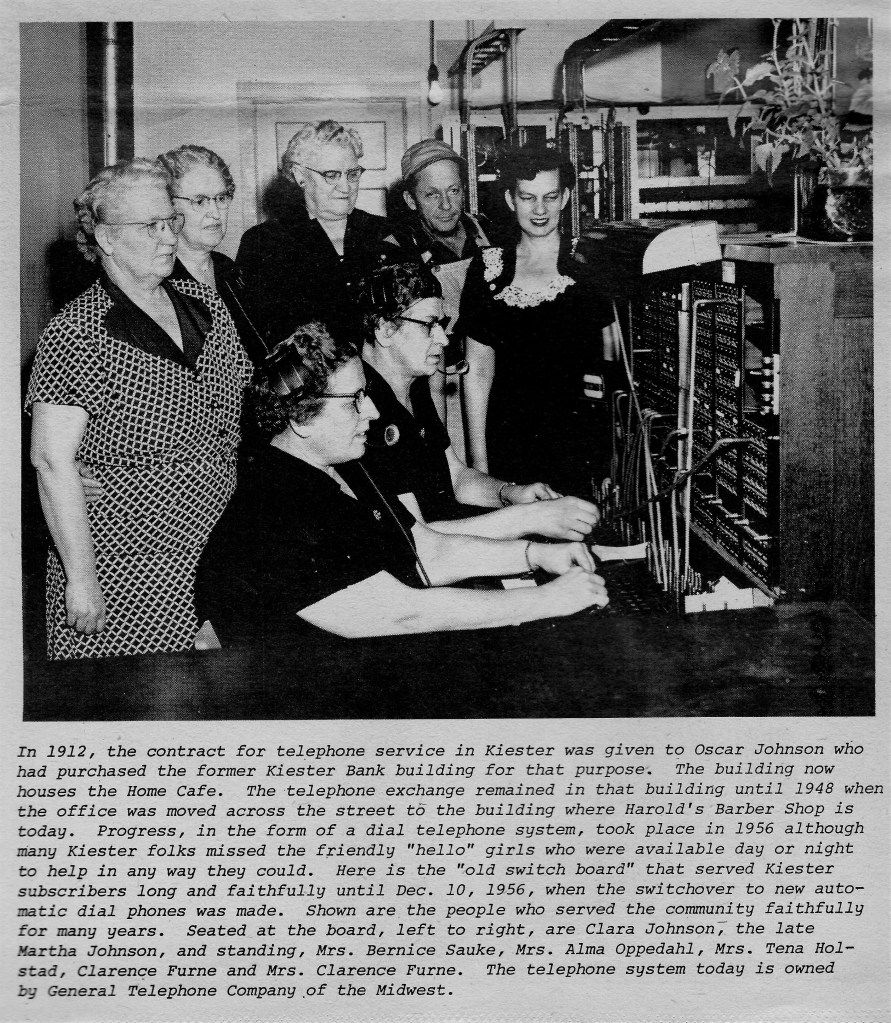
That morning, while our father was savoring mother’s excellent breakfast, a ringing sound came from our family Living Room. On the east wall, above Russell’s farm business desk, hung a wooden, rectangular “coffin crank” phone (likely a Stromberg-Carlson model). The early wooden phones of that day had been dubbed with the title “coffin” phones because of their similar resemblance of the long wooden boxes that were used to bury the dead. Most of these early telephones consisted of two bells, at the top, to announce, in audio fashion, that someone was trying to reach you. There was also a hand-held ear receiver that hung to the side of the wooden phone on a hook switch. After picking up the ear receiver, you would place that device to your own ear to hear someone speaking to you. A transmitter arm, with voice cup, stuck out from the front of the telephone. A person leaned into this device and talked. Your voice was then sent by wires to the local or distant location of the person you wanted to talk to. Finally, there was a crank on the right side of the telephone’s wooden cabinet. Usually, to make a call, you’d give the crank a series of turns. That cranking action generated an electrical charge that caused bells to ring at the Telephone Operator’s office in our hometown of Kiester. Then, the Operator helped connect you with whoever you wished to speak with.
“Your number, please?” , was what an Operator would ask when you made a phone call. Tina Holstad (standing at center) was also the wife of the Noorlun’s landlord, Morten Holstad.
Lightning fried a wire in the phone.
Unlike today’s cell phones, that are basically a hand-held computer, in those early farming days, families were thrilled just to be able to simply TALK to a neighbor or family member over the phone. These were the days long before “private lines” for phone service. Everyone was on a “party line” and when you picked up the phone receiver, you’d likely hear conversations, in the hand-held receiver, going on already. You’d have to be patient for folks to finish chatting and try again later with your call. Another facet of phone life was the way a call came to our farm. For our farm family, if we heard two long bells and one short bell, from the telephone, that was our signal to pick up the receiver and talk to someone. Another farm down the road would have a different patterned ring signal. If we Noorluns heard any other ring signal, other than our own, from the phone, we ignored it.
Russell took a jolt for helping out!
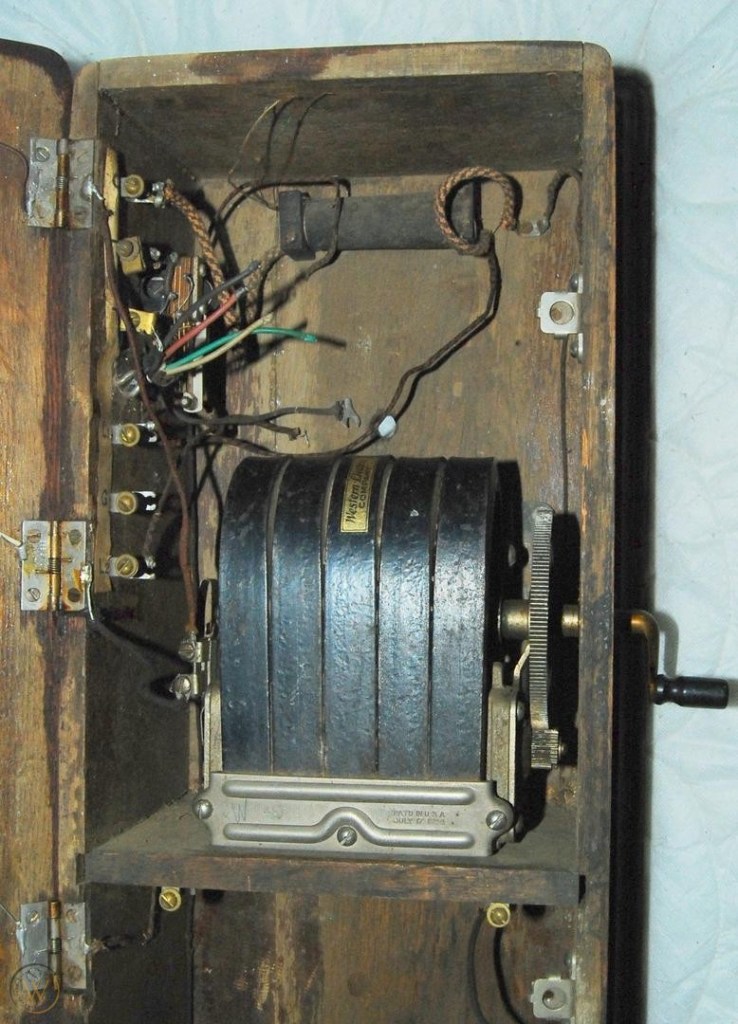
Weather across those Minnesota farmlands can change in a matter of a very short period of time. What began as a docile summer morning, evolved into a broiling thunderstorm by late afternoon. An intense lightning strike near us had sent an electrical flash charge into our wooden wall phone that fried one of the wires inside the phone cabinet. Dad, our ‘King of Cows’, was also the ‘Sultan of Shock’ when it came to being able to withstand electrical shocks to his body. Our folks needed to contact the Operator in Kiester to have our phone repaired, so here’s what they did. Russ found a piece of wire similar to what had been damaged by the lightning. Opening the hinged door of the wooden telephone cabinet, he placed one end of the wire on the magneto charging unit (that made the Operator’s bells ring in Kiester) and the other end of the wire to the proper place of the wire chassis. As he physically held the wire in place, Mom was then able to crank the phone (as the electrical shock went right through Dad) and got a hold of the Operator to report the problem. I’ll bet our daddy’s eyes even ‘lit up‘ when Mom spun that crank phone handle!!! 😉 The Operator, three miles away in Kiester, was a bit aghast as to how our mother could call her if our phone was broke down. Clarice shared how her husband had been the ‘live wire’ who had made things happen. Such were the ‘shocking’ attributes of the farmer father of this Norwegian Farmer’s Son. 😉
This big magneto (inside the wooden telephone cabinet), when cranked, sent a charge through a wire held by Elliott’s amazing father, Russell.
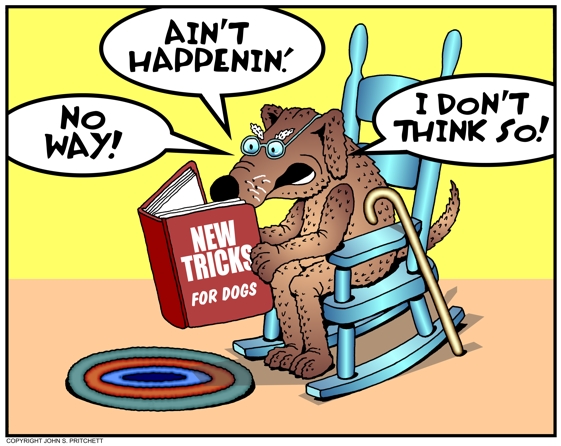
This will be my last posting for my blog supported by WordPress.com. Their new updated format of creating is just too fancy and complicated for this old dog to learn new tricks. For those few of you who have visited my Norwegian Farmer’s Son stories, I thank you so much for coming by and hope you enjoyed my “gentle adventures”.
May you all have a wunnerful day and thanks again for reading the jottings of this wannabe writer. Like Porky Pig used to say, “That’s all folks!”
January 21st…..“SHARE ABOUT YOUR PARENT’S EARLY YEARS OF MARRIAGE AS HIRED HANDS ON THE FARM OF WALLY AND GENEVIEVE MUTSCHLER NEAR KIESTER, MINNESOTA.”
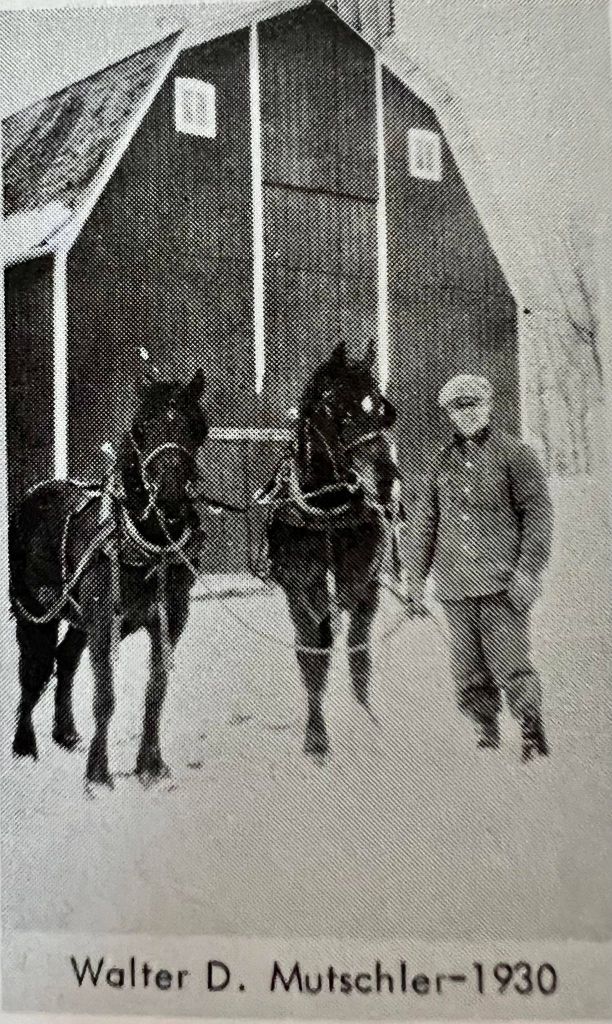
A golden sheen, from the tungsten lights within, sparkled across the predawn snow banks near the barn. The electric emanations came from the barn window glow of the “Green Gables Farm” that lay to the northwest of Kiester, Minnesota.
The farm’s ‘hired hand’ was a handsome young man by the name of Russell Noorlun. He and his lovely wife, Clarice, were expecting their firstborn child soon. As Russ faithfully and quickly moved from chore to chore in the barn that morning, daylight was still hiding beneath the cusp of the eastern horizon of sleeping farmlands. It was as if ‘Old Man Winter’ made it too cold for that old sunshine to want to make a showing in the brisk chill of another winter’s day.
Russ and Clarice had recently been made part of the Walter & Genevieve Mutschler ‘family’ by accepting employment as hired hands on the lovely site of this majestic farming operation. Part of the Noorlun’s monthly wage compensation was being granted the added blessing to live on-site in a little cottage cuddled into the treed windbreak that surrounded the Mutschler farm.
“Green Gables Farm” received its elegant title from the fact that the big barn, support structures and the family home were painted with a brilliant white coat of paint coupled with the harmonious and striking contrast color of the upper gables being an emerald green. The regal beauty of these farm buildings reflected the grand quality of the dear family that called that farm place their home.
As events of our young parent’s lives unfolded, God was about to show His loving provision to our father and mother. In their early days of being newlyweds (in June of 1941), Russell and Clarice had been employed as ‘hired hands’ (farm workers) for two, old bachelor brothers in northern Iowa. That term of employment had proved to be the opposite of enjoyable, sad to say. It seemed the two, crotchety old farmer brothers were always arguing amongst themselves and/or were seldom satisfied with the hard work our father was striving to achieve for them. Out of frustration, and in hopes of finding a better work situation, Russ had driven north across the borderline into Minnesota and arrived in the nice village of Kiester. While in town that day, Dad ‘ran into’ Walter (Wally) Mutschler and found out that a job opening was available on their farm northwest of that farming community. In a spiritual retrospect, we now know that God had that meeting all planned out in His omniscience and His best blessing was just waiting for our parents. Our farmer father accepted Wally’s offer of employment and, like they say, the rest was history for our entire family in the years to come.
Not only were Wally and Genevieve Mutschler excellent employers, they, and our parents, grew to love each other to the glorious point of becoming like a second set of ‘parents’ to our folks and like another ‘grandpa and grandma’ to all of us grateful Noorlun children over the many decades since the meeting that day of our father and Wally on the streets of our beloved hometown of Kiester, Minnesota.
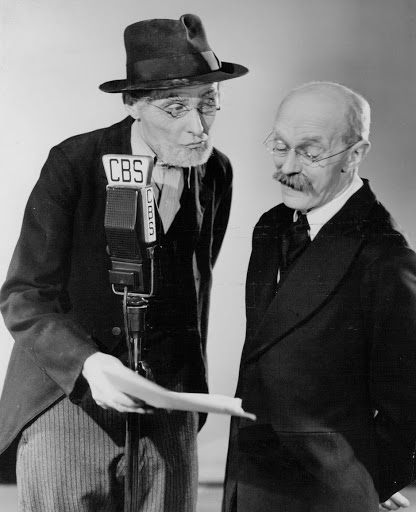
The reason, as stated earlier, that Russ was hustling with morning chores, was so that he could quickly make the walk along the farm’s snowy paths to the little white cottage that he and Clarice called home there at “Green Gables Farm”. One of our dad’s favorite radio shows was ‘on the air’ each morning around breakfast time and Russ didn’t want to miss an episode of the program called, “Snow Village Sketches” which entailed the ongoing adventures of a couple old codgers in this comedy/drama based in the State of New Hampshire.
As Russell’s young pregnant bride prepared his large farmer’s breakfast, he tuned in their Atwater Kent radio to be entertained there in their tiny kitchen while winter’s claws of wind and cold scoured the outsides of their little white bungalow.
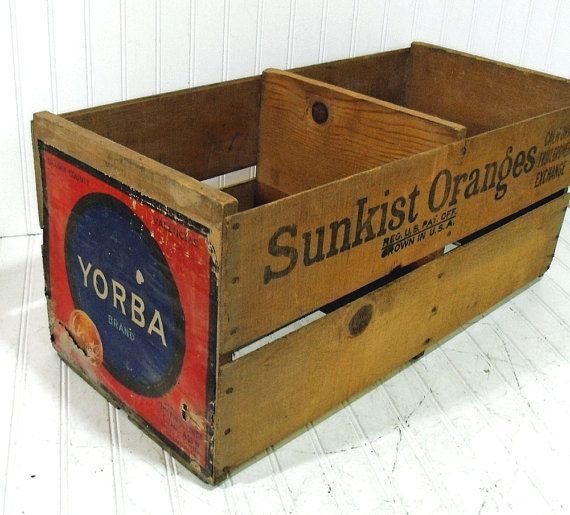
Russ and Clarice had grown up through the late 1920’s and into the 1930’s. Those were the very lean years of “The Great Depression”. And, even now, in the early years of World War II, our parents had to daily employ some sage wisdom of the times that went like this, “Use it up, Wear it out, Make it do, Or do without”. In these days of their young married life together, Russ and Clarice had to “make do” with the only furniture they could afford at the time……….wooden orange crates. Set vertical on their ends, two orange crates were their ‘kitchen chairs’ and one orange crate was their ‘kitchen table’.
That ol’ mean-spirited Minnesota winter, outside of their cottage walls, did its best to steal any heat from within their tiny kitchen. To fight back those chills, Clarice kept their little wood stove roaring with a good fire in its metal belly. As Russ relished his radio show with lots of Norwegian laughter, he also gladly consumed Clarice’s eggs, bacon, cereal, coffee and morning grapefruit. Oh, and don’t leave out his preferred ‘scorched black’ toast with melted sweet creamery butter lathered on for good measure and taste.
As winter day followed winter day, Russell and Clarice tried to stay warm the best they could. When sitting near that little kitchen stove, they would roast from the generated wood heat on one side of their bodies, but be freezing on the back side. So, like human ‘flapjacks’, they’d flip themselves around so their backs and bottoms could warm up, as well.
That small wood stove in their home couldn’t hold a candle to the intense warmth that governed the heart of our sweet mother, Clarice. Even though she, herself, was ‘heavy with child’ (our brother, Lowell), Clarice and our loving father, Russell, were quite the team when it came to caring and sharing of what they had with others. In the early fall of 1942, our paternal uncle was a sergeant in Uncle Sam’s Army during World War II. Our poor uncle was also shouldered with the burden of being a single parent in need of care for his baby daughter so that he could return to active duty in Europe. Our parents agreed to step up and be a blessing to that baby girl. Family members from the Fosston, Minnesota area delivered a little pink bundle to that Mutschler farm cottage and, thanks to Russ and Clarice, our uncle’s baby girl was temporarily loved and cared for till another relative could take over. A photo from our family collection shows our dear mother holding her tiny niece while wearing a winter coat that conceals her own pregnant tummy waiting for our brother to be born later in February of 1943.
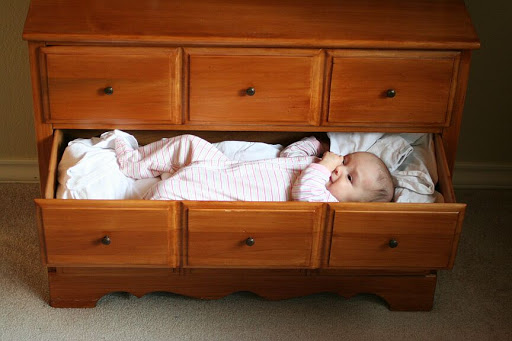
Being ‘instant parents’, with the arrival of this tiny little lady, Russ and Clarice made every effort to ensure that this little soul was taken care of to the best of their abilities. When it came to going nitey-nite, our mother became resourceful when she needed to create a ‘crib’ for the baby. Opening one of the drawers of the dresser in their bedroom, Clarice put a pillow and blankets inside that open drawer and laid the baby girl in her new-found, makeshift ‘crib’. 😉
Like the ubiquitous ‘pebble in a pond effect’, the ripples of love shown to our parents by Wally and Genevieve Mutschler enabled Russ and Clarice to then live out the tenets of our Christian faith in being a sanctuary for their baby niece in need of a temporary home. Their attributes were mirrored as shown from the Bible in Matthew 18:5, which says, “And whoever welcomes a little child like this, in My name, welcomes Me.” Their godly example is still a standard of life for this Norwegian Farmer’s Son. ><>





























 Norwegian Farmer's Son