Vol.2..Norwegian Farmer’s Son..July 8th

July 8th………“WHAT WAS YOUR MAIN SOURCE OF HEAT FOR YOUR FARM HOME NEAR KIESTER, MINNESOTA”?
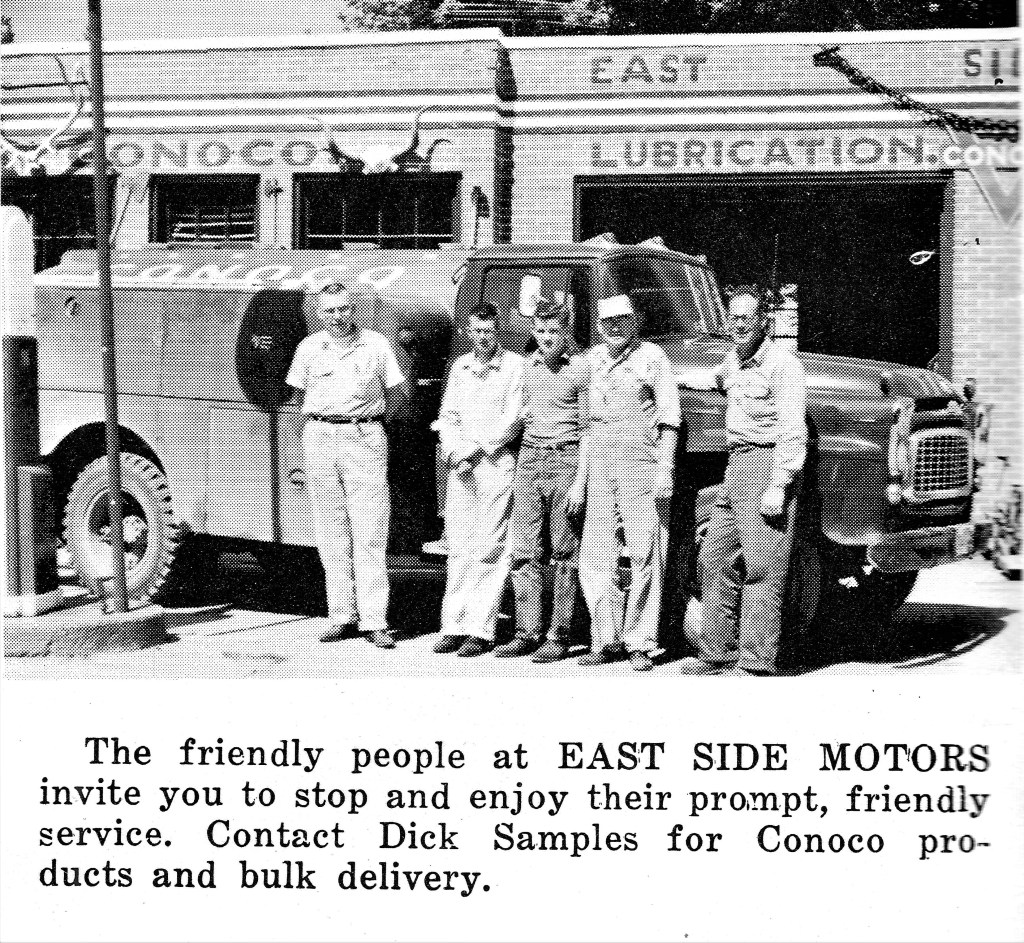
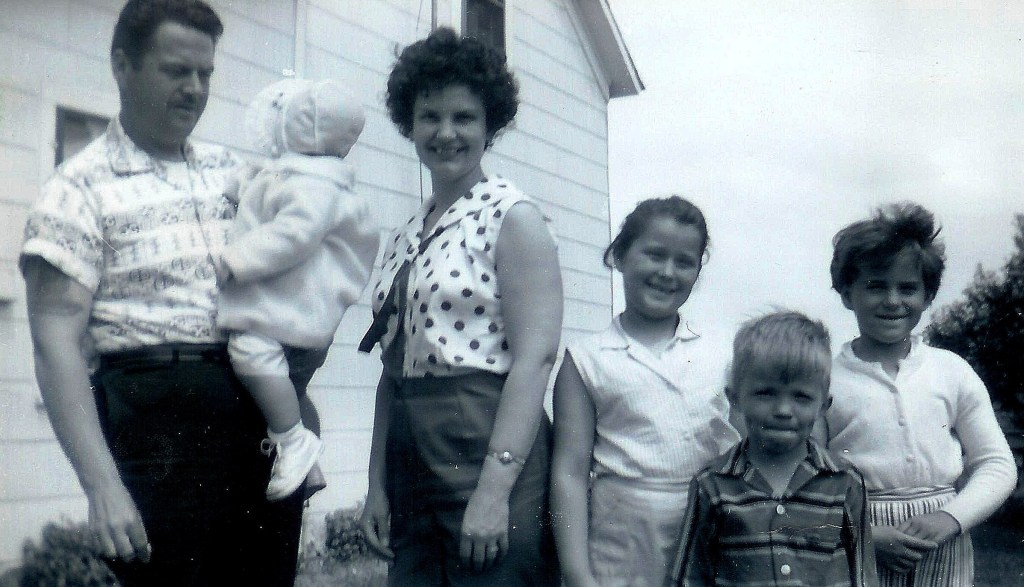
Mr. Dick Samples stands second from right in this photograph from 1960-61.

Wild, withering, winter winds did their best to keep Dick Samples from skillfully guiding his Conoco-brand furnace oil fuel truck into our farm’s north, U-shaped driveway. As if a knight of chain-link armor, Dick’s version of waging this ‘battle’ were chain-linked tire chains that surrounded those heavy-duty dualie tires on the backend of his impressive “International” tanker truck. With the lumbering weight of all that oil in his holding tank, Dick won the white battle as those chained tires churned through snowbanks at the driveway’s entrance and he made his way to our family’s oil holding tank.

Old Man Winter was not about to dim the spirits of this well-loved man of our Kiester community when it came to seeing that our farm family home had its rightful delivery of furnace-grade fuel oil for our in-house heater.

Dick was a seasoned Minnesotan and wisely dressed for the white tempest that blew around him while he carried out his business duties. A maleficent blast of ill wind had little effect on our friendly fuel oil man as he gallantly pulled a length of fuel dispensing hose from his truck to our furnace oil holding tank and filled it to the brim. Mom then invited Dick into the warm repose of our family kitchen for a hot cup of coffee and a handful of cookies before allowing this good friend back out into the cold weather and his drive back to Kiester.
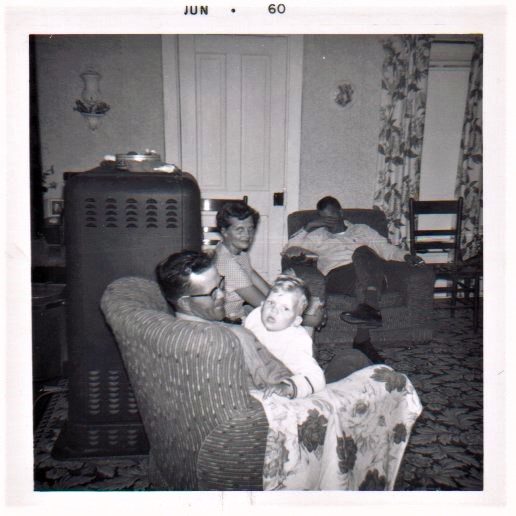
Elliott’s father, Russell (in glasses), sits with his nephew, and one of his sisters and one of his brothers. The family’s oil furnace, in this photo, was located in their Living Room and provided heat for the home during the frigid Minnesota winters.

Throughout the 1940’s, 50’s and into the early 1960’s our home’s main source of heating was a free-standing oil furnace that sat in our Living Room like a monument to the goal of keeping our farm family cozy and warm while Jack Frost, and his icy cohorts, raged in frigid frenzies just outside our frost-coated windows.
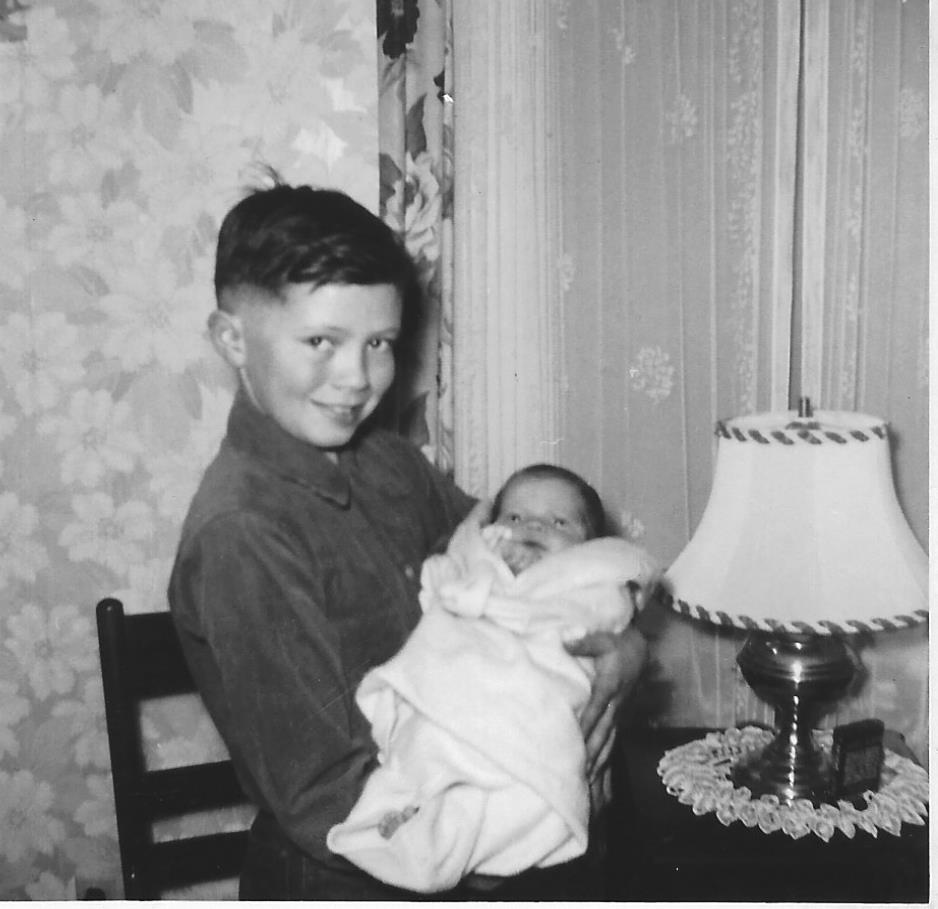
It’s 1954 and big brother Lowell holds tiny Elliott. This was the era when one of Lowell’s chores was to fill the oil furnace each day for the family’s heat.

Big brother, Lowell, recalled many a frozen morning when he’d jump out from under his warm, cozy quilts and into the below freezing temperatures of his upstairs bedroom. If there were an Olympic Record for pulling on winter clothes over his winter long-johns, Lowell would’ve gotten the gold medal, for sure. After getting dressed, our big brother made a beeline for his sister Rosie’s bedroom, next door, because that’s where the vertical vent/stove pipe came through the upstairs floor (on its way out the roof) from the family furnace below in the Living Room. Both Lowell and Rosie would give happy hugs to the almost too hot stove pipe to get themselves warm before they heard Mom call……..“Time for Breakfast”!!! down in our Kitchen.

As in any farm family, Lowell & Rosie (along with myself and Candi later on) had daily chores to carry out that taught responsibility and actively playing your part in the weave of the family unit of life.

One of those chores had to do with keeping the Living Room furnace reservoir full of oil, so, bundled up against the whiteness of winter that surrounded our abode, Lowell grabbed up his furnace oil refilling can and held his breath against the howling blast of arctic attack air that awaited him outside. With a young boy’s determination, Lowell dove out into the maelstrom and, plodding through snowdrifts, made it to the outdoor furnace fuel tank and filled his oil can. Once back inside our home, it was then time for brother to use the can’s narrow spout to very carefully fill the furnace reservoir for that day’s heat needs.
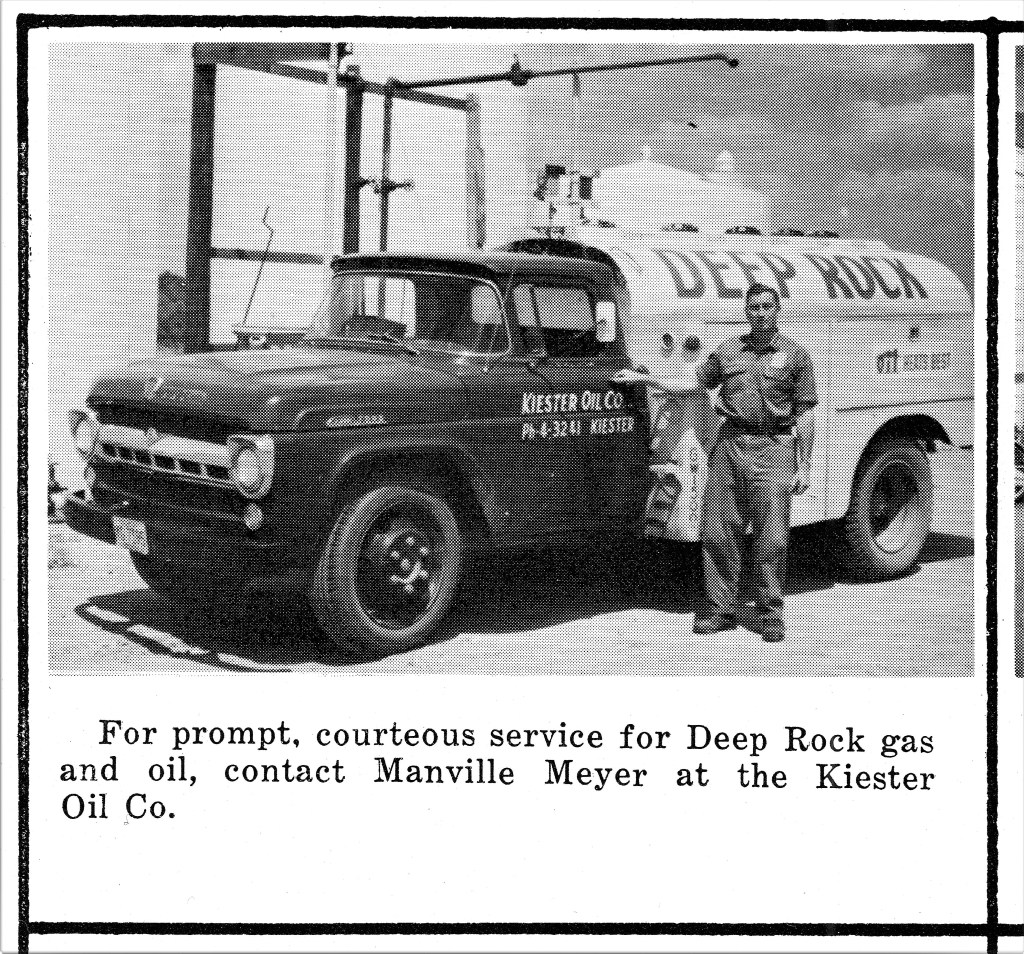
Mr. Manville Meyer not only delivered Deep Rock oil products, but he, along with his wife, Marie, also faithfully drove school bus for many, many years for the Kiester, Minnesota school district.

Our village of Kiester was so blessed, back in those fine days of yesteryear. When it came to fuel, whether it was home heating needs or gasoline and even diesel fuel for tractors or trucks, our community was proud to have at least three dealerships to meet our needs. Ervin Trytten supplied the Standard Oil company products, while Manville Meyer’s business was associated with the Deep Rock Oil Company.
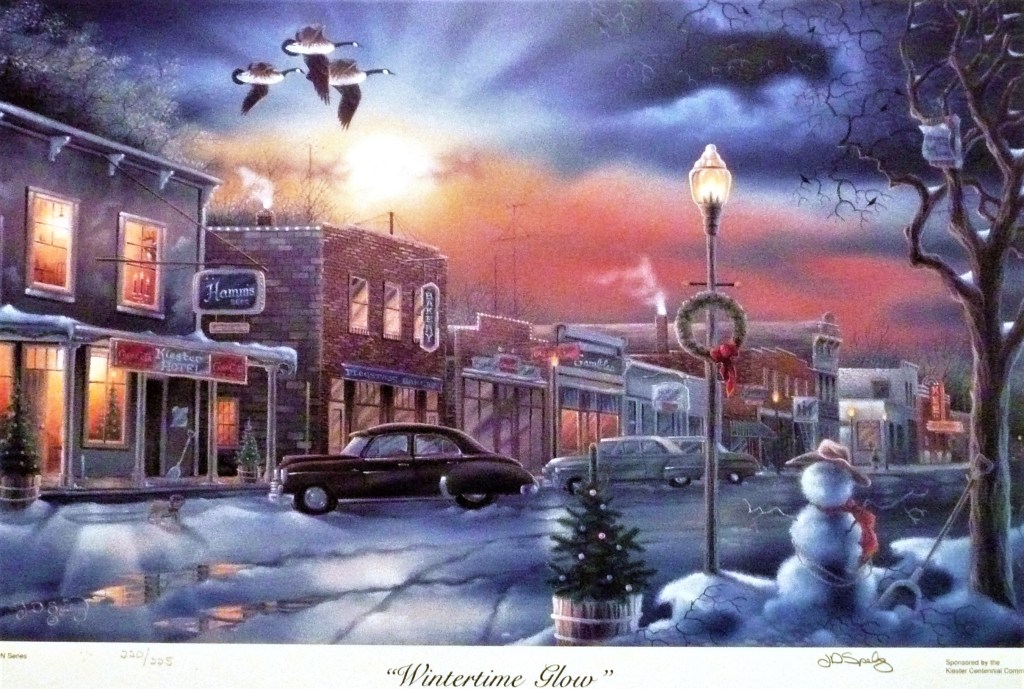
An artist’s rendition of the Main Street of Kiester, Minnesota based upon a photograph from the 1950’s.

Our town’s glory days had to do with the pleasant harmony of win/win equations that existed between a plethora of nearby family farms that, in turn, needed supplies that then kept a multiplicity of businesses thriving to meet those needs. The more family farms there were, the better the health of the overall community and its commercial well-being. There were so many ‘quilt blocks’ of businesses that kept everyone warm under the blanket of local fellowship of like minds who worked together to make the magic of what made small town America so grand for this Norwegian Farmer’s Son!!! 😉
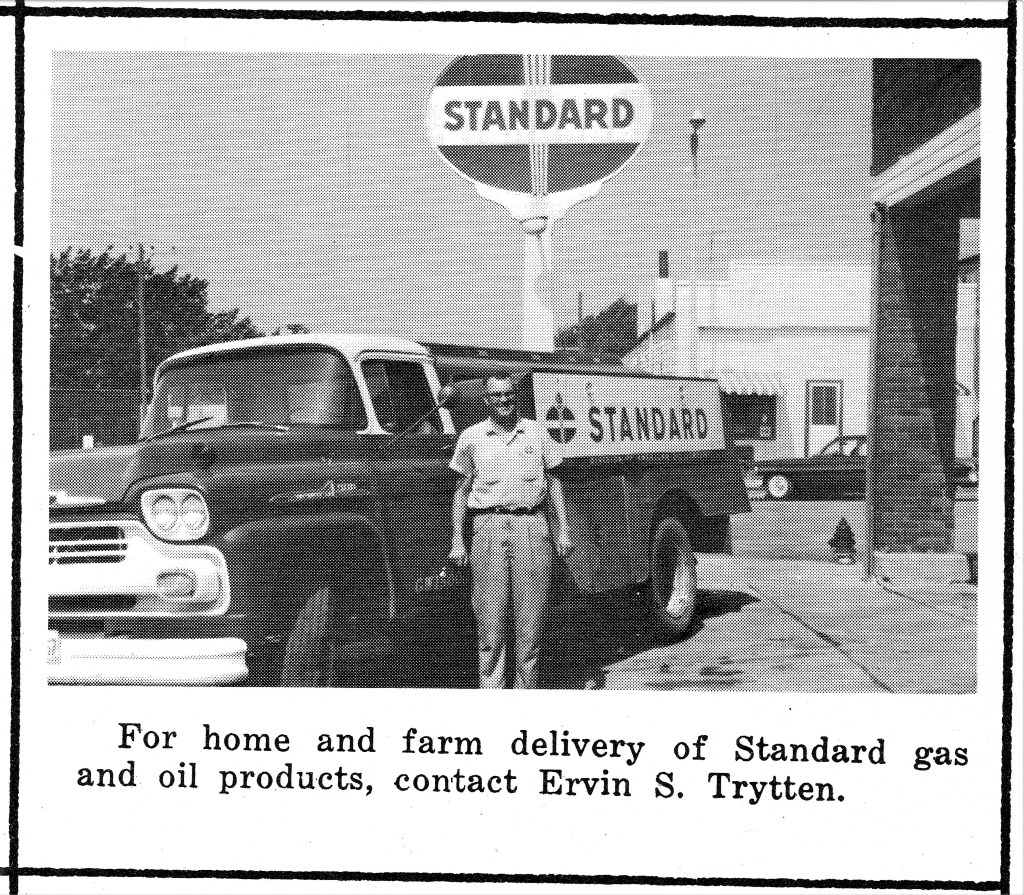

Mr. Ervin Trytten not only served our great nation during World War II, but came home to raise a fine family and serve his community of Kiester via the Standard Oil products that he delivered through his business.

Vol.2..Norwegian Farmer’s Son..July 7th

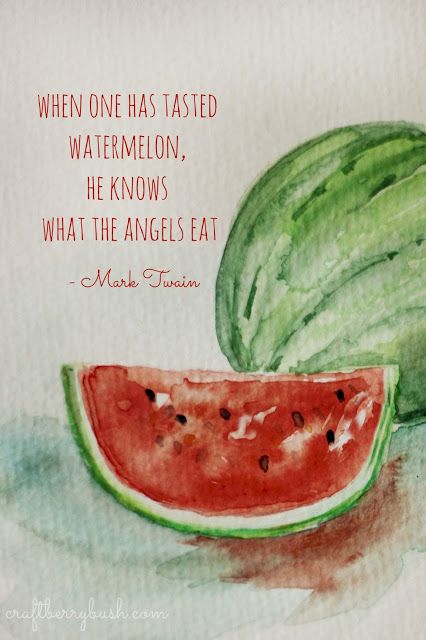
July 7th…………..POEM – “Watermelon Wisdom” created by N. Elliott Noorlun on November 28th, 2020.

It’s the summer of 1947 and our Grandfather Edwin Noorlun is enjoying some tasty watermelon with his family near Fosston, Minnesota. Splayed on the ground, near Grandpa Ed in this photo, are his son, Gaylord, granddaughter Lorraine, his eldest daughter, Ileen (in foreground) and daughter Lillian (to the right in glasses). In the distance you’ll find Grandma Marie is ‘hiding’ in the shade. To the right is the sun-illuminated window of their home that still proudly displays a United States Blue Star Service Banner with two blue stars upon it; one for each of their sons who served in the U.S. Army during World War II (Doren and Erwin).

This is an acrostic poem where the beginning letter of each line will, vertically, eventually spell the words…..WATERMELON WISDOM 😉

W…..atermelon wisdom,

A…..t home there on the farm,

T…..he War had ended, Two years hence,

E…..very day now held such charm.

R…..etiring to the lawn and shade,

M…..outhwatering, cooling treat,

E…..dwin with his family round,

L…..aunched in and began to eat.

O…..hhhh ambrosia, Both for young and old,

N…..ow happy seeds for spits,

W…..atermelon cool, Brought smiles all around,

I…..ncluding some happy feet fits.

S…..hadows even revealed their mom,

D…..odging sun for cooling shade,

O…..h for these simple days of joy,

M…..elon magic there was made!!! 😉
Vol.2..Norwegian Farmer’s Son..July 6th

July 6th……….“DID YOUR HERD OF HOLSTEIN DAIRY COWS LIVE IN THE BARN ALL THE TIME YEAR ROUND? IF NOT, WHERE COULD THEY ROAM? HOW DID YOU GET THEM BACK FOR MILKING TIME IN THE EVENINGS”?

Ominous black clouds sounded out a glowering, grumbling guidon of the passing summertime storm that had just visited the skies above our farm. This electrical weather event was a normalcy of this season in south central Minnesota.

As if playing a new game of peekaboo, the volatile, vertical lightning strikes now had been replaced by heat (or sheet) lightning that seemed to hide in the layered dimensions of the multi-grayed cloud banks. It was as if a sneaky paparazzo, with an old flashbulb attachment on his camera, was readying to sneak up on us for a candid photograph. As the mythical figure triggered his ‘flash’, there was, now and then, an occasional wide, expansive POOF of lightning in the cloud banks illuminating massive areas which revealed the cloud’s varied hues of subtle gray shadings while the ugliness of that weather system moved slowly off into the southeast horizon and any imminent danger left with it.

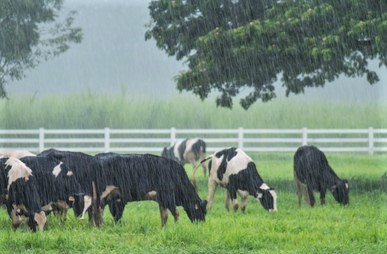
Farmer boy, Elliott, standing in front of his Smith cousins and ready for a walk in the rain to go get the family’s herd of Holstein cows for that evening’s milking.

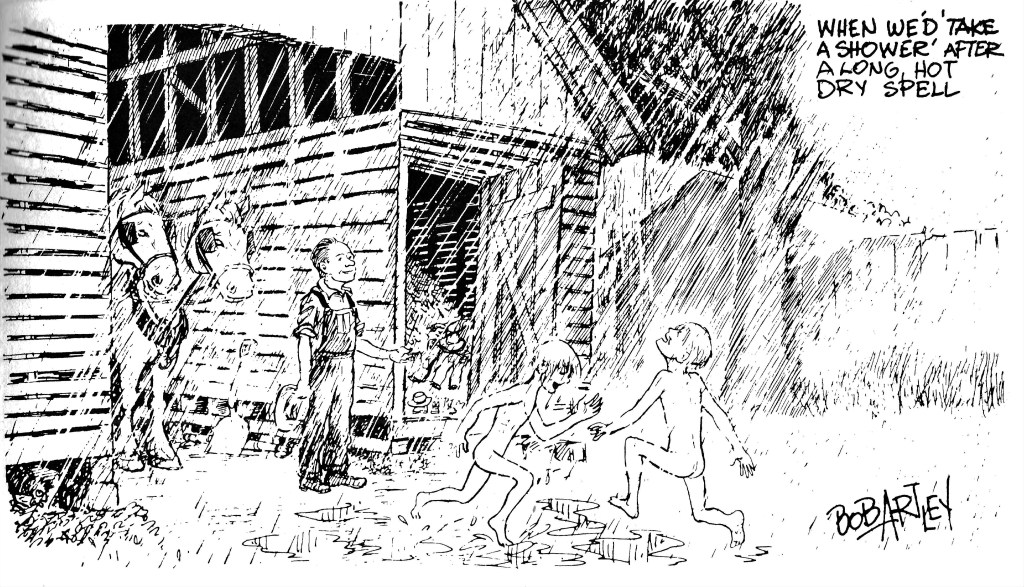
Now that the deadly fireworks in the sky had passed out of the area, the second act of God’s wonder in the skies was the arrival of the warmest rain this side of a childhood smile. The timing of the rain was ideal for a couple of reasons. #1. It was time for my daily afternoon trek down the gravel road to get our herd of Holstein cows for the evening milking from our pasture and #2. Our maternal Smith family cousins had come over that day to visit and were up for the adventure of getting the cows with me in the rain.

Although Elliott kept all his clothes on, he, his little sister and their cousins still got soaked to the bone and had fun in the very warm summertime rain that fell over their family farm near Kiester, Minnesota.

Cousins Brenda, Valerie and Deanna, along with my little sister, Candice, and myself ventured out the back porch screen door of our farm home and into the pelting drops of a heavenly rainfall that eventually drenched us all to the bone.

As the five of us sauntered down the descending elevation of our south, U-shaped driveway, tiny rivulets from God’s warm rain showers were beginning to follow gravity’s pull as the rain popped up in happy jumps upon the graveled surface of the ground.

Who needs umbrellas when the liquifying loveliness of the good Lord’s rain only required an occasional ‘windshield wiper’ of your finger across a rain-laden forehead .

Being the chit-chatting cherub children that we were, our young cousin fellowship was enjoyed thoroughly as we walked down the countryside gravel road that paralleled our electric-fenced ‘cow lane’. After our almost 1/2 mile hike, we came to the pastureland that bordered Brush Creek at the south boundaries of our farm property. These happy Holsteins of ours could munch n crunch all day long on nutrient-rich grassland and, when thirsty, could drink gallons of water to their heart’s delight that ambled lazily along Brush Creek’s watery abode.

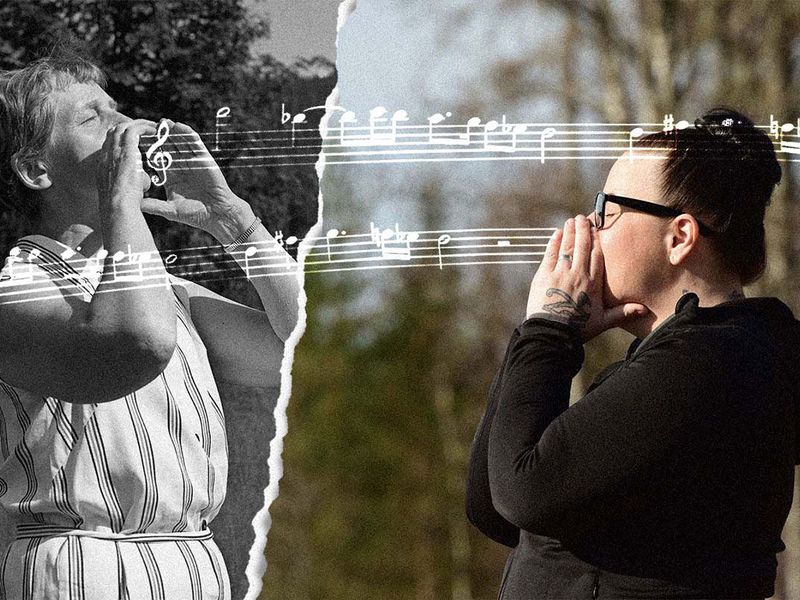
Ancient kulning melodies were so mystical and lovely that they were even incorporated into a modern, animated movie called “Frozen” and “Frozen II”.

Upon arrival at the pasture, our soaked selves saw our dairy herd at a distance grazing happily through the vertical curtain of rain that didn’t seem to trouble them at all as they pulled up mouthfuls of green grasses that kept them well-nourished and their udders full of milk.

What came next was a practice that was centuries old, called “kulning” or “herd calling”. In our ancestral Norway, tending herds of cows usually came under the jurisdiction of farm wives or daughters. The ladies would conceive distinct songs which were created by each individual family to ‘sing’ to their cows up in the mountain pastures. When a family’s bovines heard their special song sung to them, they then came towards the maiden making that calling sound and followed her back to their respective farm for milking and staying the night in the barn.

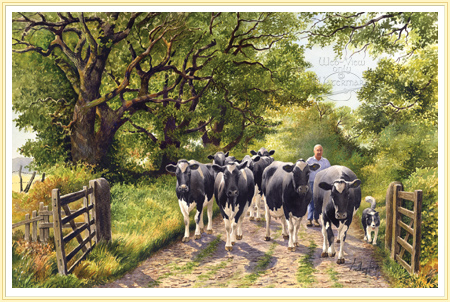
Holsteins coming home for milking down the cow lane.

Instead of the traditional beauty of kulning, I was taught the simplistic version of herd calling that merely consisted of two song tones; one high and one low. In that warm, rainy afternoon, I cupped my hands on each side of my mouth, making a megaphone, of sorts, as I hollered…..“COME BOSS!!! COME BOSS!!! COME BOSS”!!! Pretty soon the senior ladies of the herd perked up their heads and began approaching my calling. They knew well that this human sound meant even tastier food was waiting for them up at our barn and that our father would milk them to relieve the pressure in their distended milk bags called udders. The younger cows soon learned, by their elder’s example, to follow along and, next thing you know, there was a long, black n white line of bovines exiting our pasture and making their way up the cow lane leading back to our livestock yard and the barn.

A farmer heads for the barn to begin the evening milking of his dairy cows.

With the last ‘Harriet Holstein’ now entering the cow lane, those black n white beauties were heading northward with the rest of the herd. The five of us midget cow herders clamored down the ditch slope from the gravel road and ducked under the electric fence to follow the cows up the cow lane and to the livestock yard which led into the barn. With our warm heavenly showers having now ended, we enjoyed ‘Mr. Summer Sun’ peeking out shyly from the clouds. We walked slow and peacefully behind the cows as the milk-laden udders of our Holsteins swayed poetically from side to side. I was taught early in my boyhood that you never chase or yell at the cows to make them run. For one thing, their heavy milk udders could be injured by aggressive slapping back and forth in the run and, for another reason, my farmer father would yell at me saying, “If you make those cows run so much, all I’ll get out of them is “cottage cheese”!!!! It was Dad’s facetious way of saying their milk could even be affected by making them run.

In a way, we midget herders that day saw the full circle of seeing our cows safely home during a heavenly rain to the point in time of Dad getting a Holstein ‘rain’ (of milk, that is). It was a feeling of youthful accomplishment as we brought back to the farm yard the cows that belonged to the farmer father of this Norwegian Farmer’s Son.

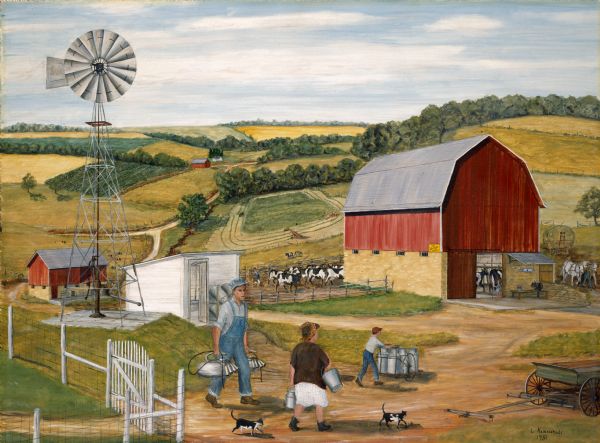
Elliott’s family barn that held their modest-sized herd of fifteen Holstein dairy cows.

Vol.2..Norwegian Farmer’s Son..July 5th

July 5th………..POEM – “A Pleasant Evening”. Created by N. Elliott Noorlun on July 12th, 2015.

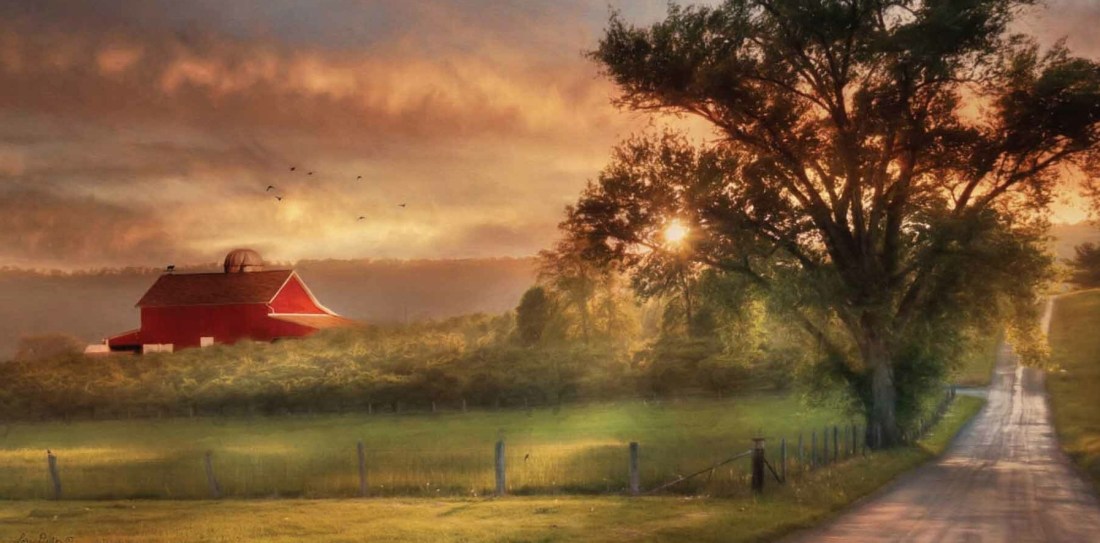
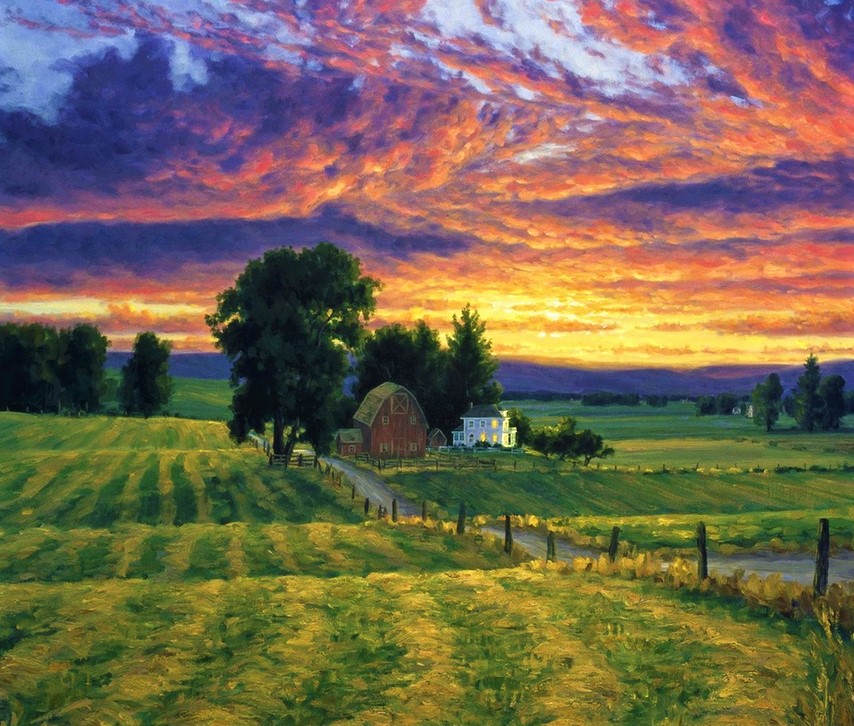
A serene evening scene of country farm life.

A pleasant evening, There on our farm, Sheltered from, The world’s alarm.

There dwelt that gentle family charm, As shadows lengthened there.

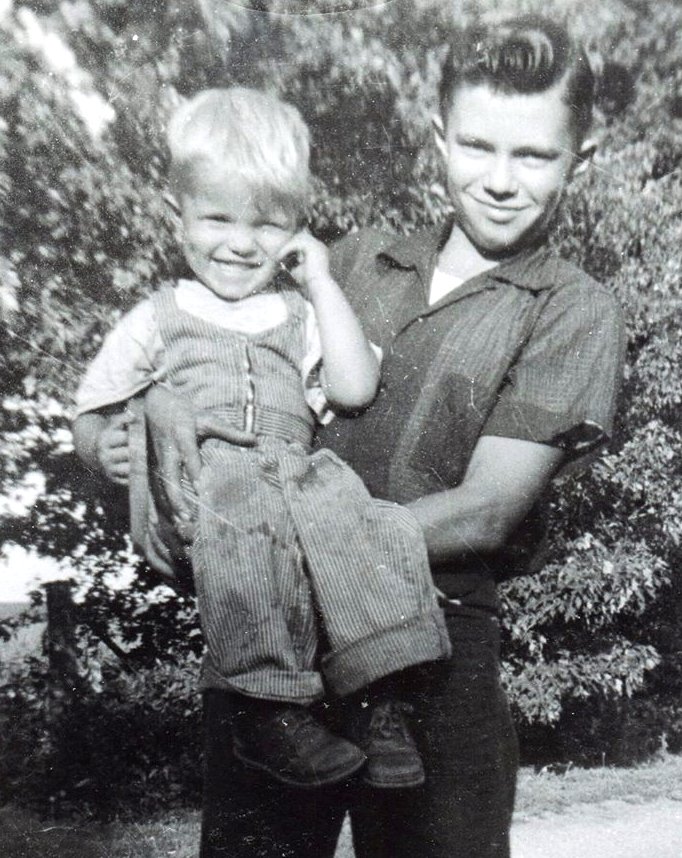
Elliott gets a ride in big brother Lowell’s arm as afternoon fades into a pleasant farm evening.

Cuddled in, My brother’s arm, From the smile I made, I knew no harm,

To family hearth, I’d always swarm, And found security there.

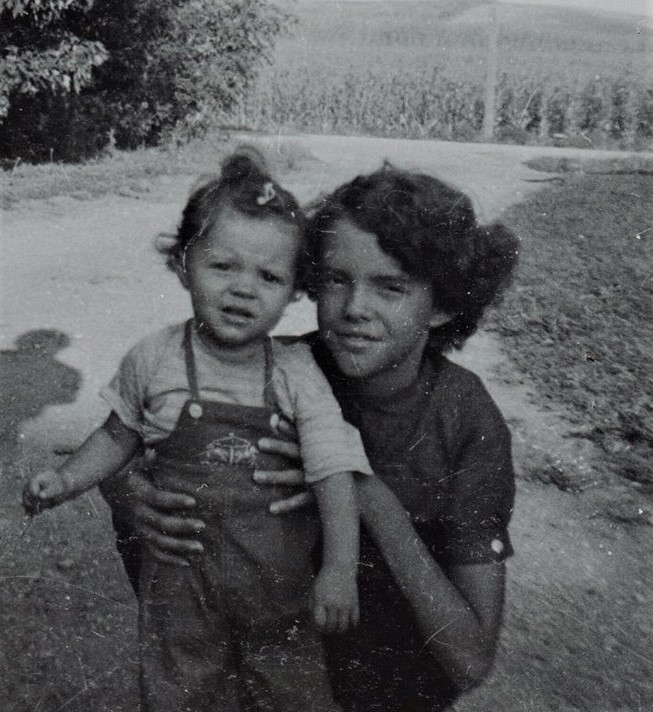
Tiny Candice is cuddled by her big sister, Rosemary, as the late afternoon sun illuminates cornfields behind them.

Little sister, Candice Lynn, So sweet at birth, From love within,

Held close to sister Rosie’s chin, There’s love exuding there.

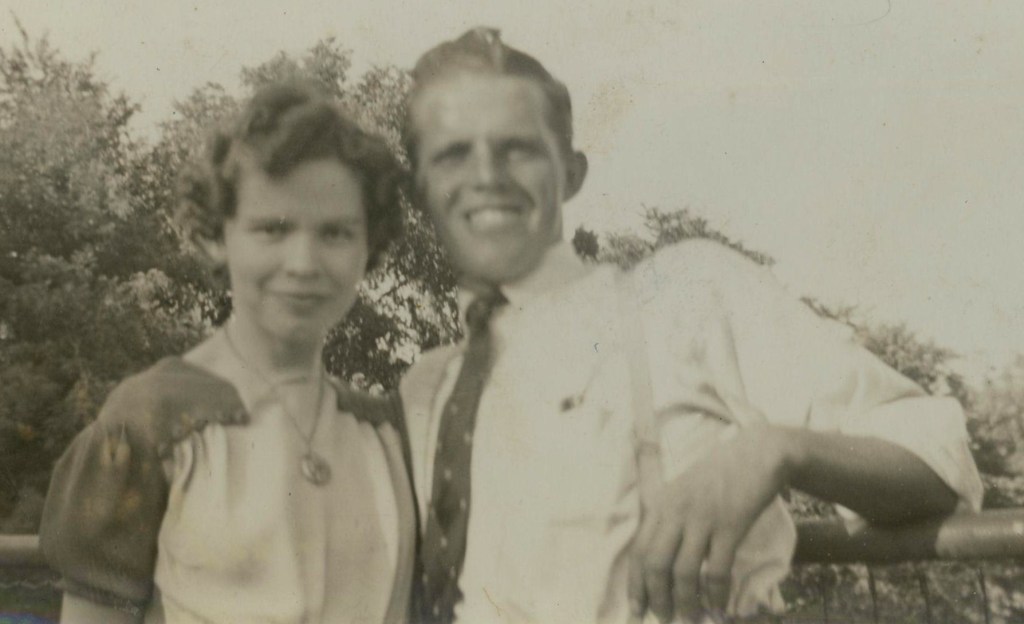
Clarice and Russell Noorlun were good and godly parents who, although monetarily not rich, gave golden treasures of home and love to their four children.

So, thank you, Lord, For parents who, Valued life, And chose to do,

All they could, To see us through, Oh the joys of family there!! ><> 😉

A very pleasant farm evening to be enjoyed by all.

Vol.2..Norwegian Farmer’s Son..July 3rd

July 3rd……….“WHEN YOUR DAD WAS YOUNG, WHAT WAS IT LIKE GOING TO CHURCH ON SUNDAYS FOR YOUR FATHER, RUSSELL, AND FAMILY”?

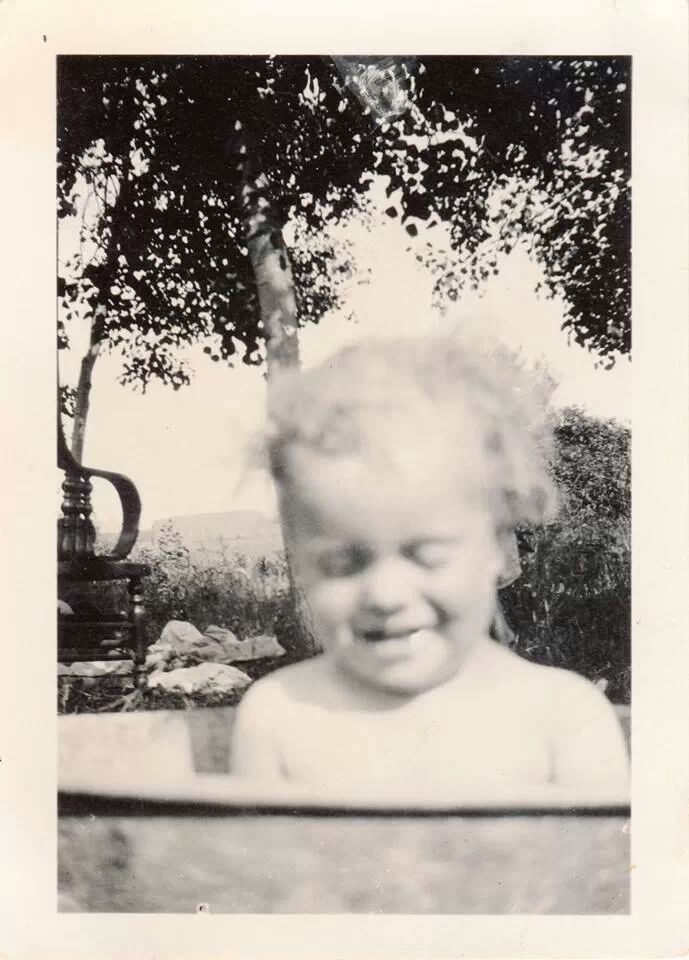
Baby Russell in a tub at 1 year of age in 1919. “Laid on a rock by a crow” was how his Mom teased of his birth in 1918.

Being a family of the Christian faith, it was a wonderfully natural, extra blessing that most of the progeny of Edwin and Marie (Tollefson) Noorlun were born into the world near the small hamlet of Faith, Minnesota.

There, amongst the White Birch forests of the North Star State came the third-born child of this full-blood Norwegian couple. Russell Conrad Noorlun took his first breath of life’s fresh air inside the farm home of his parents on September 1st, 1918. Three more handsome boys and two more gorgeous Norwegian princess sisters came after Russ’ birth. Sadly, two little Noorlun babies were either still-born or died shortly after birth. In all though, God was praised for a total of eight robust, living young legacies which made up this Scandinavian family unit.

Norwegian lady in folk costume. Maybe Mrs. Slette, who helped in Russ’ birth, looked like this lady. 🙂

Family (pronounced: fam-EEL-ya in Norwegian) meant more than just your immediate clan that lived within your own farm house walls. It was the Christian spirit of all your neighboring farmers around you who came together to help out, celebrate seasons of life and expressed deep appreciation when your reciprocal love was shown back to them.

When God’s appointed time came for Marie to need help in this most recent birth, a fine, fellow Norwegian neighbor lady by the last name of Slette (usually pronounced: SLET-tee) was destined to show grace and kindness to assist Marie in the birth of her son, Russell. Ever the family humorist, Russell’s mother, Marie, would later tease little Russ by saying that he wasn’t actually born but was “laid on a rock by a crow”!!!! 😉
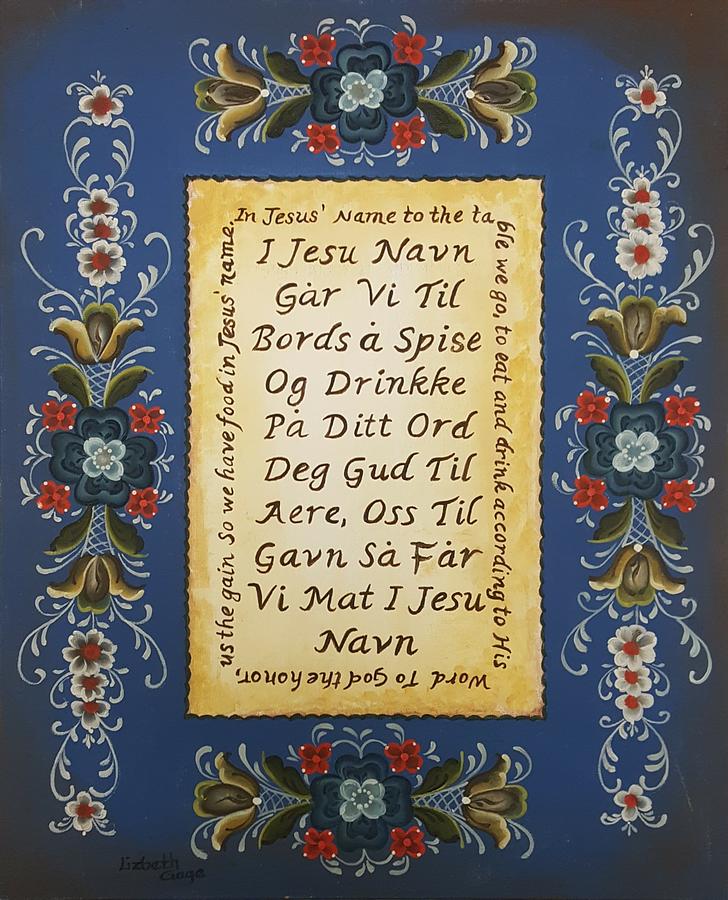
Lovely Norwegian Rosemaling-style painting surrounds this version of a table prayer.

Russell’s father, Edwin, was the first generation of their family from Norway to be born in America. Therefore, it was the normal paradigm of existence for the Norwegian language to still be a vital part of everyday life in this farming household. Many a meal began with the Norwegian table prayer that went like this [wording may be different in some versions depending on the source]: “In Jesus’ name we go to the table”, (Norwegian = I Jesu navn gar vi til bords”,) “To eat and drink in Thy Word”; (Norwegian = A spise og drikke paa dit ord;“) “To God the honor, To us the gain,” (Norwegian = “Deg, Gud til aere, oss till gavn”) “So we receive this food in Jesus’ name” (Norwegian = “Sa far vi mat, I Jesu navn.”).

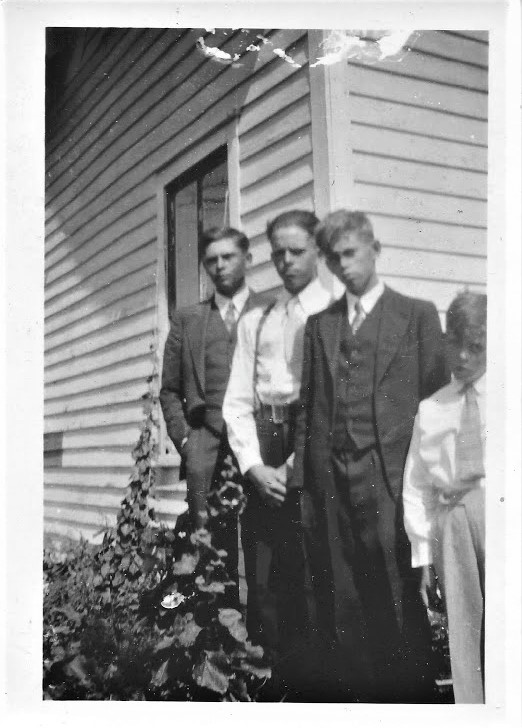
Left to right: Ray, Russell, Doren and Erwin Noorlun.

Regarding their Norwegian heritage, our father, and all of his siblings, were literally bi-lingual in English and Norwegian during their growing up years. Russell could easily be speaking to his father, at the Dining Room table, in Norwegian, then spin on his heels and report in clear English to his mother in the Kitchen how his day in school went.

Since there were so many first generation Norwegians in those surrounding Minnesota counties, it was a given that most of them greatly preferred to hear their native tongue of Norwegian spoken during Sunday morning worship at their local Norwegian Lutheran Church. That may have been all fine and good for the old-timers, but, what happened next laid a burden on the youngsters of Russ’ peers of what was now the second generation of Norwegians there in northern Minnesota.

With the snap of his suspenders over his white Sunday shirt and tie, Russ and his brothers were herded out to the corner of their farm home for a photograph before going to church that day. The Noorlun’s camera didn’t lie as it revealed the evident sad scowls and frowns upon those boy’s faces on that Lord’s Day. It was because they knew, from past experiences, that they would shortly have to suffer and sit through not just one worship service, but TWO worship hours plus Sunday School.

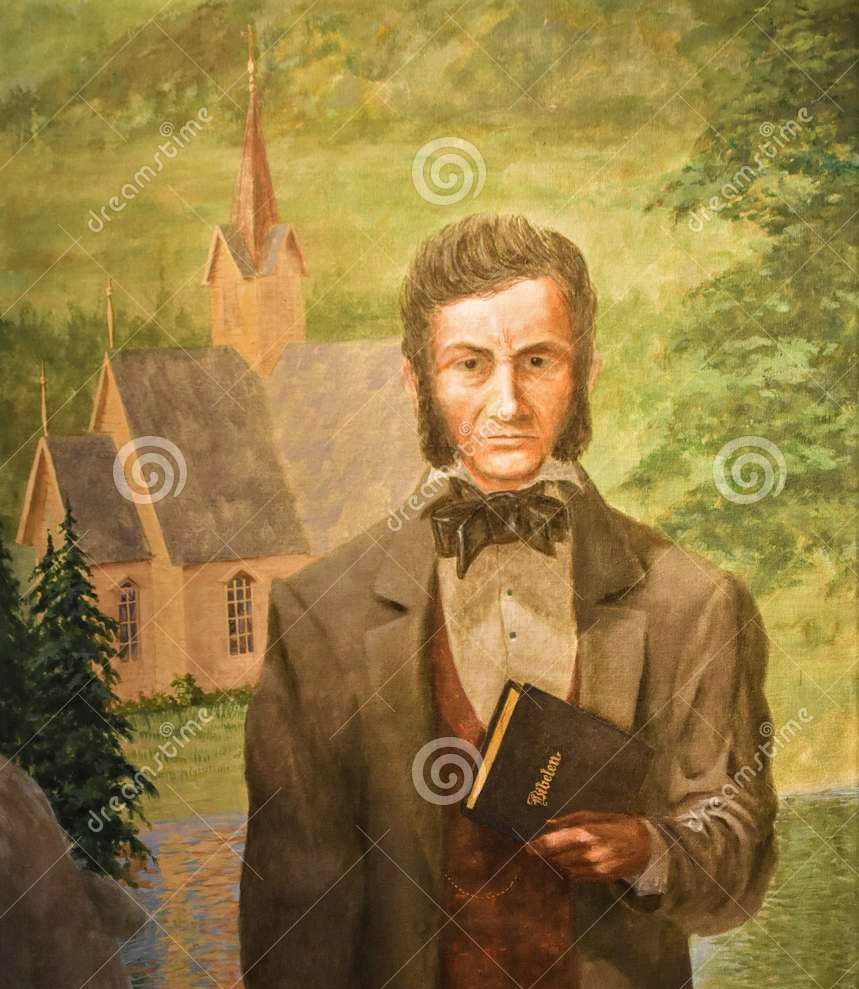
A Norwegian Pastor.

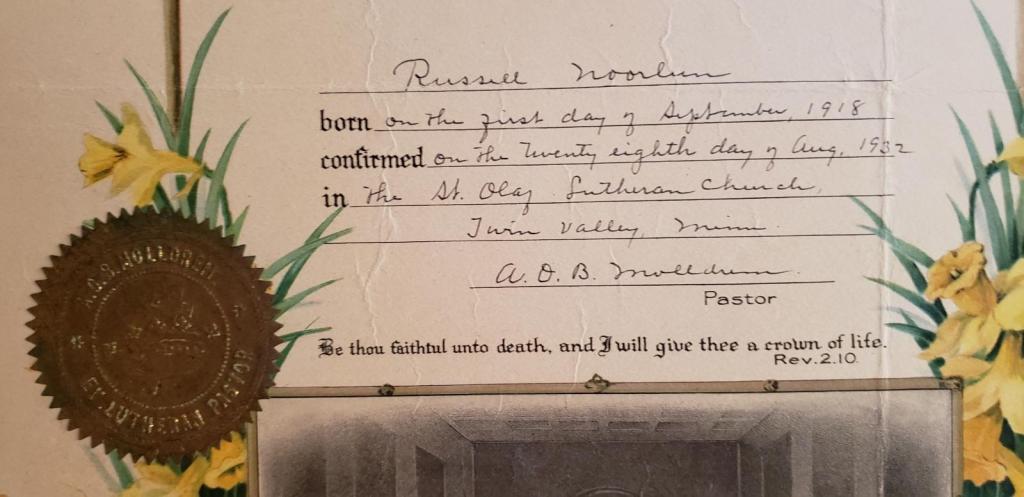
Pastor A. O. B. Molldrem prepared only one sermon for his Norwegian Lutheran congregation each week there in Twin Valley, Minnesota. Yet, the twist was this, for the older Norwegian farmers (who likely came from Norway in their youth), the first sermon was delivered in the ancestral tongue of Norwegian. Upon conclusion of singing the last worship hymn of that service, Pastor Molldrem then began a second worship hour that was now in English for the younger generation that sat before him in those hard, wooden pews.

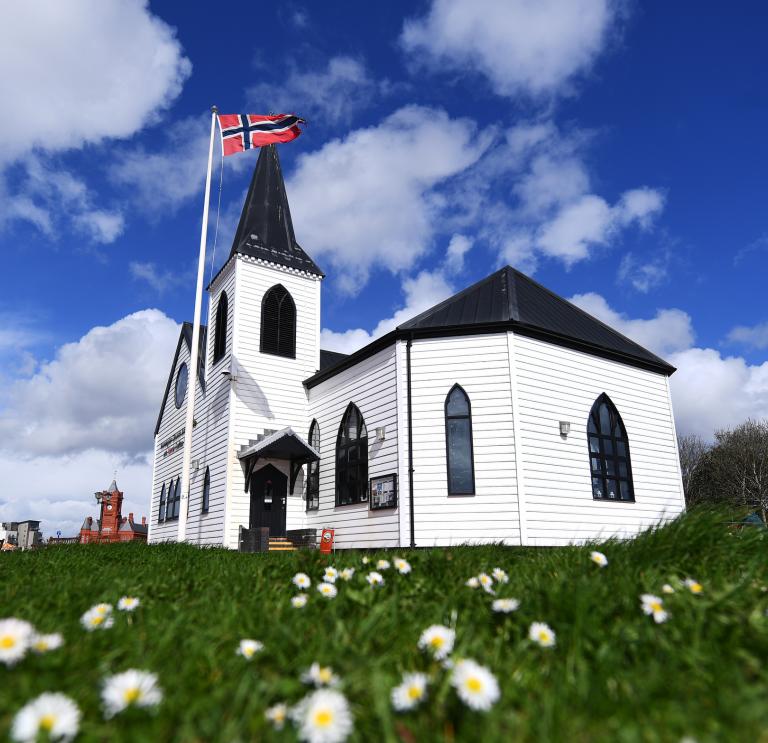
A Norwegian Lutheran church.

Without a doubt, Russ and his entire family loved our Lord Jesus!! And, they knew that it was wonderful for them to fulfill the Scripture in the New Testament book of Hebrews Chapter 10 and verse 25 that says, “Not forsaking the assembling of ourselves together, as the manner of some is; but exhorting one another: and so much the more, as ye see the day approaching”. It’s just that when you’re young and bursting with energy, it was very trying for these young boys to sit still for hours to hear all the “thee’s and thou’s” of the stoic pastor in that elevated pulpit who had the responsibility of sharing God’s Word with them each week.

Eventually, on August 28th of 1932, after all those sourpuss faces in church, and at the age of almost 14 years, Russell had learned enough patience and Biblical training to have the honor of receiving his Certificate of Confirmation from his pastor who was the spiritual leader of the father of this Norwegian Farmer’s Son.

Vol.2..Norwegian Farmer’s Son..July 2nd

July 2nd……….“WAS THERE ANOTHER GENTLE WINTER EVENT, ON YOUR FARM NEAR KIESTER, MINNESOTA, THAT YOU REMEMBER FONDLY AS A YOUNG BOY”?

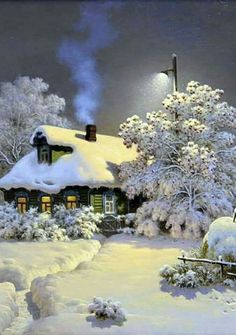
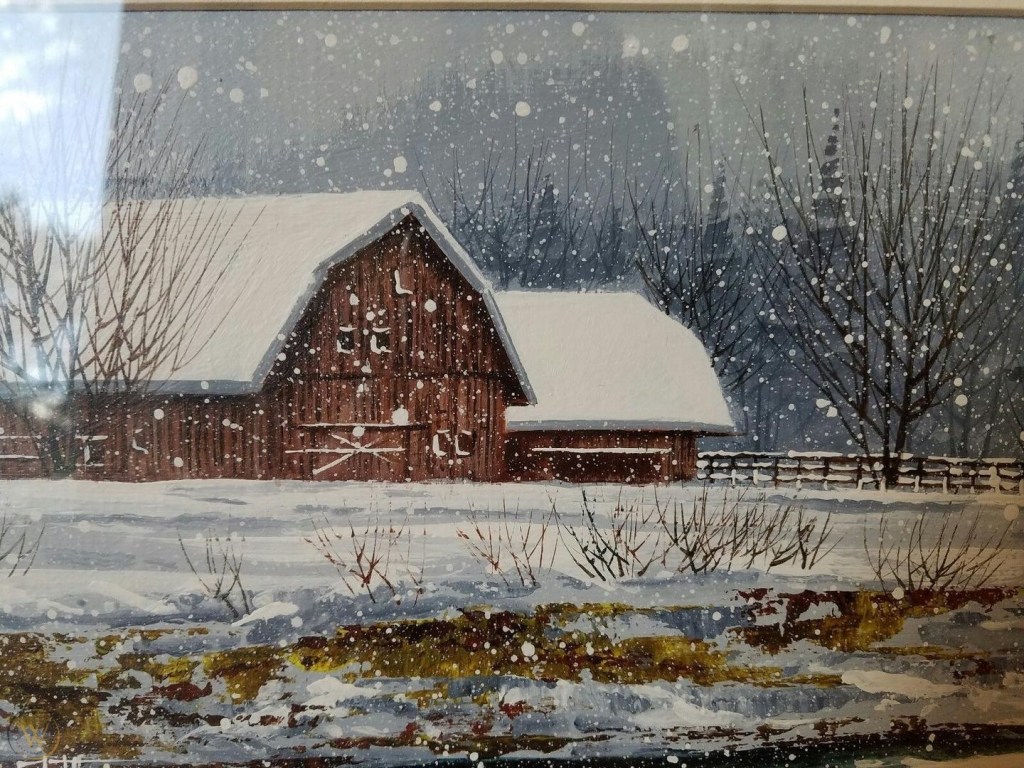
POEM – “A Gentle Winter’s Night” created by N. Elliott Noorlun. When I first penned this on October 17th, 2019, I mused upon how, sometimes, snowfall on our farm at night was so deeply quiet and gentle as it fell out of a black velvet sky and past the golden glow of our single yard lamp at the top of a tall pole. The tungsten filament of that yard lamp turned the immediate snowflakes to a golden amber, adding a rich effect to an already peace-laden moment. 😉

On many a gentle, Winter’s night, Illumined by single, Yard pole light,

I’d venture forth, As a peaceful snow, Would glide to earth, In an amber glow,

From tungsten filament, Causing each flake, To turn to gold, For beauty’s sake.

Quietness reigned, Supreme on our farm, In those cherished moments, Of winter snow’s charm.

Vol.2..Norwegian Farmer’s Son..July 1st

July 1st……….“IN YOUR LITTLE BOY YEARS ON THE FARM, DID YOU SEE YOUR FATHER, RUSSELL, SMOKE? WHAT TYPE OF TOBACCO PRODUCTS DID HE USE? DID YOU DESIRE TO BE LIKE HIM AND SMOKE, TOO”???

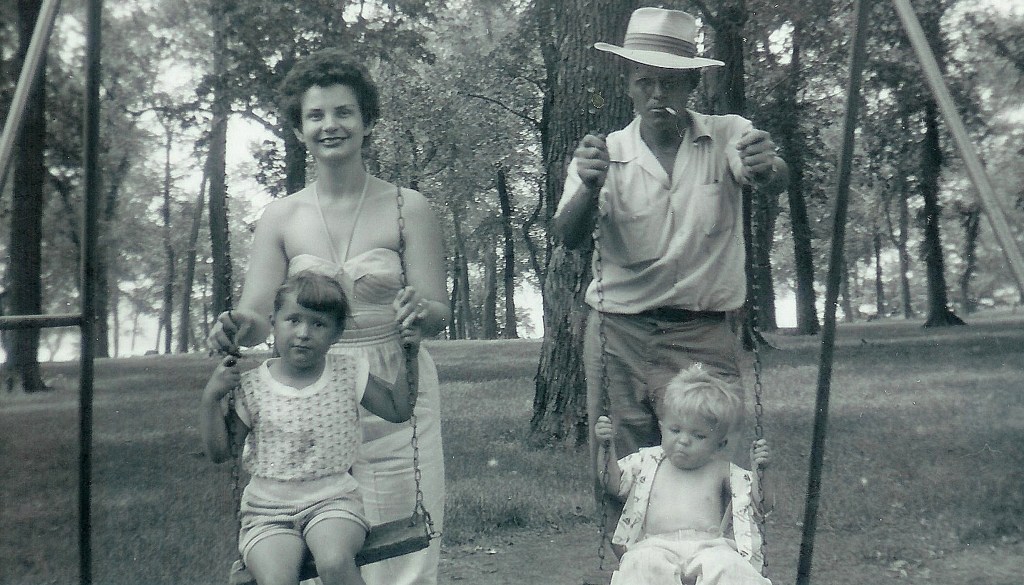
Tiny Elliott, on right, enjoys a swing set push from his cigarette-smoking daddy, Russell. It was a fun family picnic day at Pihl’s Park just northwest of Kiester, Minnesota in the mid to latter 1950’s. 😉

Pihl’s Park provided pulchritudinous possibilities of playtime pleasure for this pug-nosed puny person of a Norwegian Farmer’s Son. We had just pulled into a cool, shady spot in the park’s grounds that day to park our family car. Sitting in the back seat, my pint-sized energy level was percolating like an old coffee pot, so as soon as one of my parents either leaned forward in the front seat, or stepped out of our vehicle’s front seat, my stubby little toddler self pushed forward the vertical, folding front seat backing and I burst from the car door of our 1949 Ford Coupe. My itty bitty legs were pumping like a short-legged puppy dog as I shot across the shaded expanse of lawn. I was making a bee line for the nearest swing set!!! Once Daddy caught up to me at that swing set, out from his shirt pocket came a “Camel’s” cigarette and then out from his pants pocket came a match to strike against his matchbox cover and he lit up one of his favorite tobacco products as he pushed me back and forth on that wunnerful swing!!! 😉
Our sweet, maternal Smith family cousins had caravanned with us to this popular park along the shores of lovely Rice Lake there in Faribault County of south central Minnesota. A dear man by the name of Mr. Joe Pihl had been the creator of this picnic and camper’s paradise, eventually gifting the park to the county and people of our area to enjoy an inviting shady picnic, camping or fishing experience for all.

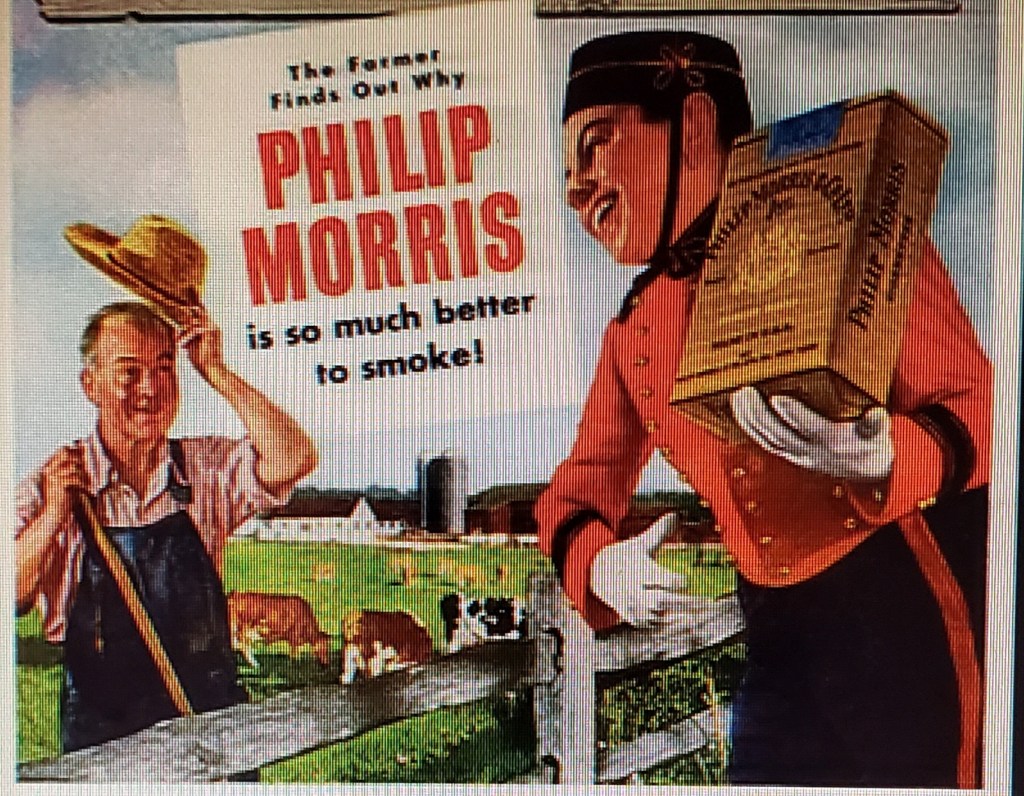
Cigarette advertisements, in the early days, catered to all echelons of the American culture; from cowboys, to fishermen to even farmers like in this promotional scene.

As ubiquitous as bib overalls on all his fellow farmers, our dear daddy, Russell, followed the culture of his “Greatest Generation” and enjoyed tobacco products of numerous varieties over the years of his life. Back then, tobacco usage was considered a completely normal, and even desirous, part of everyday living for countless millions who saw smoking as both fashionable and, for some, even a way to relax when they were stressed.

As far back as my memory goes, it was just part of Dad’s modus operandi to have either a “Camel’s” cigarette, a self-rolled homemade cigarette or a pipe in his mouth.

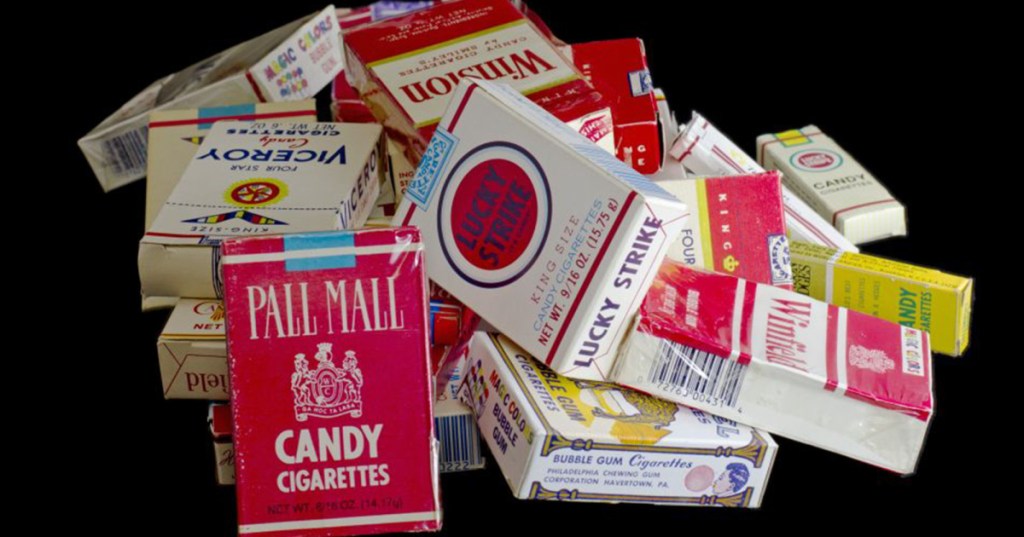
Tasty candy cigarettes and yummy bubble gum cigars allowed kids to emulate their parents who smoked the “real thing”.

Even being knee-high to a grasshopper, like I was in those days, I idolized anything and everything that my hero dad did. Therefore, since I saw my handsome daddy smoking, I figured it was something only cool people do; and of course, I, too, wanted to be cool!!! I could hardly wait for the day when I could emulate and eventually smoke just like Dad did.

So, whenever I’d come across tobacco-related candies, in the stores within our hometown of Kiester, I just had to have my very own pack of candy cigarettes or bubble gum cigars. Most candy companies made the ‘cigarette’ out of a white sugar concoction that was coated in powder and then wrapped in a white paper. As I’d put the candy ‘cigarette’ to my lips, I’d actually give a little blow of air which made ‘smoke’ appear at the tip of my ‘cigarette’ from that sugar powder coating at the factory. My ‘buzz’ wasn’t from tobacco, but from the mental excitement of looking just like my daddy. Eventually, I’d just peel off the paper wrapper and munch n crunch my candy stick till it was all gone.

Elliott watched his father ‘roll his own’ on many an occasion.

Even though a pack of cigarettes, in the late 1950’s, was barely $.25 cents, our daddy tried to save money by ‘rolling his own’. He’d buy a small package of wrapping papers and then get himself a flat, metal can of “Prince Albert” tobacco to carry in a pocket of his bib overalls. A small amount of tobacco was sprinkled onto the ‘onion skin’ thin paper and rolled into the form of a white ‘stick’, so to speak. To keep the tobacco inside the ‘stick’, Dad would lick the paper all along its edge and then ‘seal’ the paper along the long seam of the ‘stick’. Oftentimes, he’d also wet the ends of his now cigarette and twist them closed to hold the tobacco inside. Out would come his match or lighter to ignite the end of his homemade creation and he’d begin his smoking.

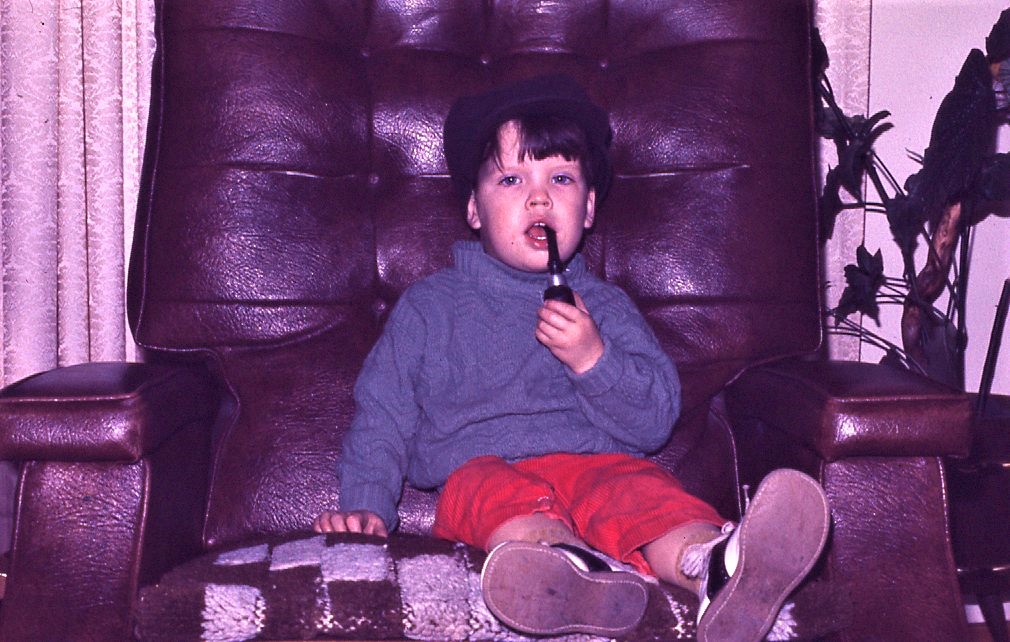
A Grandson imitates his Grandpa Russell’s pipe smoking style, even wearing Grandpa’s cap.

‘Monkey see, monkey do‘ was not only my mantra of following Dad’s smoking example, but, even when the grandkids came along, they, too, began to want to be like their Grandpa Russ and would want to pretend to smoke with his actual pipe. Since Dad didn’t want them to taste the nastiness of real tobacco, he’d buy them a tiny, clean pipe of their own to be their toy to pretend to be like their grandpa.

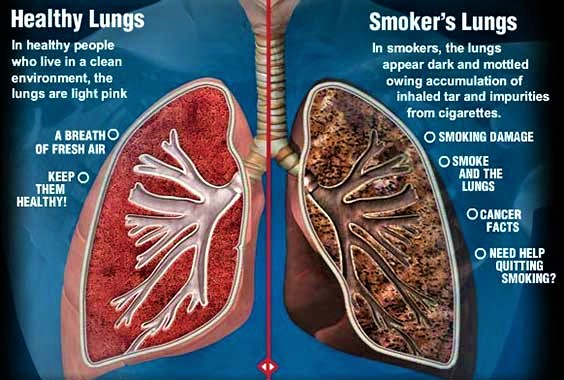
In my young, robust days, the only time that I ever coughed was when I had a bad case of the cold or a flu. One fine morning, there on our farm, when I was about maybe 9 years old, I came bounding down the squeaky wooden stairs from our bedrooms to find Dad at our family kitchen table waiting for some of Mom’s delicious breakfast cooking. Poor Dad, he was coughing something fierce!! I could tell that his lungs were heavily congested and his coughing, mixed with thick phlegm, actually caused him to gag and choke on whatever was troubling his lungs that day. I asked him (based on my having colds), “Geeee, Dad, do you have a cold today”??? When our father finally re-gained his composure and air enough to speak again, he said, “No, Son, this is what smoking does to you!!! Please, don’t ever smoke”!!!! Now, in an instant, the playtime nature of emulating my dad went right out the window of reality!!!

I had grown up alongside our father, through the years, and recalled times how he nonchalantly held his cigarette between his two fingers as he steered our old pickup truck down the local roads. Or, how he’d converse with fellow farmers with his cigarette dangling at the corner of his mouth, bouncing (as if in a dance) with every word from his lips.

Even with Dad’s warning, there was still an air of fashionable desire to still want to at least try to smoke someday.

“You suck this INTO your LUNGS”???

Reality finally grabbed me by the butt one day when, as a teenager, I was riding in a pickup truck with some neighbor buddies of mine. I was 15 years old in 1969 and the elder brother of my good friend had just come back from serving with the U.S. Army during the war in Vietnam. As the elder brother drove us along our town’s country roads, he leaned over and offered both of us ‘kids’ a cigarette. Here was my moment of truth. I lit my cigarette and started sucking the smoke into my mouth (only) and pushing it back out into the cab of the truck as we rolled along. “Jim” leaned over, from the driver’s seat, and chided me severely, “HEY KID, you’re not smoking”!!! “Sure I am!!!“, as I defended myself. “The hell you are!!! The smoke comes out whiter when you suck it into your lungs”!!! I was absolutely incredulous as I earnestly responded in a question, “You suck this smoke INTO your LUNGS”???? “Hell yeah, kid!!!” came his derogatory exclamation!! Immediately, I retorted, “In THAT case, NO THANKS!!!” as I squashed dead the hot end of the cigarette in the truck’s ashtray. The first and LAST cigarette for this Norwegian Farmer’s Son!!!

Vol.2..Norwegian Farmer’s Son..June 30th

June 30th………“WERE THERE PEACEFUL TIMES DURING THE WINTER ON YOUR FARM IN SOUTH CENTRAL MINNESOTA? WHAT IMPRESSED YOU DURING THOSE QUIET MOMENTS”?

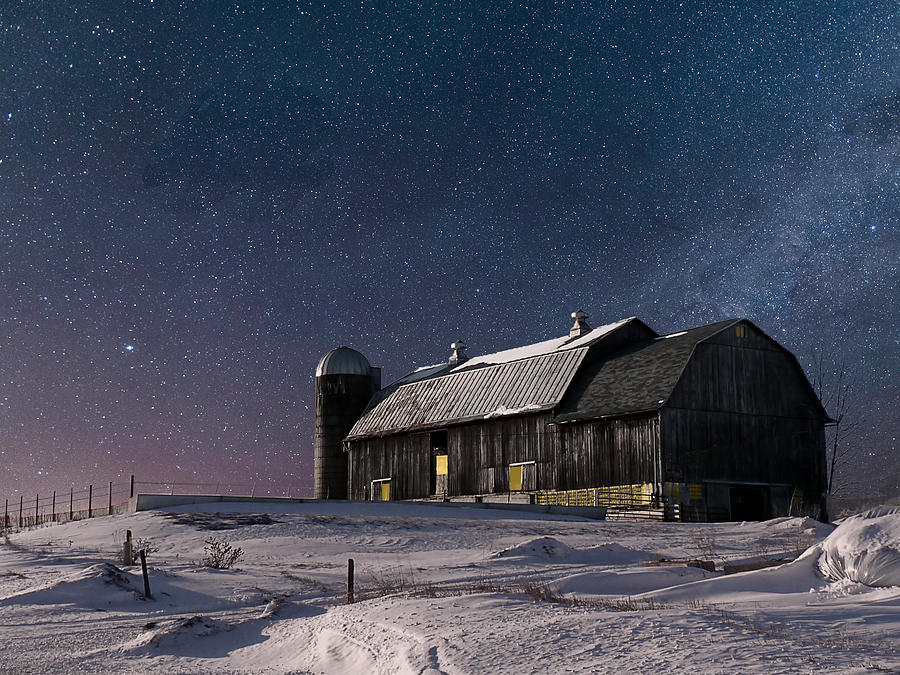
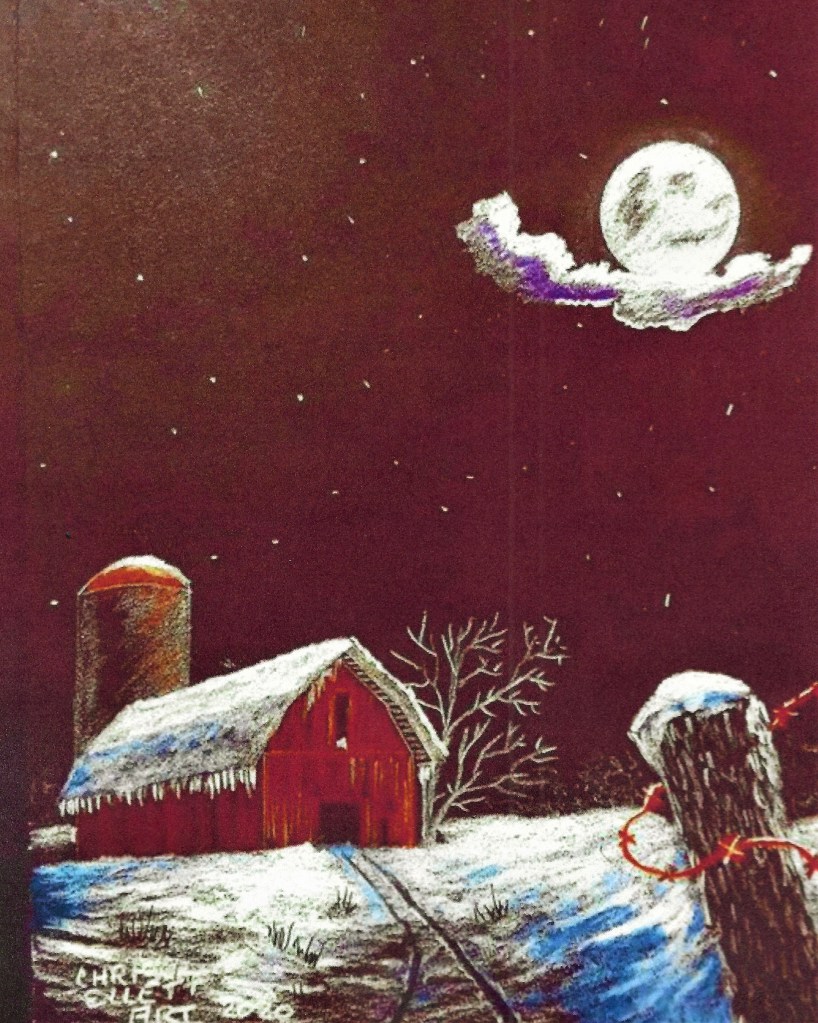
POEM – “Star Smiles” created by N. Elliott Noorlun. I came across some lovely paintings of winter nighttime scenes on a farm. I mused upon the many exquisitely quiet wintertime moments I enjoyed as a boy while gazing for long periods of time at the vast diamond skies above me.

I could’ve sworn, My little boy eyes,

Could see that frozen star smile.

I knew, for a fact, That they all did wink,

As I gazed at their quiet for awhile.

With snow all around, And nary a sound,

As I stood in the frozen bliss,

While above our farm, In ethereal wonder,

Each star sent me down a kiss.

Our barn in the distance, Beckoned me,

To the warmth of bovine charm.

Yet, I gazed a bit more, To the night starshore,

Of a Winter’s beauty, There on our farm.

Vol.2..Norwegian Farmer’s Son..June 29th

June 29th………..“WHAT WAS A DANGEROUS TASK THAT YOUR FARMER FATHER CARRIED OUT TO MAKE HIS TEAM OF HOGS OVERALL STRONGER AND THEIR MEAT BETTER”?

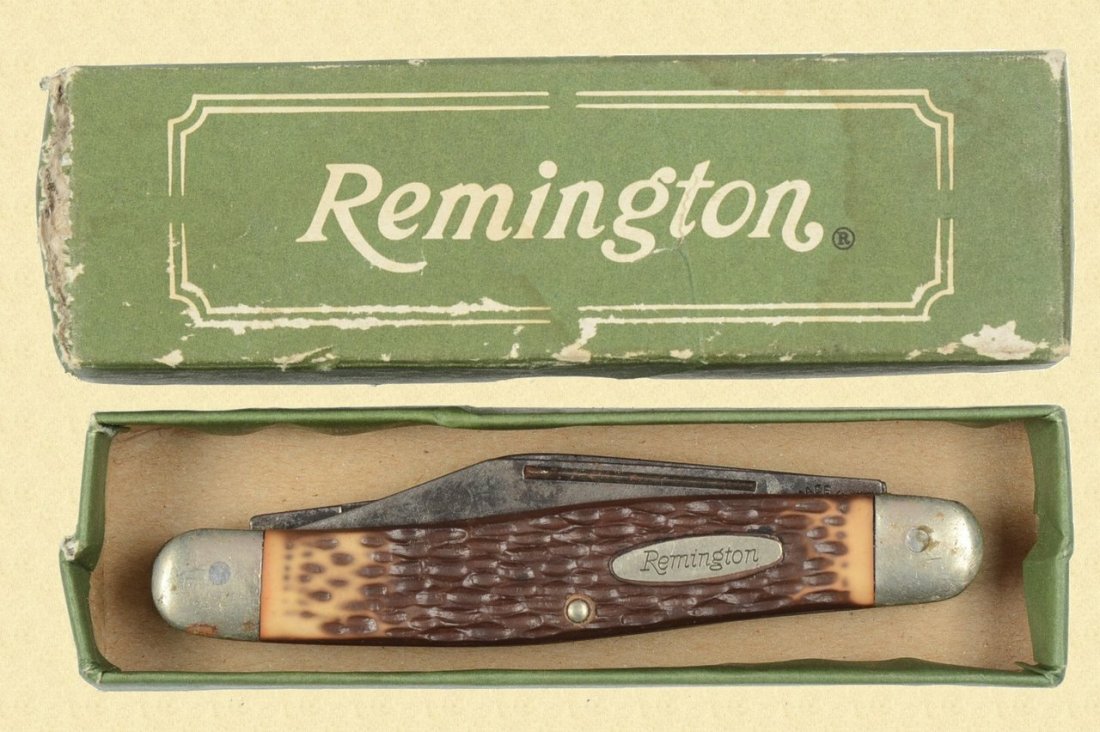
Spit, swirl, swirl, swirl, check the cutting edge……..spit, swirl, swirl, swirl, check the cutting edge and repeat. As I trotted into our family Kitchen, one fine morning there on our farm, that’s the sounds I heard from our farmer father, Russell, as he sat there at his kingly spot next to our family’s dinner table. Dad was spitting on the whetstone and intently focused on sharpening his pocket knife to a near scalpel’s edge with every angled stroke upon his well-worn, old-fashioned sharpening device. So worn was his whetstone that it resembled a sway-back horse with it’s very own ‘valley’ where our patriarch’s knife blade had traveled thousands of times through the years.

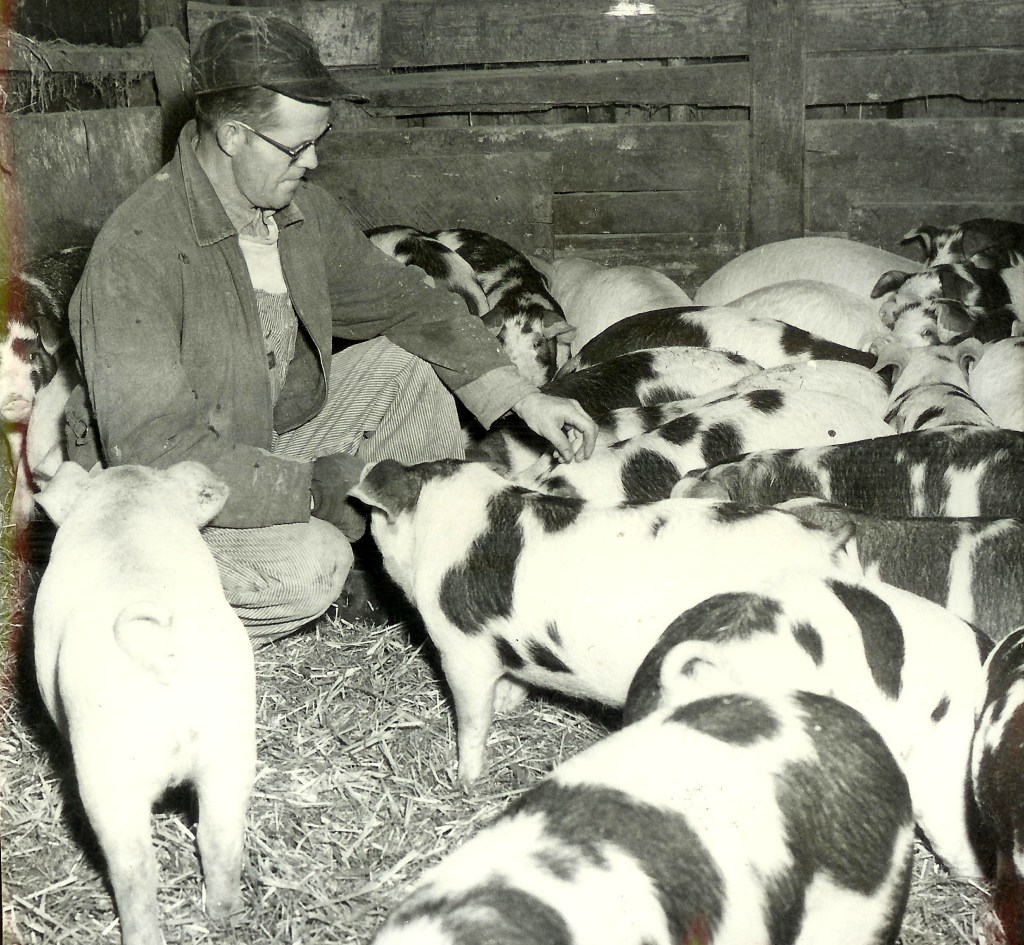
Elliott’s father, Russell, with some of their pigs on their farm near Kiester, Minnesota. Circa 1963.

“Whooeeee, Dad, just how sharp IS that knife of yours”?? to which he answered, “I’ll show ya, Son”! And with that, Dad spit on the hair of his forearm (for a bit of lubrication) and shaved the hair clean off of his arm lickety split!!!

“Wowsa!!!, Are ya gonna do surgery”? said I. “In a way, yes”!, said Dad... “And you’re gonna help me”!!

As the back porch door slapped shut behind us, our father took aim and was walking us towards the Hog House at the southeast corner of the yard. Pa informed me, as we walked, that today was his day to castrate all the young males of the recent litters of piglets that had been born there in our family’s little ‘hog heaven’. “What is castration, Dad? and why do we do it to the boy piglets when they’re young like this”? “For a couple reasons, at least, Son”…said Dad. “For one thing, as a farmer, I want the very best team of hogs that I can breed. That, in turn, will give me the best dollars for them when I take them to market. Also, I already have my one and only strongest male boar pig for breeding. Hopefully, as he does his job, strong baby pigs will be born to the sows. Therefore, I just don’t need a bunch of other males around the farm. Castration, Son, is the process of removing a couple parts from these young male pigs that will keep them from make baby piggies with the females as they grow into adults. Another reason we castrate is that, if all male pigs WERE allowed to stay male, their bodies would produce hormones that will taint their meat (makes the meat stink when it’s cooked after butchering and is actually called “boar taint”). And, yet another reason, Elliott, is that it’s better to do this procedure when the piglets are still small enough to handle and for the trauma of this experience to not be quite so hard on them as it would be when they’re older.”

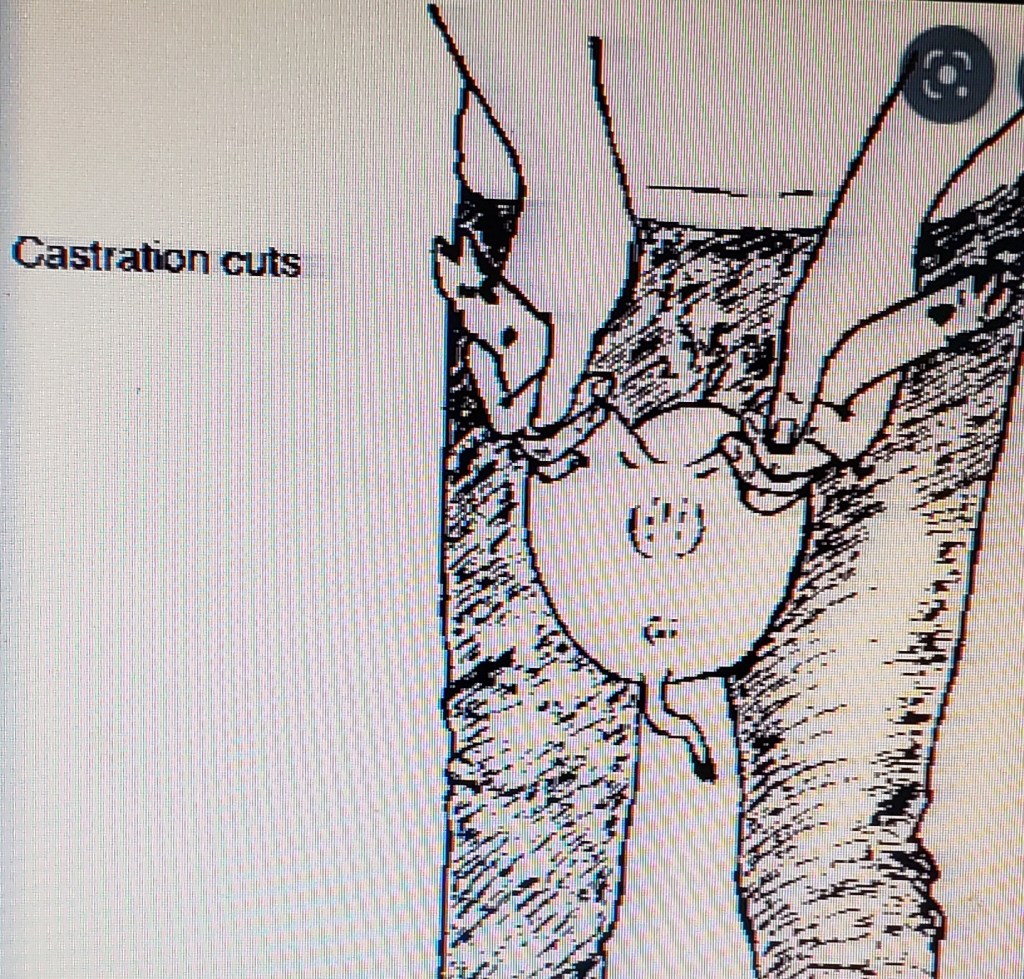
The two dotted lines, in this drawing, shows where Elliott’s dad made the cuts to make this upside down piglet boy NOT a boy. 😉

With that animal husbandry knowledge now imparted into my young boy brain, it was time to get this adventure underway.

My little boy job in this piggy process was to standby, there in our Hog House, and hold a squirt bottle of disinfecting iodine while Dad reached out and caught the first little male piglet. With decibel levels above a first soprano, that little oinker was squealing to high heaven for getting caught by our father. The next thing that little porcine prince knew was that he had been flipped upside down between our muscular daddy’s legs and he was looking up at that cobweb covered ceiling above us still squealing in protest. Out came Dad’s super sharp pocket knife with the blade out and ready for ‘surgery’. For me to put it in as gentle terms as possible, Dad found and squeezed the two little orbs that designated that animal to be a boy and made two quick incisions with his blade. When the ‘objects’ came out from those incisions, our father made a second quick slice to sever them away from the piglet’s body. My job, that day, was to now squirt a sufficient coating of iodine on the two little wounds to help kill any latent germs in the area and help with healing. In a quick re-flip and release, the little pink porcine went squealing back over towards his other family members and the healing slowly began. One less boy in what’s known in farm language as a “sounder” (or group) of pigs.

The real danger in this operation stemmed from the fact that, even though these young pigs were still relatively small, they could really kick hard in their excitement of being handled and upside down in Dad’s lap. On more than one occasion, a male piglet got a lucky kick in against our Pop that caused that ultra-sharp knife to cut our dear daddy instead of the piglet. Poor father, now it was HIS blood that was gushing from a deep gash into his hand from his own knife!! 😦 But, our father was one tenacious man who didn’t give up and call it quits. He just doused himself with iodine, grimaced with the pain and continued the castration process till the job was done. What a tough and determined man was our poppa and it made me proud to be a Norwegian Farmer’s Son!!!

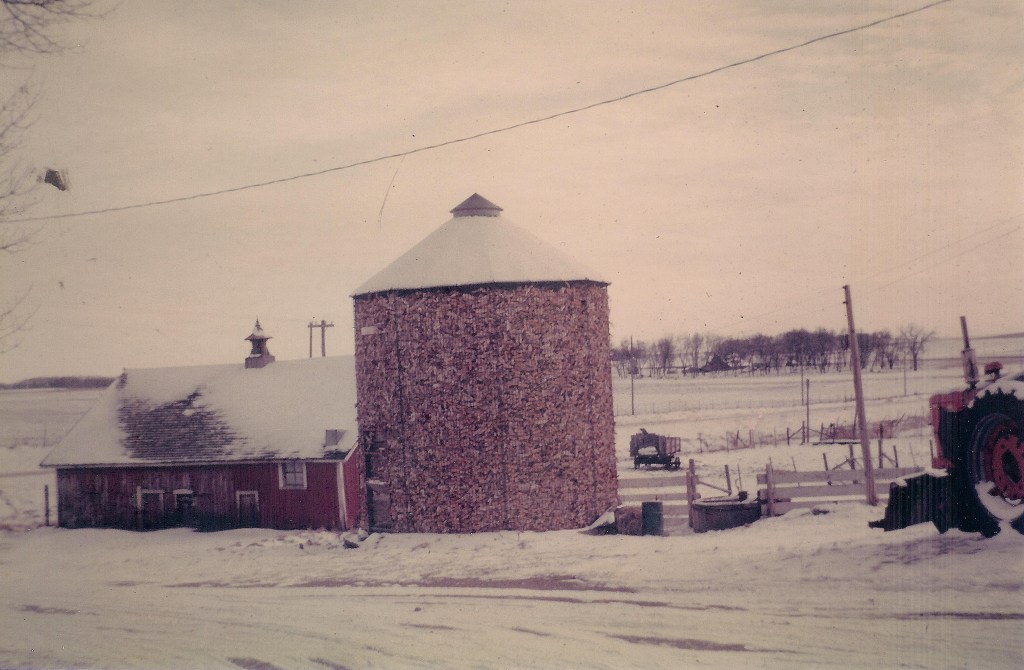
The Noorlun’s Hog House is the red building to the left in this 1965 photograph. View is to the southeast.

Vol.2..Norwegian Farmer’s Son..June 28th

June 28th……….“WHEN YOU WERE IN HIGH SCHOOL, DID YOU BUY A CLASS RING? WHAT WAS IT LIKE? DID YOU EVER GIVE IT TO YOUR GIRLFRIEND TO WEAR”???

POEM – “My High School Ring” created by N. Elliott Noorlun.

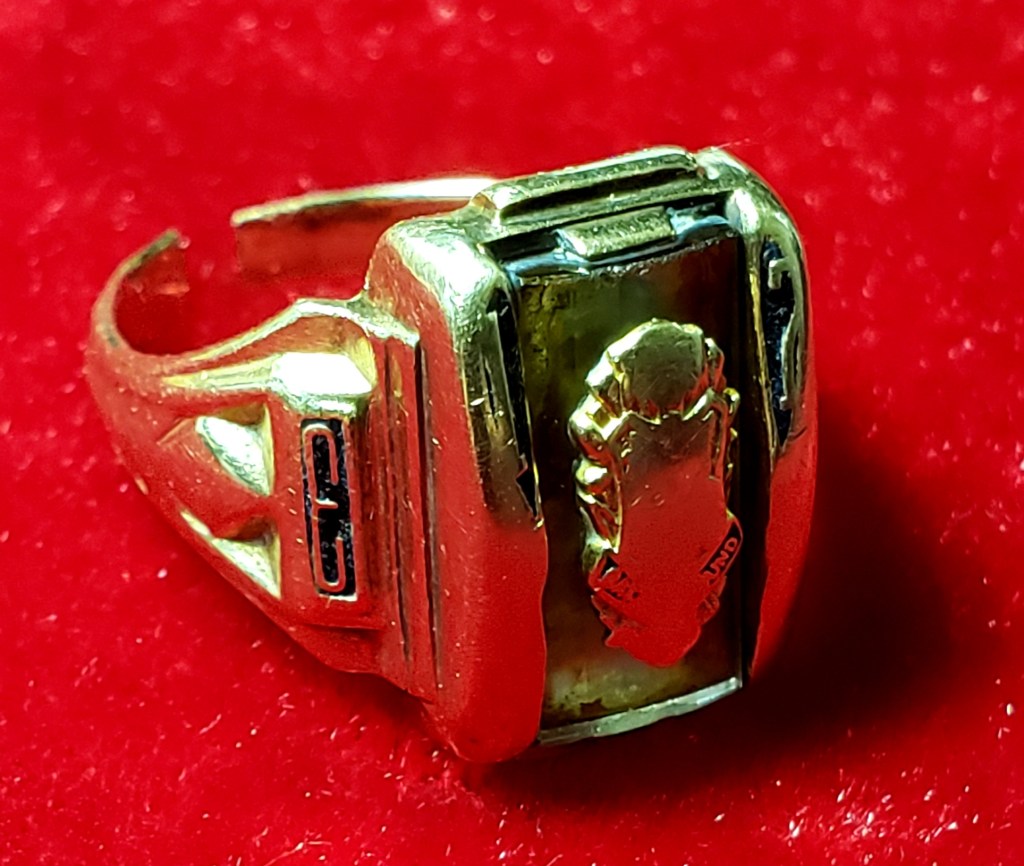
An “E” for Elliott can be seen on the side of his very worn 1972 class ring from Battle Ground High School in Battle Ground, Washington.

Today I found, My High School ring, Among a box of treasure.

And memories, Came flooding back, In abundance without measure.

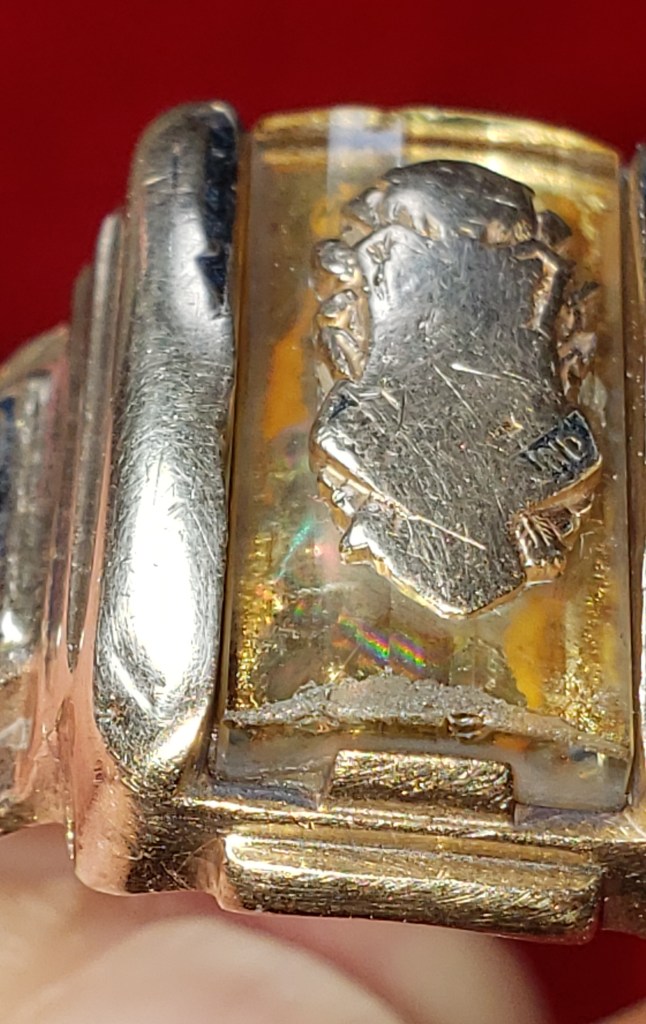
Look closely at the bottom center of the ring’s stone and a faint rainbow effect can still be seen.

The Rainbow Stone would sparkle, Especially ‘neath spot light,

Spectrum colors would intensely dazzle, Within my pleasured sight.

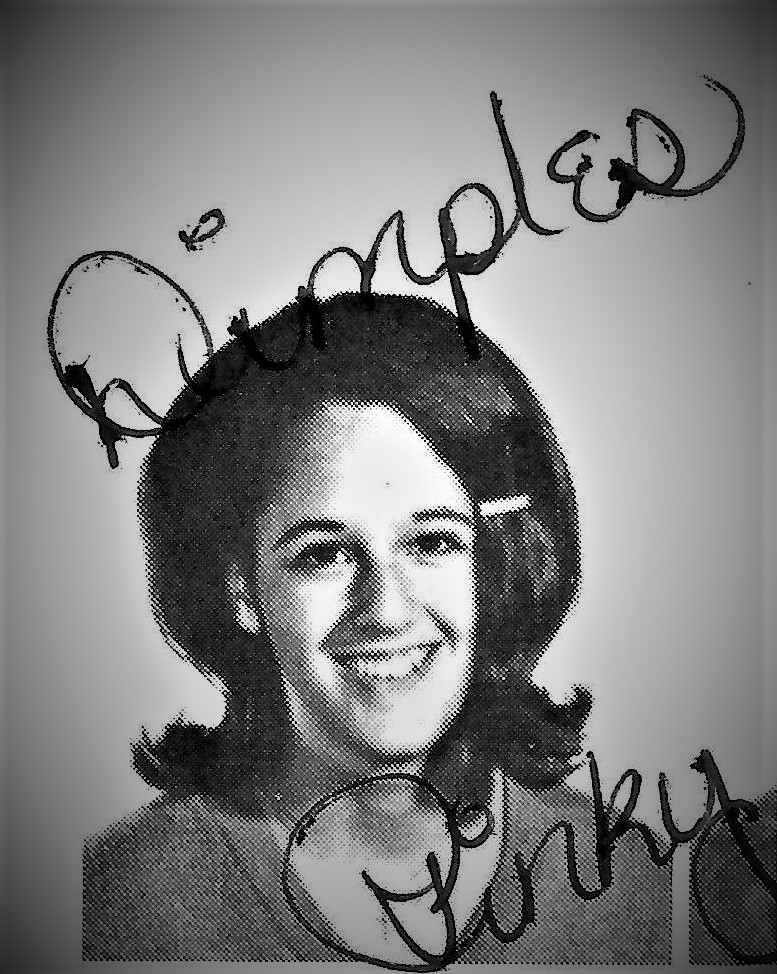
Elliott’s High School Girlfriend, Derra Abernathy, would wrap yellow yarn around the ring to make it to fit her smaller finger. “Dimples” was Derra’s nickname for Elliott in those days. 😉

My High School Sweetheart, Would wrap it round, With yarn to fit her finger,

Then show, with pride, To her girls alongside, Why by my side she’d linger.

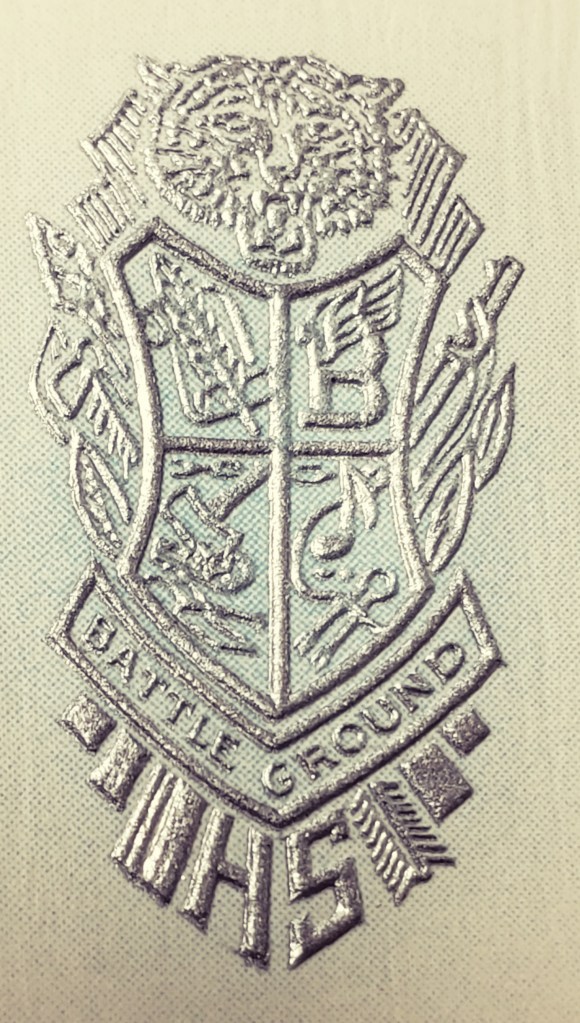
This is the Battle Ground High School emblem that USED to be visible on the face of Elliott’s High School class ring.

I’d worn it for years, Till it was tired, And faded from past glory.

But it still has power, To bring to flower, The past and it’s sweet story!!! 😉