Vol.2..Norwegian Farmer’s Son..April 9th

April 9th……..”GRANDPA, HOW DID OUR GREAT GRANDMA CLARICE FIX CLOTHING ON YOUR FARM IN YOUR YOUNG DAYS IN MINNESOTA”?

Like a rocket out of a big yellow bazooka, my little boy body took a leap of joy off of Marie Meyer’s school bus that afternoon. I loved our bus driver Marie, don’t get me wrong, it was just me exuding my exuberant thrill of having finished, unscathed, another rigorous day in the halls of my Grade School education. Now, my farm boy freedom was about to erupt in abundance!!! Even the sad cooing of Mourning Doves in my ears, that I heard up in our windbreak of trees, couldn’t suppress the boundless boy joy I felt as I raced along our north gravel driveway. The pixie transit of my happy feet took me around the back corner of our farm house while leaving a cloud of delight dust behind me.
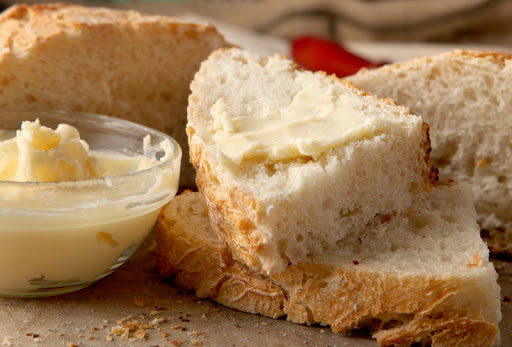
As I reigned in my ‘shank’s horses’ (legs) from my running, I reached out to grab the handle of our back porch screen door. The late spring breezes, wafting through our kitchen windows towards me, carried with them a vaporized elixir upon the air of the fresh-baked perfume of Mom’s homemade bread, just out of the oven. Yuuuhhmmeee!!! 😉 It’s no wonder that I felt so secure, in those young years, when my world encompassed such delectable wonders to my senses and taste. With real, sweet cream butter melting into the still warm bread, I took a happy mouthful and sauntered into our cozy, family Living Room.
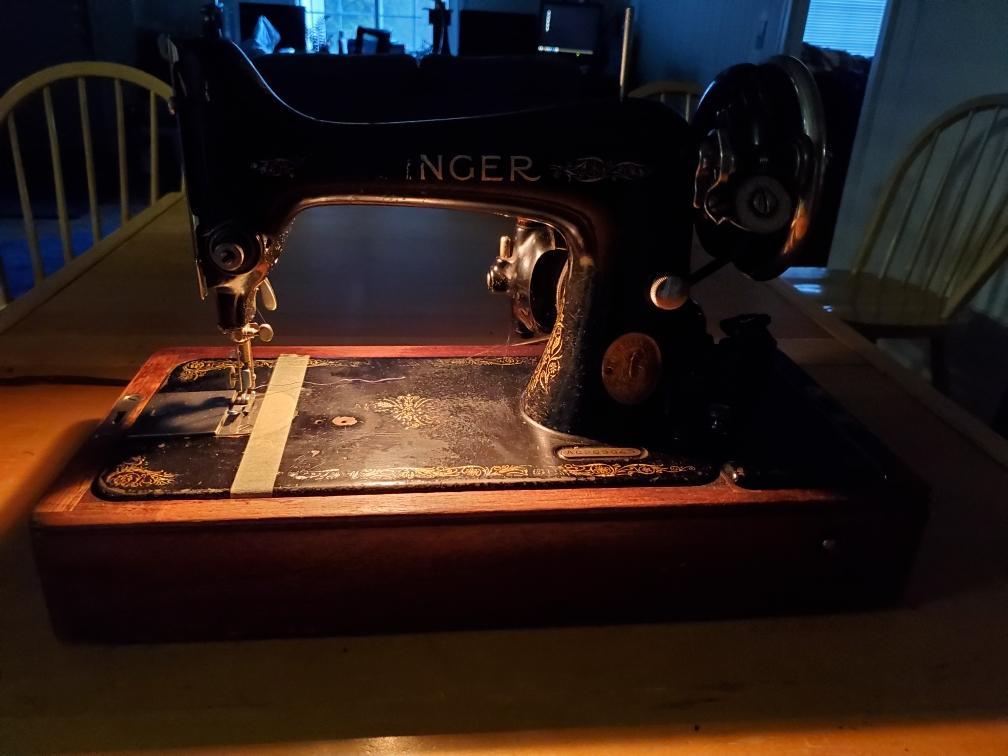
This is a recent photograph of the actual 1928 “Singer” sewing machine that belonged to Elliott’s mother. The amber glow of the sewing lamp lends an aura of peacefulness. Other than a little tender-loving-care, it still works fine after nearly 100 years.

A familiar and soothingly repetitive “slickety-click, slickety-click” emanated from below the amber lamp of Mom’s electric 1928, Model 99 “Singer” Sewing Machine. There sat our Norwegian ‘Queen’ of our family as she diligently worked on repairing one of our daddy’s bib overalls with her sewing prowess. Our dear parents, having endured the hardships of The Great Depression of the 1930’s, were part of a generation that, unlike today, followed the saying, “Use it up, Wear it out, Make it do, Or do without”. When the hard rigors of our farmer father’s work created a tear or a worn out spot in his heavy-duty bib overalls, those bibs were repaired by Mom and put back into service for our dear dad. There was to be no silliness of “Well, we’ll just throw these away and buy new ones”! No sir, by golly gee!!! Besides, any farmer could tell you, dollars were always in short supply, so our folks made do with what they had and made things last as long as possible. Even then, if Dad’s overalls were ‘too far gone’, Mom, in her grand diligence, would salvage as much fabric material, buttons, clasps, etc. to help repair any of our other clothing needs in the future. Mom, many times over the years, had said, “If I wasn’t already Norwegian, I’d be Scotch”!!! (meaning she really liked to pinch a penny and save when she could).
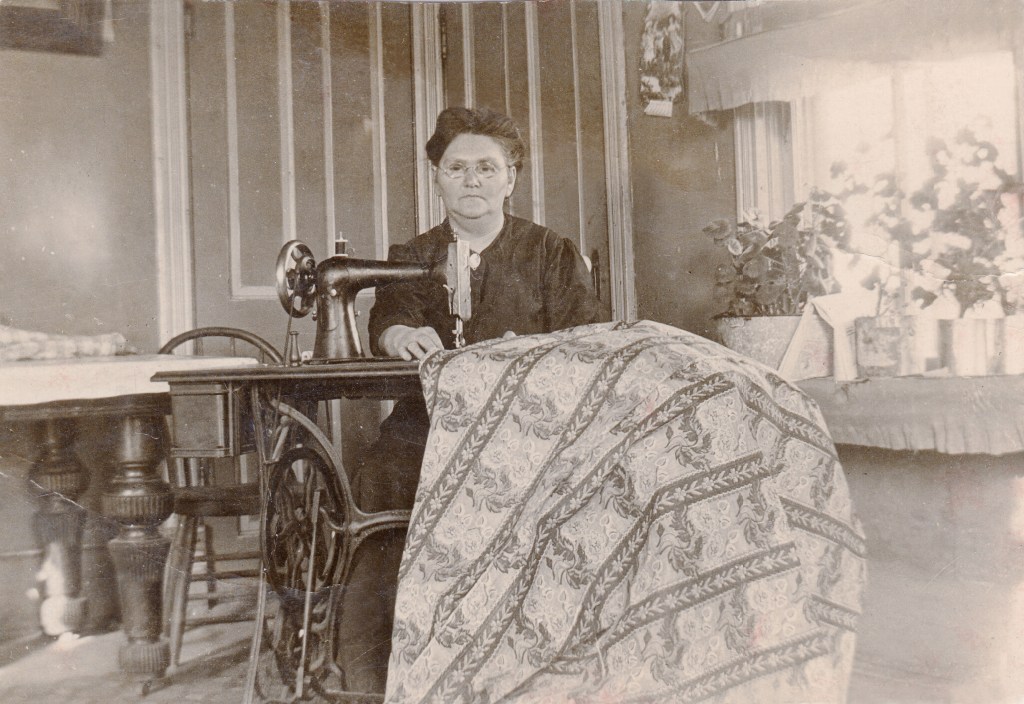
Elliott’s maternal Great Grandma Martha Larson Sletten who taught so much to young Clarice about sewing and quilting.

Our sweet mother, Clarice, absolutely adored her mother, Amanda! Sadly, though, our Grandmother Amanda Rogness Sletten had contracted tuberculosis, during Clarice’s young teen years, and was quarantined in an Iowa Sanitarium for over two years while she slowly recovered. During those sad years without her mother, our sewing sweetie, Clarice, spent long hours under the loving tutelage of her paternal Grandmother Martha Larson Sletten. A kindly and patient teacher was Grandma Martha to her tender-spirited granddaughter, Clarice. Our young Norwegian ‘princess’ was a very grateful and quick learner when it came to Martha teaching her the A to Z’s of sewing. Not only sewing knowledge was bequeathed to our mother, but, via Martha’s grand stitching knowledge, there also came a life-long love of quilting, too.
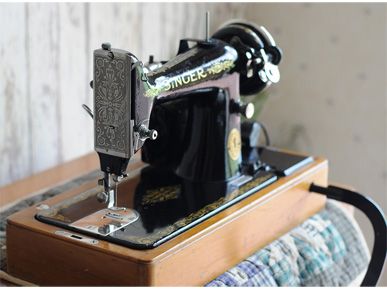
Notice the “knee lever” on the right. The more sideways knee pressure, the faster the “Singer” would operate.

There, in the pleasant parlor of our farm home that day, I watched in fascination as our beloved mother deftly handled fabric as she fed it across the “throat plate” and then under the “presser foot” of the “Singer”. The almost imperceptible vertical flashings of the needle were a blur as she, in this case, did some sewing on a part of her recent quilt she was working on. What I thought to be pure magic, was how she made her electric sewing machine come ‘alive’ by not one, but three different methods. There was the “knee lever” that could actuate sewing by pushing her knee gently to the side; the farther she’d push the lever, the faster the “Singer” would perform. Then there was her choice of using the “graduated gear foot switch” to make her “Singer” work slowly or fast, depending on the downward pressure of Mom’s foot. And then, last, but not least, was the “Singer” “balance wheel” on the right end of the machine. Mother could, when needing utmost accuracy, take hold of the “balance wheel” and gently turn the wheel to move the needle carefully and slowly through the fabric of her latest project.

Elliott’s parents, Russell and Clarice Noorlun.

Like a real to life “Dynamic Duo”, was our mother and her 1928 “Singer” Sewing Machine. Together, they did innumerable clothing repairs for our family, created dresses and with impressive skill, beautifully sewed pieces together for her much loved quilts over the years. And, I’m happy to share that her faithful “Singer” is still alive and well at this writing in the year 2024. The “Singer” is reverenced and cared for by Mom’s first-born granddaughter, Debbie Ehrich Lehner in Battle Ground, Washington.

I have a pleasant feeling in my heart that our good Lord, upon Mom’s arrival into the portals of Heaven, likely shared with her that a number of the jewels in her crown had to do with the giving love of a mother’s heart by seeing that the family He had given her were well taken care of, including the clothing of this grateful Norwegian Farmer’s Son!!! 😉


Vol.2..Norwegian Farmer’s Son..April 8th

April 8th……..“WHEN LIFE HAS HANDED YOU LEMONS, WERE YOU ABLE TO MAKE A FUN LEMONADE”?

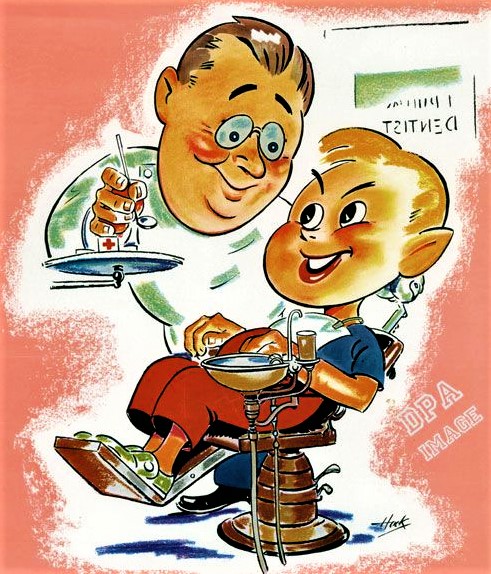
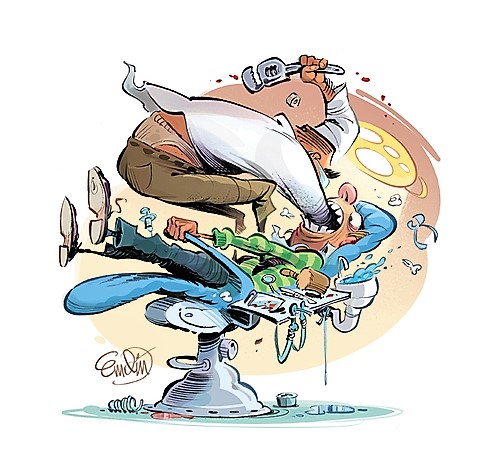
The answer to that question is a smiling, Yes! 😉 To my embarrassment, I have not been a very disciplined person in regards to my dental health over the years. There came a time when my good friend and dentist, back in Battle Ground, Washington, said that I had to have an upper tooth pulled. He wisely cautioned me that, sometimes, depending on the depth of the tooth’s root, there may result in an actual hole up into my sinus cavity called a “fistula”. And, whaddaya know……..that’s exactly what happened! So, rather than cry about my air hole into the head, I decided to have some fun and created a song about it. Using a fun, opera-sounding tune called, “Funiculi, Funicula”, I created some fun. I hope you get a giggle from singing along to my own lyrics to the song I call……..

SONG – “My Flappy Fistula” lyrics by N. Elliott Noorlun

VERSE: I went to see my dentist on a Monday, To clean my tooth, To clean my tooth.

He said, that due to rotting, yuk and decay, It was uncouth, It was uncouth.

His plan, was fix it up upon a Wednesday, It had gone bad, He told this lad.

“But now, we’d better yank it”!, I heard him say, I said, “O.K.”!, He yanked away.

CHORUS: Heave and ho!!! The long tooth popped right out, Now there’s a hole, Clear up into my snout.

He said, “It’s called a Fistula”, The size of a fist, The Fistulaaaaaaaah!!

Now the air blows through my smile, All the way up my Fistula!

VERSE: Before, I had this porcelain pull procedure, My speech was fine, Like flowing wine.

But now, my “P’s” and “F’s” inflate my tooth hole, So now I whine, Just like a swine!

I used to spit and make all kinds of mouth sounds, My friends would snort, From my retort.

But now, just trying to speak sounds like a Bloodhound, Blubbering drool, Just like a fool!!

REPEAT CHORUS AND END WITH A FLUORIDE FLOURISH !!! 😉
Vol.2..Norwegian Farmer’s Son..April 7th

April 7th……“WHERE DID YOUR FARM GET ITS WATER? FROM YOUR NEARBY TOWN? OR A WELL”?

See the south driveway on Elliott’s farm? By those two tall trees? The family’s first little ‘Well House’ was located next to the large wooden corn crib building.

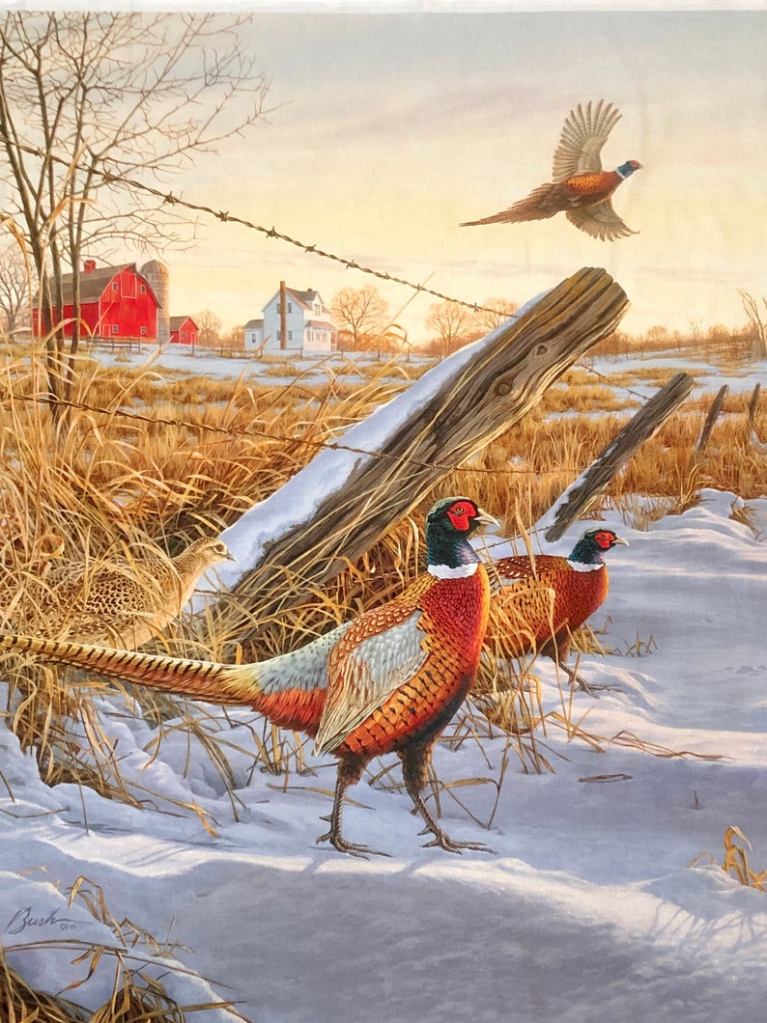
Even The Rockefeller Sapphire, itself, had to blush with shame in comparison to the brilliance of our blue sky above us on that spectacular fall day there on our farm northwest of Kiester, Minnesota. A veritable caravan of big station wagons and pickup trucks had just banked into our farm’s U-shaped driveway from the north. Word had gotten out to the ‘city slickers’ up in the “Twin Cities” (Minneapolis/St. Paul) that the Noorlun farm folk were friendly and had a poppin’ up passel of pretty pheasants just a waitin’ for hunters to come and try out their marksmanship………..shot gun style.

With a robust joy, these avid outdoorsmen piled out of their various vehicles with the happy gusto of school boys heading for a playground. Whatever their regulated city lifestyles were on a 9 to 5 basis; here they were able to escape the closed-in confines of their concrete jungle of metropolitan life each fall and come ‘let off some steam’ here on our 120 acres. As a form of thankfulness and appreciation to our family, for allowing these city visitors to camp and hunt on our land, the generous hunter guests always brought a series of gifts for our clan to enjoy. My little sister, Candice, and myself were very much touched and taken by these handsome gents who took on an aura all their own as they donned their khaki Heritage Jones caps, hunting vests, boots and a plethora of regalia for the goal of bagging their limit in pheasants.

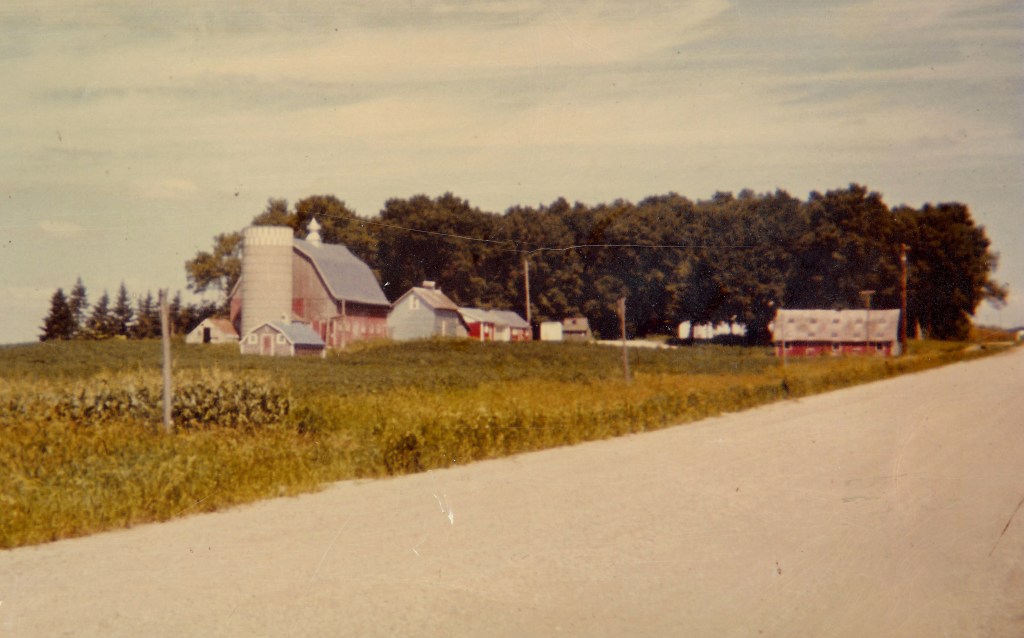
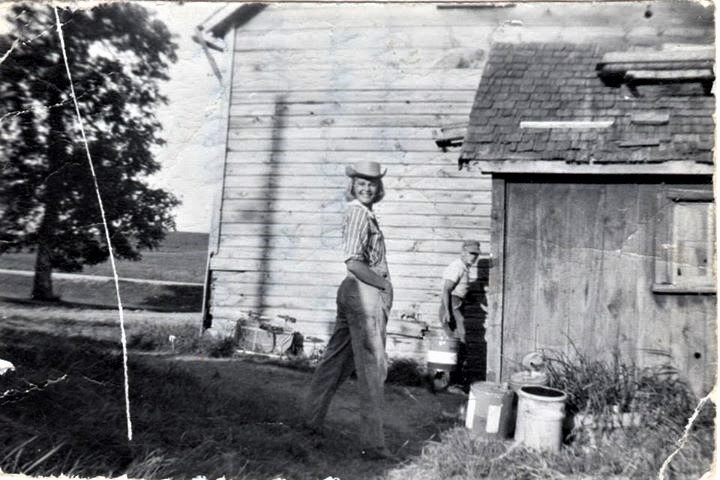
In the very center, of this photo of Elliott’s farm, you can see the white, small, newer ‘Well House’. There were two water wells on the farm yard property.

Even though our pheasant fanciers loved getting their quota of birds each year; to a man, they ecstatically extolled the highest praise for a liquid ambrosia that our family enjoyed each and every day…………our super delicious WATER!!! All year long, these poor city guys had to suffer with drinking heavy chemicals coming out of their water faucets back home in the city. But at our farm, those happy hunters would rave and rave about how tasty our well water was!! They’d even load up all the containers they could to take some of our liquid gold with them back up to the Twin Cities.

The first pioneers who settled upon our acreage and created our farm initially, were successful in ‘striking it rich’ by digging their first well till they reached the underground water table. That first water well was located at the southeast corner of our farm building property near the old wooden corn crib and the south exiting driveway. Once the water well was established, these sturdy folk then built a small building over the site. That little structure was naturally called, “The Well House( or Pump House)”. Until the 1930’s (before rural electricity came to the countryside of America), water was pumped to the surface by the classic hand pump. With the advent of rural electricity coming into the life of farm families, the hand pump was replaced with an electric motor.

To the right, of Elliott’s lovely Aunt Lillian, is the first water ‘Well House’. Big brother, Lowell, is in the background hauling buckets of grain to our Hog House nearby.

Water is such an essential component of life itself, especially on a farm when you need to provide, not only water for your own family’s needs, but also for all your animals to drink in order to thrive there upon the land God gave us to take care of.

When our family moved onto the farm we knew as home, in 1946, there was still no running water in our house. That’s right, there wasn’t even a flushing toilet in those days. Our family used what was called, a ‘Chamber Pot’ to use for bodily waste needs and then that smelly container had to be carried out to and poured down the seat holes in our ‘Out House’ in the woods. Our dedicated mother, Clarice, would trek down to ‘The Well House’ and carry buckets of water, year round, to the house to use for cooking, washing dishes, clothes, etc.. She even had to boil water on top of our stove for her family to use for Saturday night bath times. Water was precious and it was up to Mom, Dad or our big brother, Lowell, to carry untold numbers of buckets of water from ‘The Well House’ to the barn, chicken coop, pig house, etc..

Eventually, a second well was dug about 20 yards, or so, from the first ‘Well House’. This time, an electric pump system was installed to bring all the water up from underground that we needed for daily activities and thirsts.

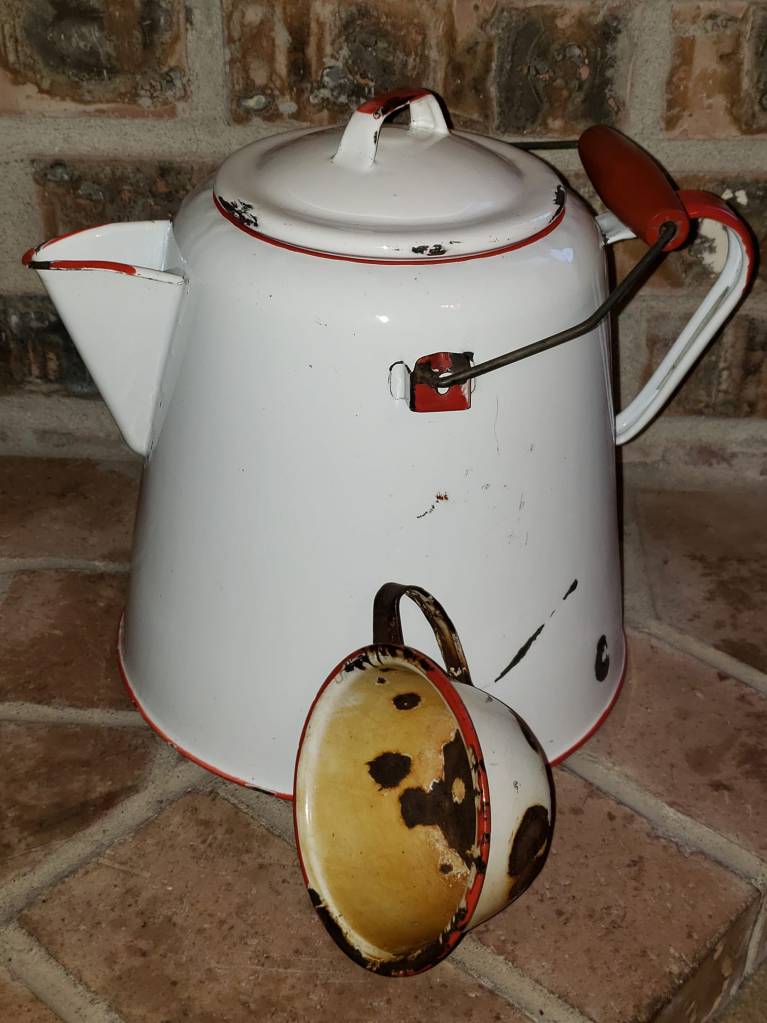
This is the actual water cup that hung from the spigot of the Noorlun family’s newer ‘Well House’. Behind the cup is Mrs. Noorlun’s BIG coffee pot for feeding large groups of workers.

One of the key ingredients for our tasty water was iron. That mineral was highly prevalent in our well water that we enjoyed on a daily basis. That natural mineral gave our H2O a robust flavoring, along with the other natural minerals that existed down below the earth in the strata known as the water table. The newer ‘Well House’ was more compact in size and thoroughly insulated to protect against freezing pipes in the winter, as well as helping to keep the water in the holding tank that much cooler in the muggy, humid heat of a Minnesota summer. A spigot was installed on the south side of the newer little ‘Well House’ and a cute porcelain-coated cup was hung there for any and all to quench their thirst when they’d pass by. That dear little cup sure took its beatings over the years by being dropped and chipped severely of it’s nice white coating. Some citified folk may see it as a detriment, but we farm folk actually enjoyed the ‘badge of honor’ in the natural brown iron staining that built up inside that little cup over time.

You know, life has gotten way too fancy. We’ve become a throwaway society of single use this and single use that. Personally, I’m a happy n healthy guy thanks to these farm day practices of drinking from that little, iron-stained cup that gave us the sweetest water this side of anywhere on the farm of this Norwegian Farmer’s Son. 😉

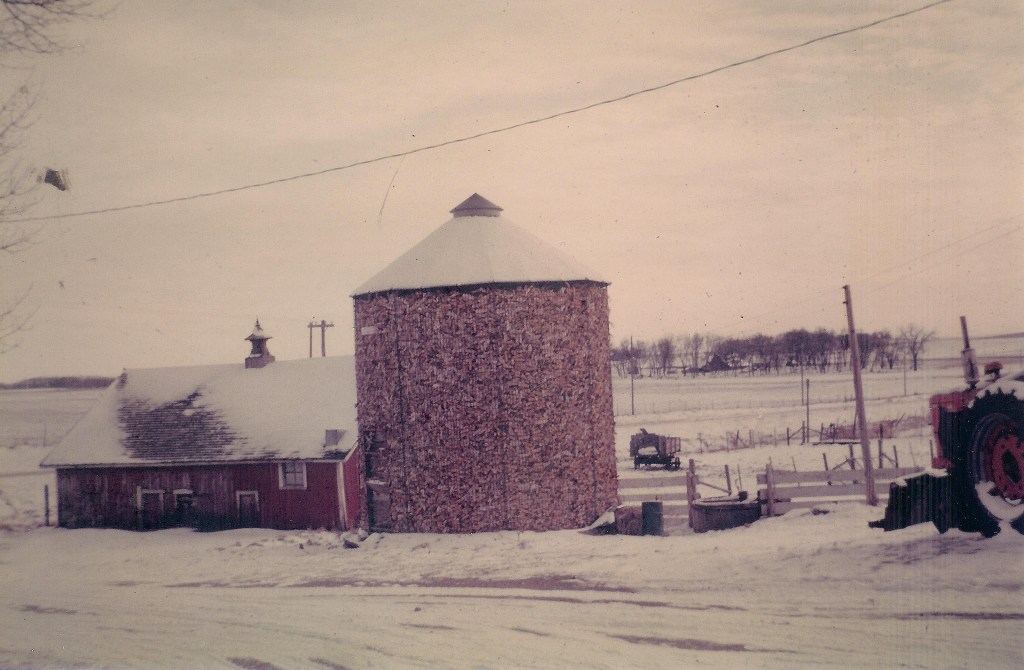
In this 1965 photo, the old wooden corn crib is replaced by a wire one. On the right side of the wire corn crib, you’ll see the old ‘Well House’ is gone now also. A ‘stock tank’ in the same location, still exists to provide lots of tasty water for the farm.

Vol.2..Norwegian Farmer’s Son..April 6th

April 6th……..“WHAT KIND OF ATTRIBUTES DID YOU AND YOUR FAMILY GLEAN FROM WORKING WITH COWS ON YOUR FARM THERE IN SOUTH CENTRAL MINNESOTA”?

POEM – “How Now Black n White Cow”? (This is my idea for a poem title. The actual poet author is anonymous from a 1936 Old Farmer’s Almanac).

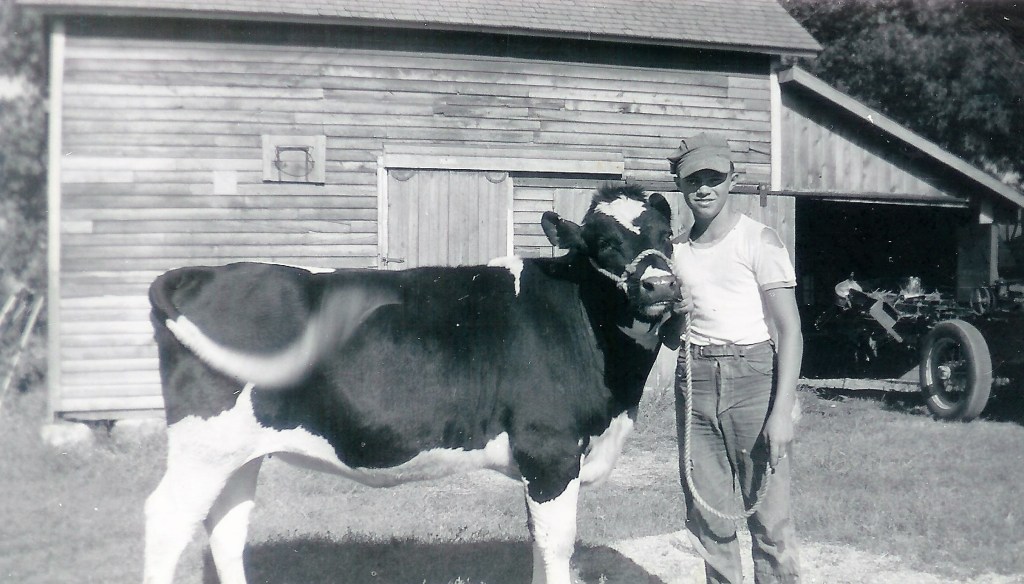
The year 1959 saw Elliott’s big brother, Lowell, as he gets a young Holstein heifer ready to take her to the Faribault County Fair, in Blue Earth, MN. His goal to was to win a Blue Ribbon First Place Prize with her.

When life seems one too many for you, Go and look at a cow.

When the future’s black, And the outlook blue, Go and look at a cow.

For she does nothing, But eat her food, And sleeps in the meadow, Entirely nood,

Refusing to fret, Or worry or brood, Because she doesn’t know how!

Whenever you’re feeling, Bothered and sore, Go and look at a cow.

When everything else, Is a fearful bore, Go and look at a cow.

Observe her gentle, And placid air, Her nonchalance, And savoir faire,

Her absolute freedom, From every care, Her imperturbable brow.

So, when you’re at the end of your wits, Go and look at a cow.

Or when your nerves, Are frayed to bits, And wrinkles furrow your brow;

She’ll merely moo, In her gentle way, Switching her rudder, As if to say,

Bother tomorrow, Let’s enjoy today, Take the advice of a cow!!!! 😉

Vol.2..Norwegian Farmer’s Son..April 5th

April 5th…………..“WHAT WAS A PHYSICAL CHARACTERISTIC YOU SAW IN YOUR FARMER DADDY THAT MADE HIM EVEN MORE SPECIAL”?

POEM – “A Farmer’s Man Tan” by N. Elliott Noorlun

Elliott’s mother, Clarice, handsome Elvin Wogen (sporting his farmer man tan).

There’s nothing so grand, For a ‘prince’ of the land,

Than the honored visage, Of a farmer’s man tan.

Elliott’s father, Russell, (top right).

With his forehead white, While his face burned brown,

From wind and sun, T’was an award of reknown.

Just like their livestock, They lived outdoors,

Working in the fields, And a doin’ their chores,

Whether baseball cap, Or fedora’s full brim,

Or engineer’s cap, With striped blue trim,

It gave them protection, From weather’s ire,

As they farmed their land, Their passion’s fire.

To provide for their legacy, In the farming life they ran,

And proud they were to wear, A farmer’s man tan!! 😉

Vol.2..Norwegian Farmer’s Son..April 4th

April 4th……...”HAVE YOU EVER BEEN CLOSE TO A LARGE GAME ANIMAL BEFORE”?

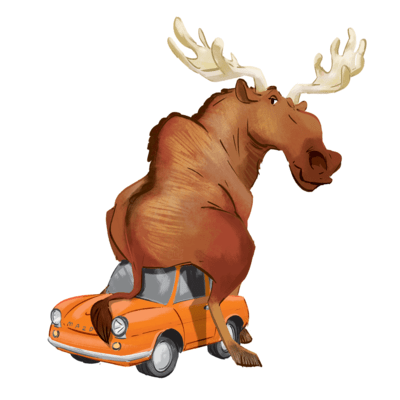
POEM – “To Goose A Moose” by N. Elliott Noorlun

Some Big White Hunter, I’ll never be, I’m just too tenderhearted.

But what I saw, In my mackinaw, Done scared me till I farted!!!

My uncle and I, Driving down the Al/Can, Slowly bumpin’ upon snow road,

Looked up in the woods, The best we coulds, In the brush of the moose abode.

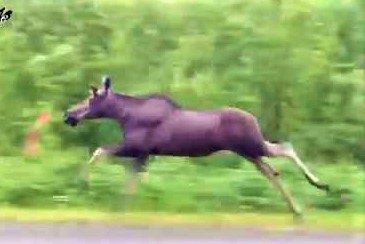
When down off that rise, To our utter surprise, Came a female moose on the run.

She caught up to us quick, Alongside car at a click, And we both thought, “You son of a gun”!!!

Maybe she was confused, In her love-starved mood, And thought our car was her mate,

But we didn’t want to, Take the chance, Of her love soon turning to hate!

Barney yelled, “HANG ON”!!!, “Gonna scream her a song”!!, “To get her away from our car”!!,

“Cause if she should charge”, “Our motorized barge”, “We’ll land in the canyon afar”!!!

Barney banged the car’s side, He hooted n cried, And, by golly, She headed for the hills.

Now my “moose-pimples” could settle, And return to my mettle, For me that was PLENTY of thrills!!! 😉

Vol.2..Norwegian Farmer’s Son..April 3rd

April 3rd……..”GRANDPA, DO YOU KNOW ANY CHURCH SONGS THAT HAVE TO DO WITH FARMING”?

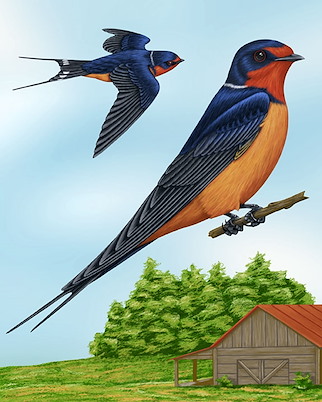
A rich, cobalt-blue reflected off the glistening crowns, backs and wings of Barn Swallows. Their handsome, feathered frock of colors were ignited by a golden Minnesota morning sunlight that refracted through the barn windows of the Noorlun farm near Fosston, Minnesota. The deep fork in the tail of these cheery chirpers resembled the ancient harp-like instrument called a lyre. These little beauties of the bird world gave a happy greeting to our grandfather, from their mudded, cup-shaped nests in the rafters of our paternal patriarch’s barn. I can envision a quiet smile of acknowledgement on his face as Edwin glanced up while stepping across the large wooden threshold to begin his day of harvesting their grain field.

Not many folks today even know what a threshold is, but it was important and appreciated by Grandfather Edwin. For one, “thresh” is another name for the leftover straw material after the seeds of grain were removed from the stalks of the mother plants. Before the advent of concrete flooring, “thresh” was often used as animal bedding in barns and even in old-time log cabins to cover the dirt floors. The “hold”, in this case was either a log or a large beam across the ground-level entryway of the barn (or log cabin) that kept the “thresh” from being tracked outside of the structure; thus it became a “thresh-hold”, or, in another way of speaking………the “holder of the thresh”. The shear height of the “hold” at a doorway is why newlywed grooms would (and still do) often carry their new bride across the threshold so that she wouldn’t trip and fall over it while walking into the honeymoon home in the long, flowing wedding gown she wore.

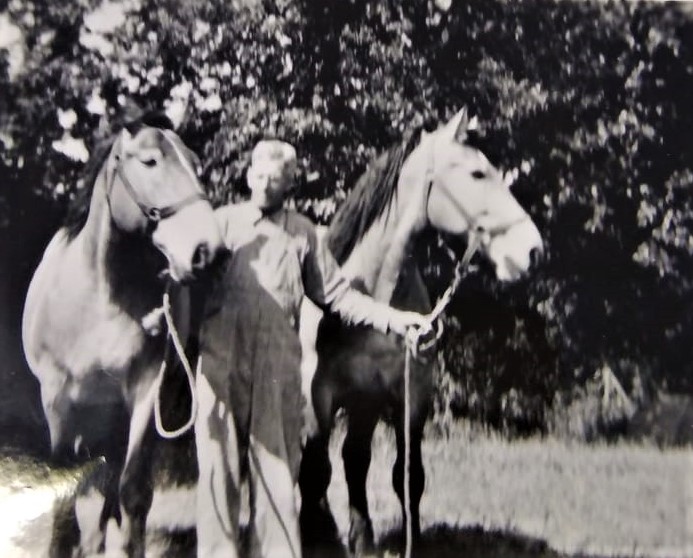
Elliott’s grandfather, Edwin Noorlun, with his handsome draft horses, “Sugar” and “Cane”.

The rippling and well-defined equine muscles of grandpa’s BIG draft horses, “Sugar” and “Cane”, quivered with happy anticipation to be part of another day on the farm there with Grandpa Ed. Our Norwegian elder was a first generation, born in America, man. The year of 1888 saw Edwin’s birth into this world and, like his father before him, he grew up in the era when horses were still the honored source of power in all agricultural vocations. Ed loved his horses and had followed in the footsteps of his father, Arne, before him as he, too, chose to be a farmer of the land and enjoyed seeing what it could produce. Matter of fact, our grandfather never used a tractor on his farm……only horses. With the new day before him, Edwin led his two, tall and mighty steeds from their barn stalls and mounted a full working harness on each of them for the day’s task of cutting and binding oats.

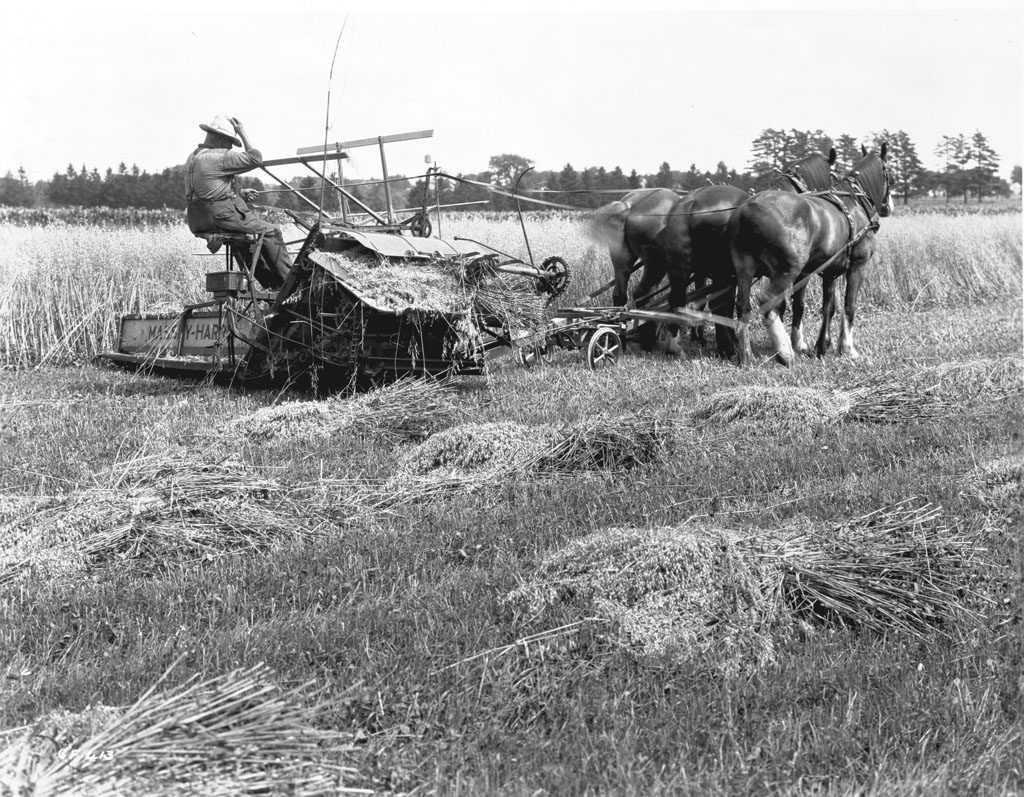
With his team harnessed and ready for work, Ed took up their reins, gave them a gentle ripple slap across their backs and made a “Chick, Cherup” sound with his mouth to move “Sugar” and “Cane”, at a walk, out to their oat field. Once on site, Grandpa Ed gave a long, steady pull on the reins while verbally commanding his team to “Back, Back” up as they obediently moved in reverse. Once in position, they were then hooked up to what’s known as a Grain Binder or Reaper. Ed climbed aboard the seat of this magic machine, engaged its gear system and with a slap of the reins “Sugar” and “Cane” pulled forward and began cutting a wide swath of oats as they moved along the field. The Binder would cut down and then move the long, cut grain stalks to the side of the machine and, every so often, a device would wrap a twine around a large bunch of the long grain and drop it to the ground. The bundle of tied, long grain was now called a sheaf. The plural form of that grain, now in many bundles on that field, were now called sheaves.

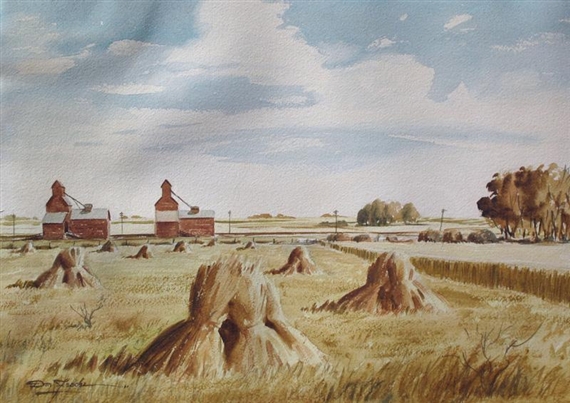
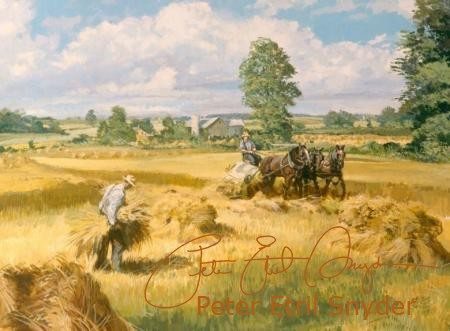
With the field of oats now cut and bound into sheaves, it was time for our grandfather, his sons and other workers to begin walking around the field grabbing and standing up the sheaves into vertical piles of three or more sheaves called a “stook”(also known as a “shock”). Pretty soon the oat field was dotted in picturesque teepees of stooks(or “shocks”). The reasoning for this practice was to allow the brisk prairie winds to dry the grain, rather than allowing the cut grain to lay on the ground where it was susceptible to moisture and rot from the morning dew, light showers, etc..

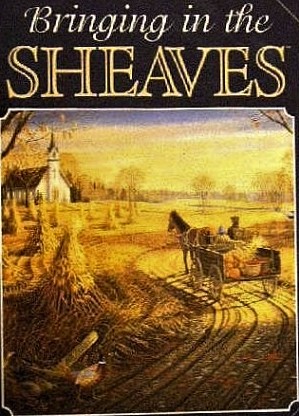
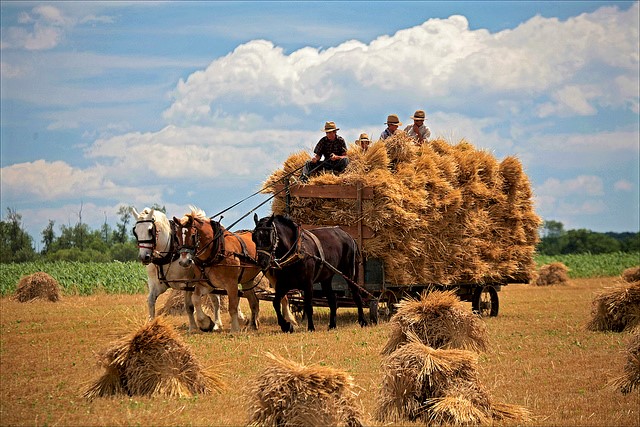
Like the song, these farmers are, literally, “Bringing In The Sheaves” to their farm for threshing the grain from the plant stalks.

In a poetical agrarian parallel, what happened next on Grandpa Ed’s farm coincides with the Old Testament book of Psalms Chapter 126 and Verse 6 which, paraphrased, says, “He that goes forth…….bearing precious seed, shall doubtless come again rejoicing, and bringing his sheaves with him.” For you see, once the sheaves were properly dried in their stooks (or “shocks”), it then became time to bring them into the barn from the field. Men began to fork the oat harvest onto a wagon and brought in all those sheaves of grain to have their seeds threshed from the plant stalks. Those separated grain kernels could now become feed for their farm animals and even be used by the family for various tasty foods like breakfast oatmeal, oatmeal cookies, oatmeal bread, etc..

My grandfather, Edwin A. Noorlun, had faithfully planted those oat seeds in the spring of that year. But it was the good Lord above who warmed the soil with His sun, watered the seeds with His rain, and grew those seeds to uncountable thousands more than what Edwin planted. And, at the right time, the Lord Jesus brought a magnificent harvest to bless the Noorlun family, just as in the church song that’s called, “Bringing In The Sheaves”. We, as Christians, ‘plant the seeds’ of the Gospel as we go out in the ‘field’ of life each day. We ‘plant seeds’ by showing the agape love of Jesus to everyone we come in contact with. Just as grandfather put hope in the Lord for his harvest of oats, we, as believers put our hope in the Lord to rejoice when He brings in a harvest of people who want to make Jesus Christ their Lord and Savior. Farming and Christianity go hand in hand for this Norwegian Farmer’s Son.

Vol.2..Norwegian Farmer’s Son..April 2nd

April 2nd………“DID YOU EVER HAVE TO LEARN SOMETHING IN GRADE SCHOOL THAT YOU WERE EMBARRASSED TO DO”???

POEM – “A Doe See Doe Upon My Toe” by N. Elliott Noorlun

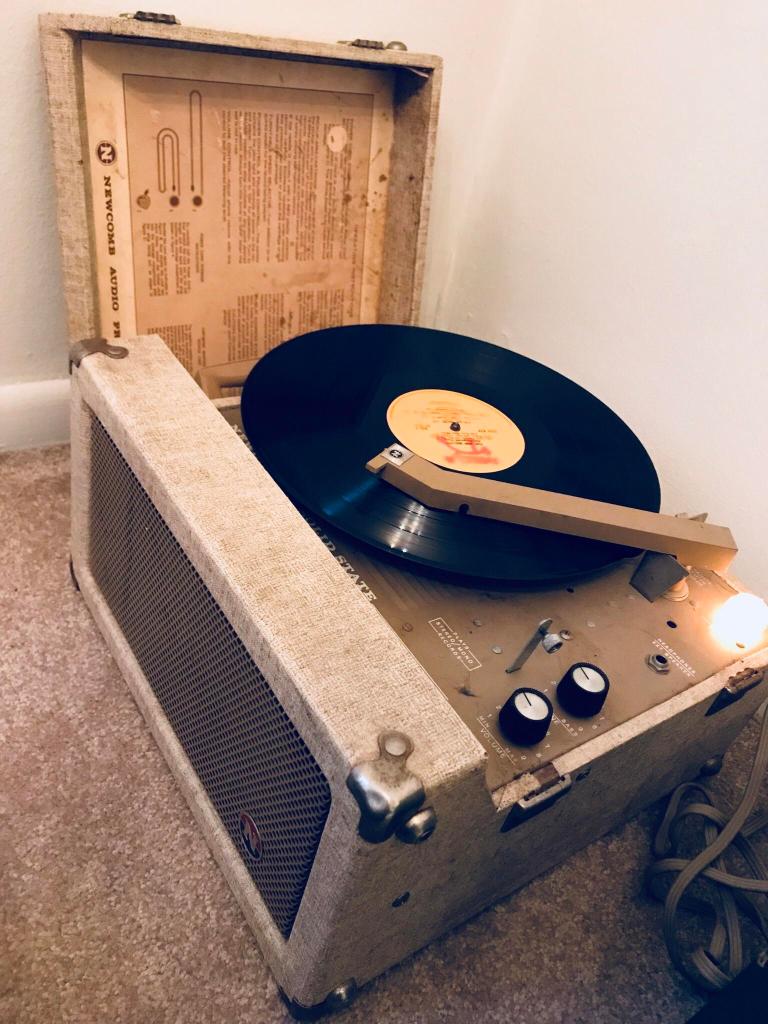
Teacher dropped that needle, In scratchy groove,

Of record that told us, How to move,

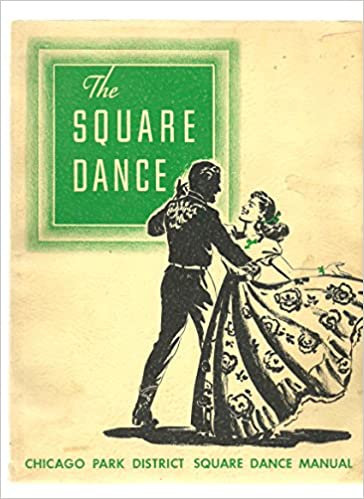
A country folk jig, That’s called Square Dance,

But my ‘two left feet’, Didn’t stand a chance.

I thought I heard, The lyrics go,

“Don’t let the fat girl, Step on your toe”!!!! 😉

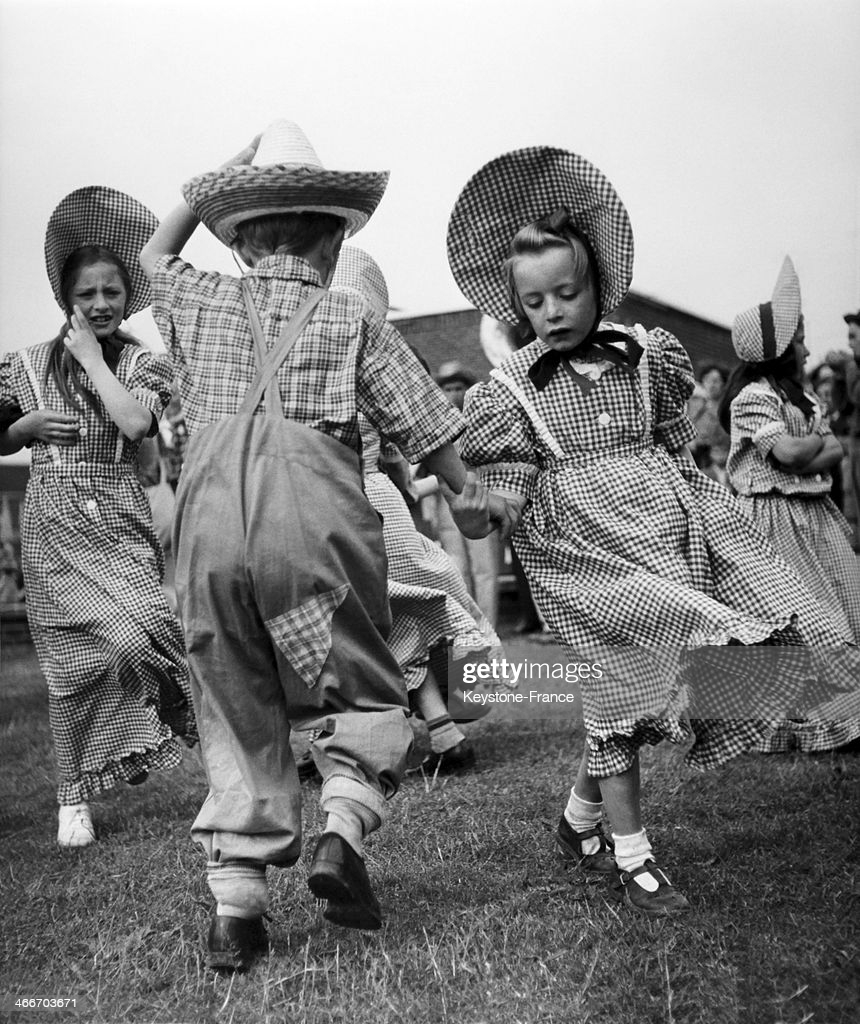
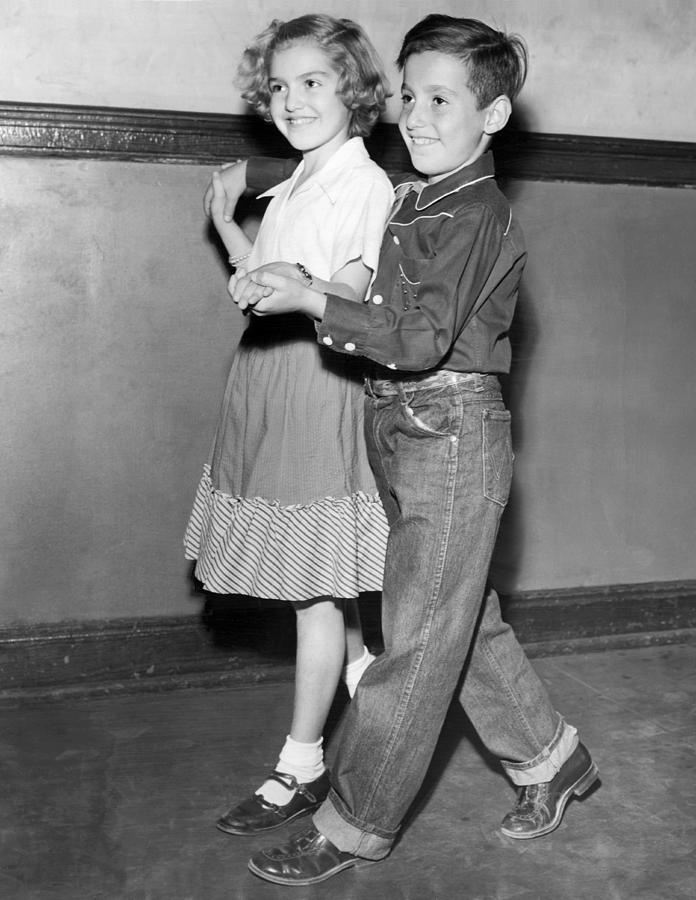
Elliott is roughly the age here when he had to learn to Square Dance with his classmates.

So I tried and tried, Till I almost cried,

And if I could’ve, I’d choose to hide,

But I stuck it out, While the fiddles sang,

And my savior came, When the class bell rang.

Maybe some future day, With practice per chance,

I’ll redeem myself, When it comes to Square Dance. 😉

Vol.2..Norwegian Farmer’s Son..April 1st

April 1st……..“WHEN YOU LIVED ON YOUR FARM, DID YOUR COWS STAY IN THE BARN ALL THE TIME? IF NOT, WHERE COULD THEY GO AND HOW DID YOU GATHER THEM BACK TO YOUR BARN”?

The intense scarlet of his epaulets flashed in the late afternoon Minnesota sunlight as a handsome Red-Winged Blackbird stretched out his ‘feet’ to make a landing on the barbed wire fence alongside me. My handsome feathered friend looked like a little soldier from the sky with his red epaulets of rank on his shoulders. It was as if the good Lord, Himself, had sent this hardy harbinger of good and protection to this young farm boy as I, in my bibbed overalls, enjoyed a late afternoon stroll to call in our herd of Holsteins from their daytime grazing pasture. My travel path was our low-lying cow-lane along the roadway ditch which paralleled below the upper grade of the gravel road running north and south along our farmlands there northwest of Kiester, Minnesota.

Red-Winged Blackbirds were known to be bold and courageous in their command and protection of their aerie domain. They’ve even been known to attack eagles in defense of their nesting area. Even the song ‘Mr. Red’ sang to me that day had an authoritative musicality as his throat cried out “Conk-Lah-Ree, Conk-Lah-Ree”!!! Many other feathered friends also flew close to serenade me that afternoon as I traversed to the end of our cow-lane and to the gated opening of our expansive pasture land. Soon, to my little boy ears, there came the glorious warble of a golden, majestic Western Meadowlark who proudly wore his own black chevron on his glorious bright yellow chest.

These, and other friends of the sky, made it a much more pleasant task for me to carry out my daily chore of “kulning” (also known as ‘calling’) our herd of Holstein cows back to the barnyard and into our family barn for milking. Once milked and fed, our farmer father, Russell, kept the herd safely overnight in the barn and, after the morning milking, would release each cow from their vertical stanchions and allow them, weather permitting, to saunter back out to munch a bunch of grass from the lush pasture land that bordered Brush Creek at the south end of our property. Do you question the word “kulning” that I used earlier? I’ll share more of its origins.

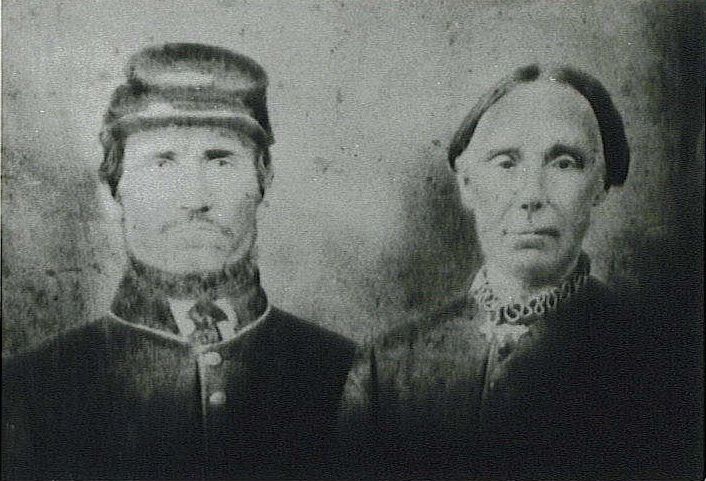
Elliott’s maternal Great Great Grandparents Ole & Beret Sletten who were both born in Norway.

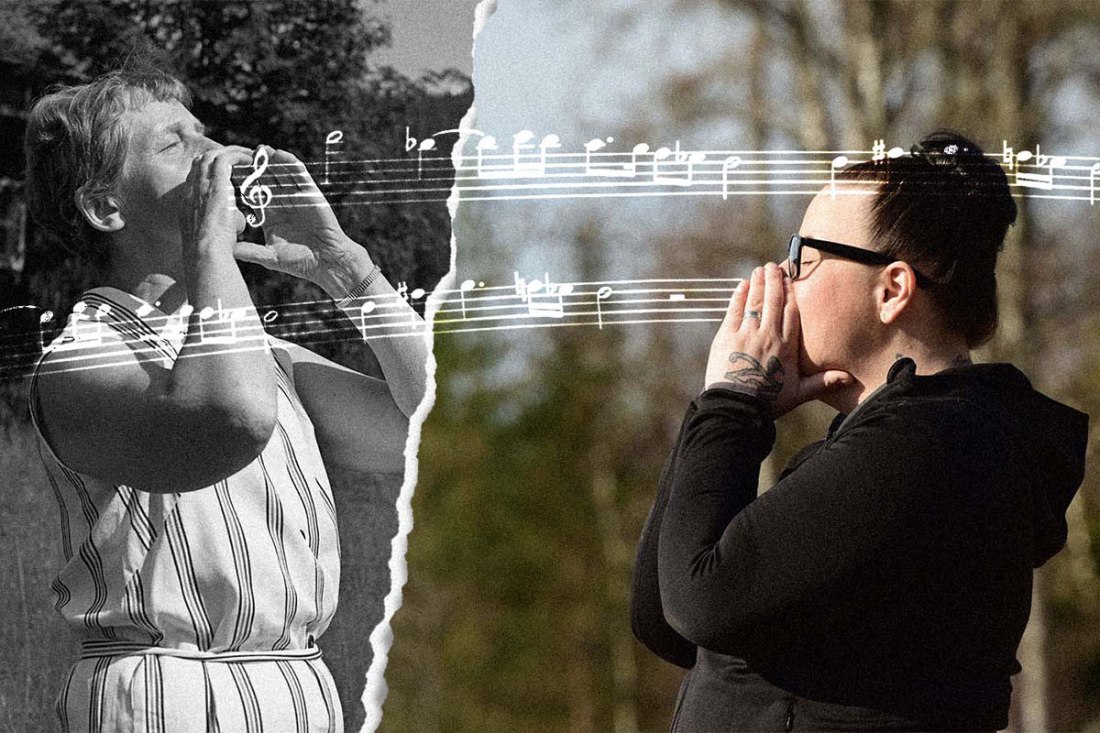
In my farm boy years of the late 1950’s and into the 1960’s, my generation was taught that this daily chore was merely entitled, “Calling The Cows”. Dad showed me how to cup my hands around my mouth to make like a trumpet’s flared horn bell, of sorts. I was then to yell out, in a high to low, melodic fashion, “COME BOSS!!! COME BOSS”!! With many repetitions of my call, eventually, the elder bovines of our herd would hear and acknowledge my calling by starting to come towards me and then make their way up the cow-lane towards what we called “The Cow-Yard” next to our barn. The young ‘moo-mates’ came to learn that to be obedient to my human calling meant that they too would receive food, water and warmth that awaited them in our barn if they followed their elder ‘moo-mistress’ leading.

It is a very good probability that my maternal Great Great Grandmother Beret Sletten (1814 – 1905), who was born in Norway, likely called her family cows and goats by the musical art of kulning. It was tradition, in those times, for women to use their high-pitched voices to sing the animals in to their farm from the Norwegian hillsides of Aurdal, Norway. Both bovines and goats were given bells to wear around their necks as an audio locating device as they meandered in their grazing up on the meadows and hillsides of our ancestral countryside. Each farm family created their own special song to sing (or kuln) to the animals. Even if their animals had mingled with another local herd, they only responded to the lilting song sung by their specific human mistress owner. There were even occasions when the animal’s names were incorporated into the kulning to make the call, or song, even more attracting to their own herd members.

Bovines have been known to respond well to the human singing voice. Research has shown that even the singing of birds nearby causes them to relax and produce oxytocin which results in higher milk production. For you see, birds only sing when there are no harmful predators nearby. The cows sense this in the birds happy songs and therefore will relax and are then in a more pleasant state of contentedness which produces more milk.

I can never tell the Lord thank you enough for allowing me the blessings of living on our Minnesota farm for those first 13 years of life. And, as years have passed, it’s been a joy to learn more of our family heritage and the very likely way they called in their herds for milking. Such were the stalwart predecessors of this Norwegian Farmer’s Son.

Vol.2..Norwegian Farmer’s Son..March 31st

March 31st………“GRANDPA, LOOKING BACK ON YOUR FATHER RUSSELL’S LIFE ON YOUR FARM THERE IN SOUTHERN MINNESOTA, DID YOU SEE HIM AS A HERO”?

POEM – “Our Paladin Prince Of The Plow” by N. Elliott Noorlun. Created June 13th, 2013.

Notes: The word ‘paladin’ comes from the French language and means ‘heroic champion’. To this little farmer boy, that’s how I saw our farmer daddy; a hero who battled weather, machinery and even ornery animals in doing what he loved……..farming. Hope you enjoy my tribute poem. 😉

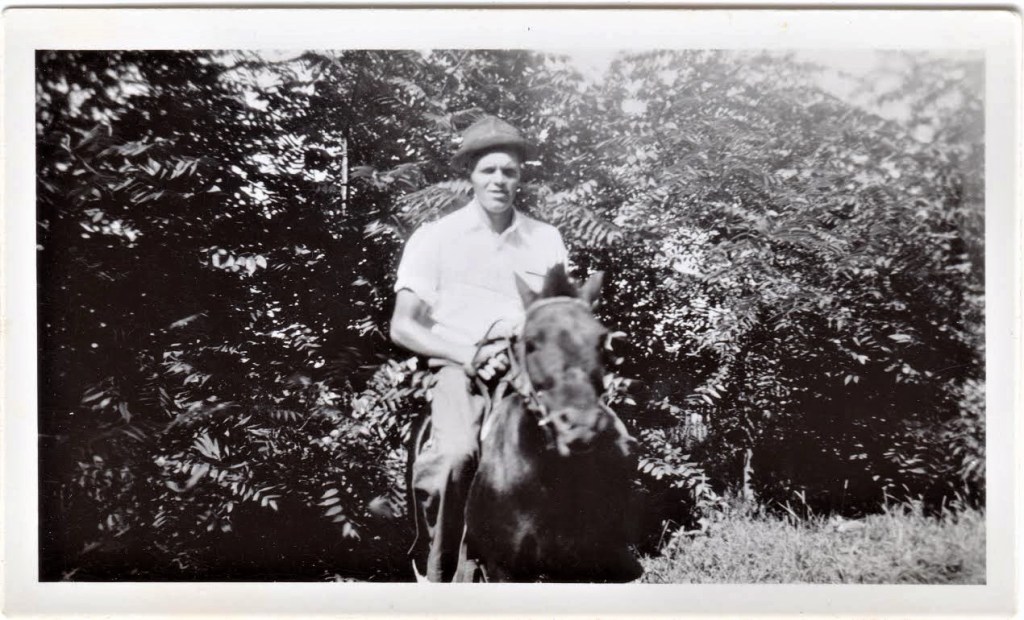
Circa 1944 and Russ Noorlun is riding a fine super steed at the Wally & Genevieve Mutschler farm near Kiester, MInnesota.

Our paladin prince, Of the prairie plow,

Rode horse and Farmall red.

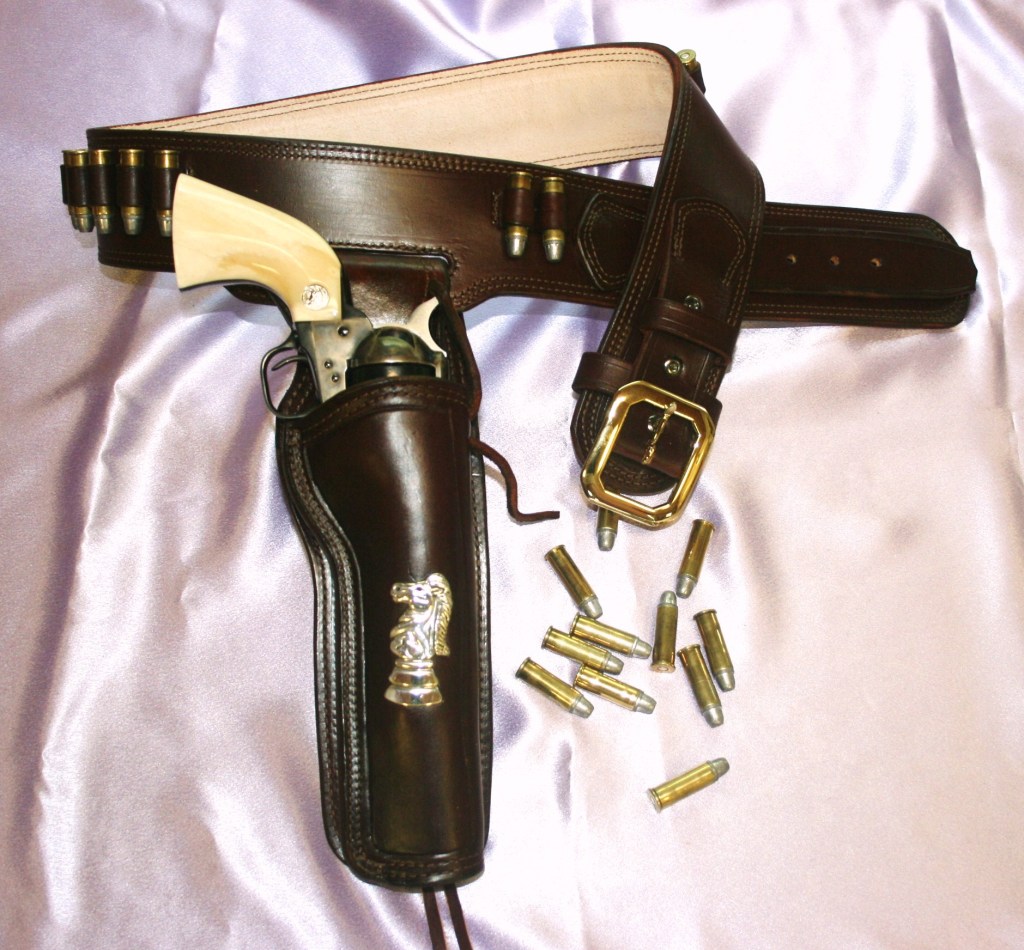
And the only ‘gun belt’, That Russ ever wore,

Were full of tools, To fix things instead.

Farming has many happy moments. Like running around the acreage in this old jalopy with Elliott’s Aunt Pat Noorlun. 😉

In comic books, And movie screens,

The super heroes soar.

They adroitly exude, Amazing strength,

And endurance all the more.

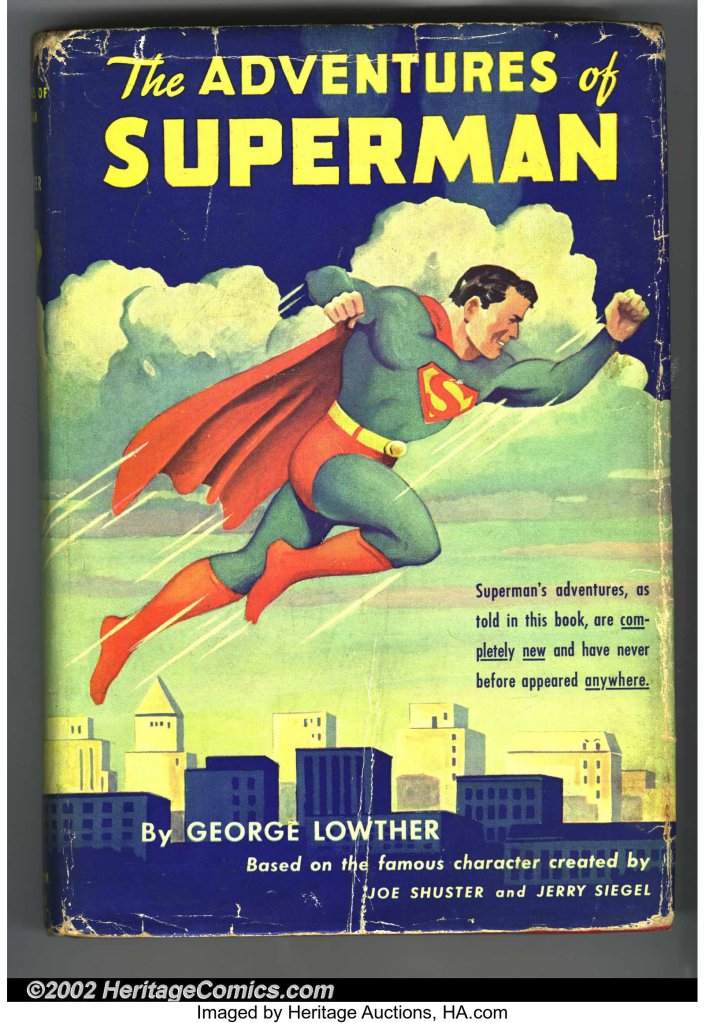
In a sense, Elliott saw his daddy to be like Superman, in bib overalls, that is! 😉

My farmer dad, That Norwegian lad,

Was a ‘Super Hero’ to me,

Cause on that farm, No matter the harm,

His endurance was awesome to see!

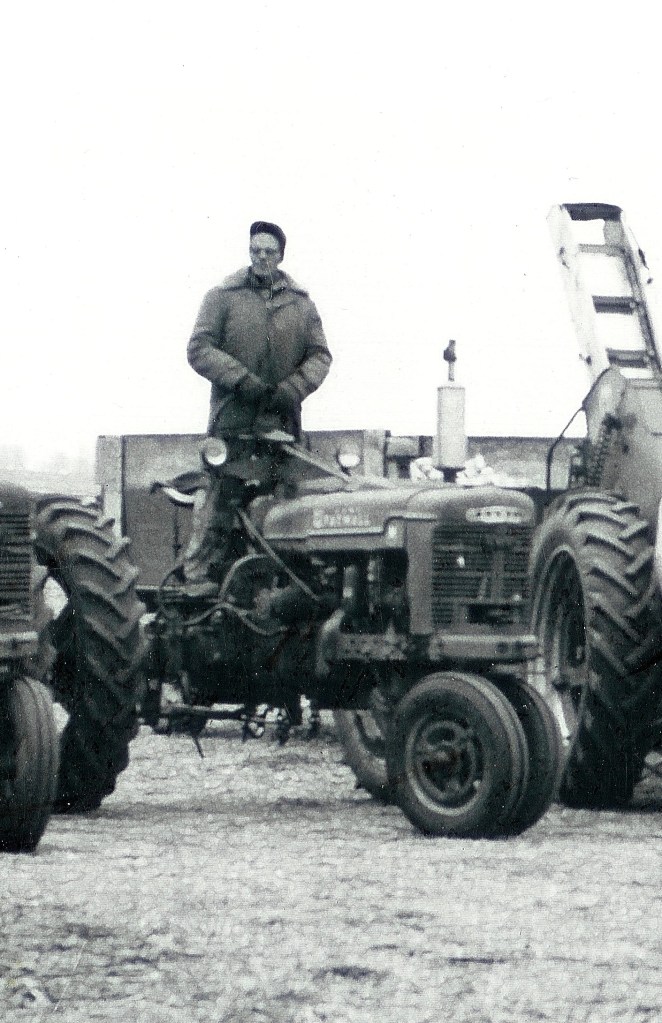
Russ Noorlun riding his “steel steed” of a Farmall H while helping neighbors in their harvest. 1962.

For there’s no sick leave, Or vacation leave,

And there are no substitutes to call.

Life is 24/7, There on the farm,

In winter, spring, summer or fall.

The swinging head of a cow caused Russ to land on his ribs against a manger, breaking three ribs. Poor Daddy! :o(

Like the time Dad’s ribs got broken,

I heard his hollers and moans!

Mom wrapped him up tight, And later that night,

He milked our cows while holding those bones.

After milking 15 head of Holsteins by hand, the muscles in Russ’s hands cramped up very badly.

Or the winter when we lost power,

In frigid blizzard conditions.

He milked cows by hand, Till he just couldn’t stand,

His pain-racked hand positions.

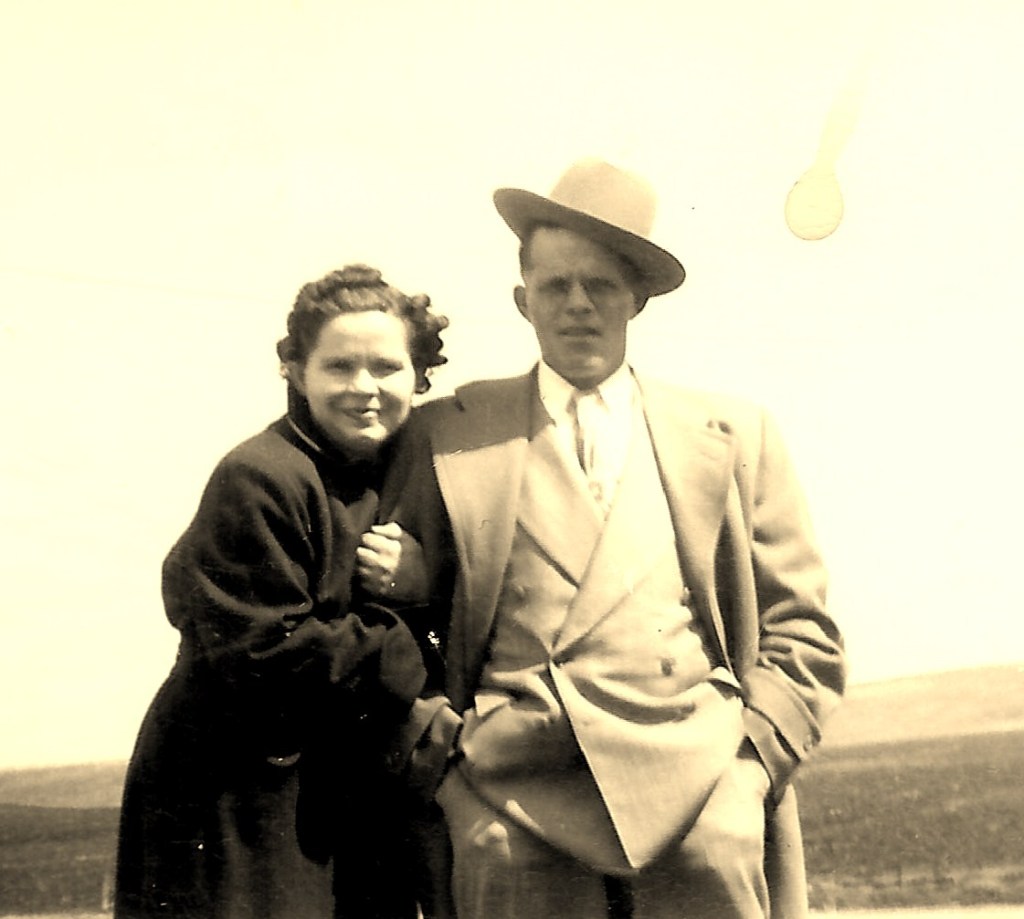
Easter Sunday, 1952. Clarice hugs the arm of her handsome Norwegian hero, Russ, while six year old Rosie took the photo. 😉

This father of ours was human,

With frailties like all of us,

Yet for love of his family, And providing our needs,

He was SUPER FARMER RUSS to us!!! 😉

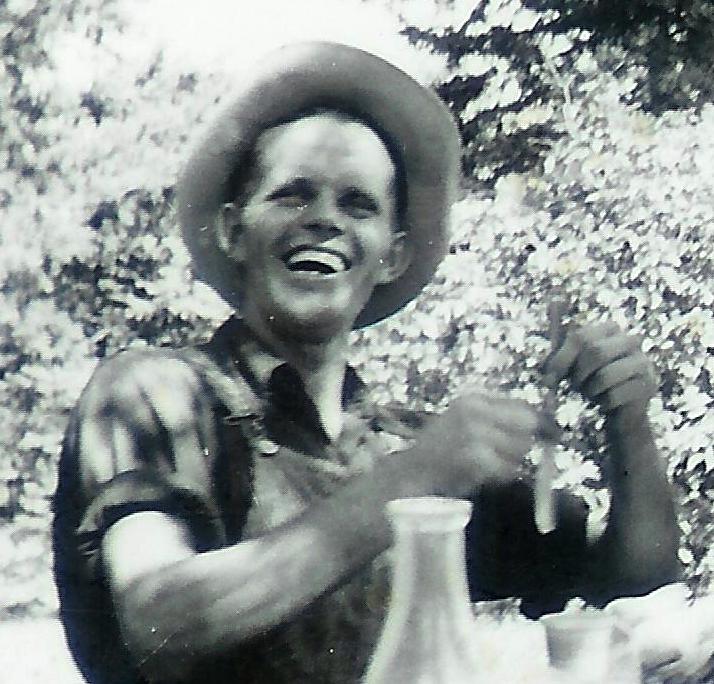
Elliott’s daddy, Russell, loved to laugh!! Such a Super Hero he was in Elliott’s young eyes and to this very day!! 😉